Case Reports
. 2015 Aug;36(8):764-73.
doi: 10.1002/humu.22805. Epub 2015 Jun 13.

An Interdomain KCNH2 Mutation Produces an Intermediate Long QT Syndrome

Affiliations
Case Reports

An Interdomain KCNH2 Mutation Produces an Intermediate Long QT Syndrome

Marika L Osterbur et al. Hum Mutat. 2015 Aug.

Erratum in

  • Corrigendum.
    Osterbur ML, Zheng R, Marion R, Walsh C, McDonald TV. Osterbur ML, et al. Hum Mutat. 2019 Mar;40(3):357. doi: 10.1002/humu.23711. Hum Mutat. 2019. PMID: 30740826 No abstract available.

Abstract

Hereditary long QT syndrome is caused by deleterious mutation in one of several genetic loci, including locus LQT2 that contains the KCNH2 gene (or hERG, human ether-a-go-go related gene), causing faulty cardiac repolarization. Here, we describe and characterize a novel mutation, p.Asp219Val in the hERG channel, identified in an 11-year-old male with syncope and prolonged QT interval. Genetic sequencing showed a nonsynonymous variation in KCNH2 (c.656A>T: amino acid p.Asp219Val). p.Asp219Val resides in a region of the channel predicted to be unstructured and flexible, located between the PAS (Per-Arnt-Sim) domain and its interaction sites in the transmembrane domain. The p.Asp219Val hERG channel produced K(+) current that activated with modest changes in voltage dependence. Mutant channels were also slower to inactivate, recovered from inactivation more readily and demonstrated a significantly accelerated deactivation rate compared with the slow deactivation of wild-type channels. The intermediate nature of the biophysical perturbation is consistent with the degree of severity in the clinical phenotype. The findings of this study demonstrate a previously unknown role of the proximal N-terminus in deactivation and support the hypothesis that the proximal N-terminal domain is essential in maintaining slow hERG deactivation.

Keywords: KCNH2; LQT2; deactivation; hERG; ventricular arrhythmia.


Conflict of interest statement

The authors have no conflicts of interest.

Figures
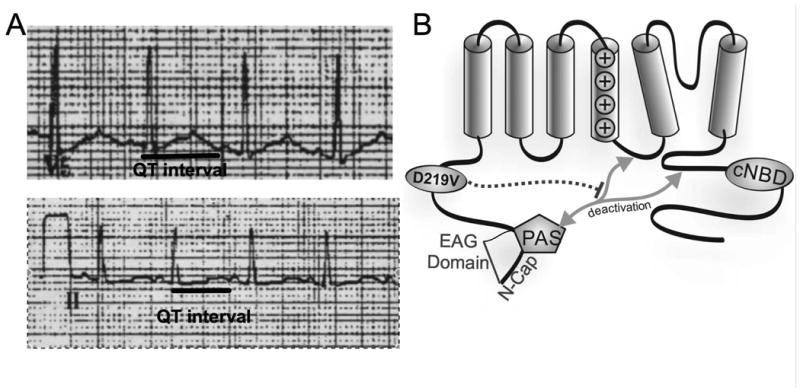
Figure 1
Figure 1. Patient ECG and Location of p.Asp219Val hERG
A) Leads V5 and II of a 12 lead ECG obtained at rest from the proband following a syncopal episode and showing a prolonged QT interval. B) Representation of the hERG protein, with mutation location denoted by the circle within the proximal N terminus. Grey arrows indicate interacting regions that affect channel gating. Dashed line shows proposed influence of the p.Asp219Val mutation.
Figure 2
Figure 2. Heterologous protein expression of p.Asp219Val hERG
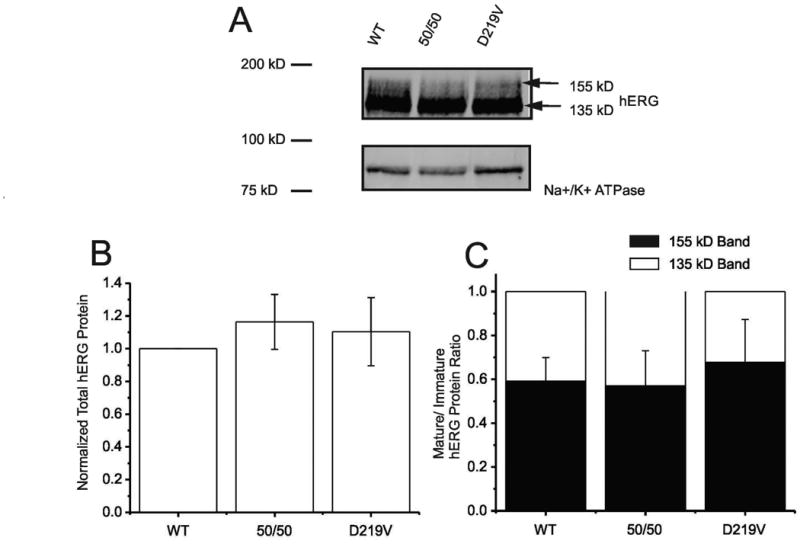
A) Representative Immunoblot shows whole cell lysate of HEK 293 cells transiently transfected with WT hERG, 50/50 mix or p.Asp219Val hERG plasmid DNA. Antibodies targeted against hERG and Na+/K+-ATPase (loading control) were used. hERG channel protein appears as a double band (a discrete 135 kD species and 155 kD broad smear of heavily glycosylated protein) representing immature and mature hERG, respectively. These data are a summary of 5 immunoblots performed and analyzed. B) Histogram showing summary of total hERG protein from 5 immunoblots, normalized to Na+/K+-ATPase. Graph shows densitometry quantification of WT hERG and p.Asp219Val hERG and demonstrates that there was no significant difference between total protein expression. C) Histogram illustrates relative distribution of immature hERG (135 kD) and mature hERG (155 kD), normalized to 1 for WT, 50/50 mix of WT and mutant, and p.Asp219Val hERG. This reflects the ratio of channel protein expressed on the cell membrane to the channel present in the ER/Golgi. The ratio indicates trafficking success to the surface of the cell. There was no significant difference between these ratios for each of the samples.
Figure 3
Figure 3. Effect of p.Asp219Val mutation on hERG channel activation
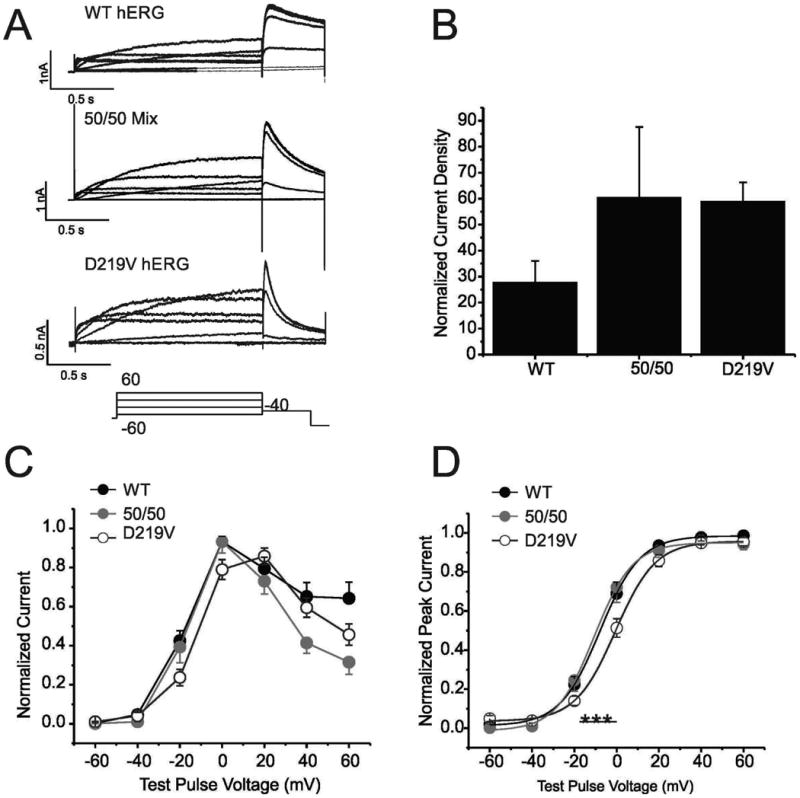
A) Traces are families of whole cell K+ currents from cells expressing the indicated cDNAs in response to a series of depolarizing steps (Voltage clamp protocol is illustrated below). HEK 293 cells were transiently transfected with WT hERG, a 50/50 mix of WT and p.Asp219Val hERG, and p.Asp219Val hERG alone. 9, 8 and 32 cells respectively were sampled. B) Histogram demonstrates summary of current density for each of the samples. Current density was measured at peak amplitude at the -40 tail current/cell capacitance. There is no significant difference between these current densities. C). Graph shows the current-voltage relationship of WT, 50/50 mix and p.Asp219Val. Measurements were taken at the end of the depolarizing phase. D) Normalized voltage-dependent activation curves are shown for all 3 samples. Curves were fitted using a Boltzman function. V½ for WT hERG was -7.83±0.2mV, 50/50 mix was -10.6±0.68mV and p.Asp219Val hERG was -0.57±0.47mV. These values were significantly different, with a P value of > 0.001.
Figure 4
Figure 4. Effect of p.Asp219Val mutation on hERG channel inactivation
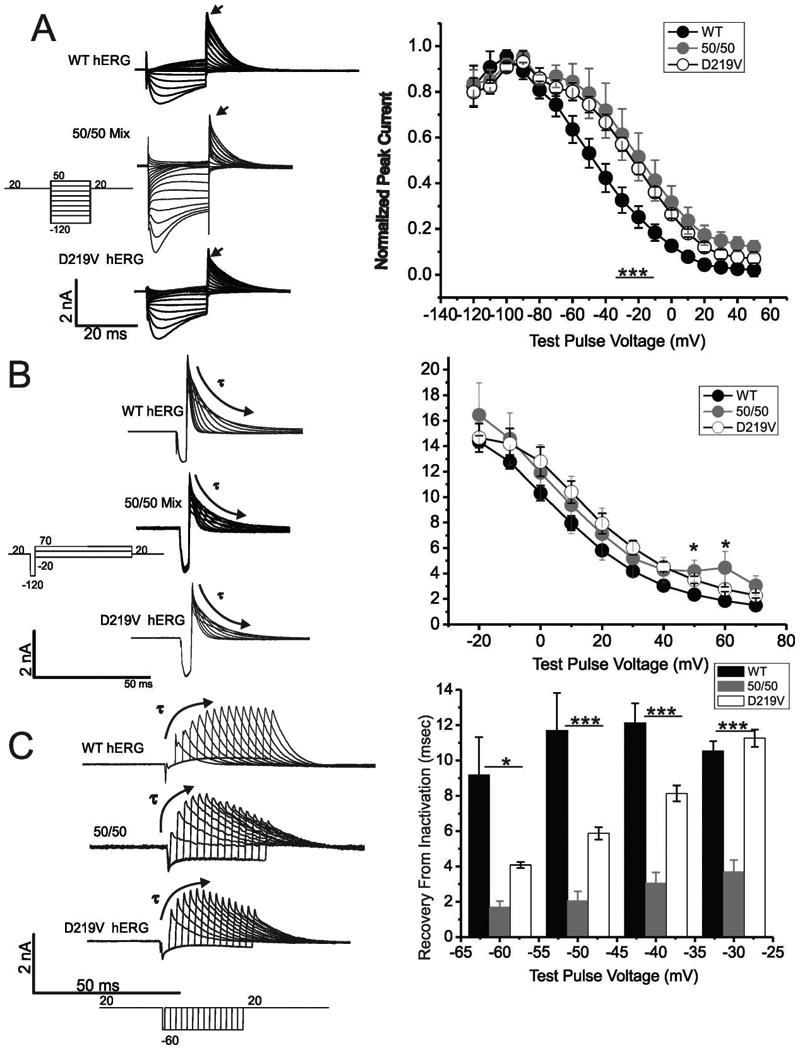
A) Data traces show a family of whole cell current recordings of WT hERG, 50/50 mix or p.Asp219Val hERG undergoing a protocol for steady-state inactivation (protocol is below traces). Stably transfected WT-hERG and p.Asp219Val hERG HEK cells were used, and HEK cells transiently transfected with WT hERG and p.Asp219Val hERG plasmids were used for the 50/50 mix electrophysiology. Peak current was measured at the depolarization to +20 mV after the test pulses (indicated by the arrowhead), and was graphed against voltage. Summary data is displayed graphically in the panel to the right. The 50/50 mix and p.Asp219Val hERG steady-state of inactivation was right-shifted, and was significantly different than WT hERG (p= <0.0001). B) Families of whole cell current recordings demonstrating onset of inactivation are shown for WT, 50/50 mix or p.Asp219Val hERG. The lines were fitted by a single exponential curve to determine time of inactivation onset, and time constant was graphed against each respective voltage. The graph demonstrates a trend that p.Asp219Val hERG and the 50/50 mix have a longer onset of inactivation, with significantly different points at 40 and 60 mV mV (p=<0.05). C) Whole cell traces of WT, 50/50 mix or p.Asp219Val hERG demonstrating recovery from inactivation. Peak current at each time was obtained, and a single exponential curve was fitted to these data (to the peak, indicated by the curved arrow). The resulting time constant was plotted against the voltage. This protocol was repeated at -60 mV, -50 mV, -40 mV and -30 mV. There was a significant difference between the time constants for recovery from inactivation at -60- -50 (p<0.05) and between -40 - -30 mV (p=<0.001) for WT, 50/50 mix and and p.Asp219Val hERG. N=5 for WT hERG, 4 for 50/50 mix and 6 for p.Asp219Val.
Figure 5
Figure 5. p.Asp219Val mutation effects on channel deactivation
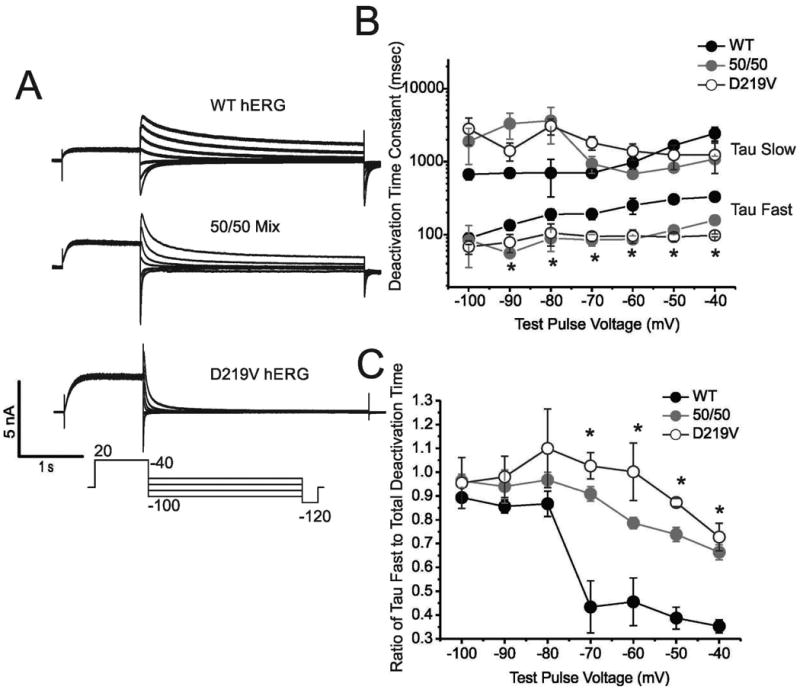
A) Whole cell current traces of hERG channels in repose to a deactivation voltage clamp protocol (protocol is shown below the traces). A combination of stably transfected WT hERG and p.Asp219Val hERG HEK cells and transiently transfected WT, 50/50 mix and p.Asp219Val HEK cells were used for these traces. B) Log10 graph demonstrating the time constants (Tau Fast and Tau Slow) for the WT hERG, 50/50 mix and p.Asp219Val hERG deactivation. There is no significant difference between the Tau Slow constants of the samples. The differences in Tau Fast between WT hERG, 50/50 Mix and p.Asp219Val is significant at all points except -100 (N=5, 5, and 11 for WT, 50/50 and p.Asp219Val respectively), each with a P-value of <0.05. C) Graphical illustration of relative contribution of Tau Fast to total deactivation time constant in WT, 50/50 mix and p.Asp219Val. This shows a decrease in Tau Fast contribution at -70 mV through -40 mV in WT hERG that is not seen in the p.Asp219Val and 50/50 mix samples.
Figure 6
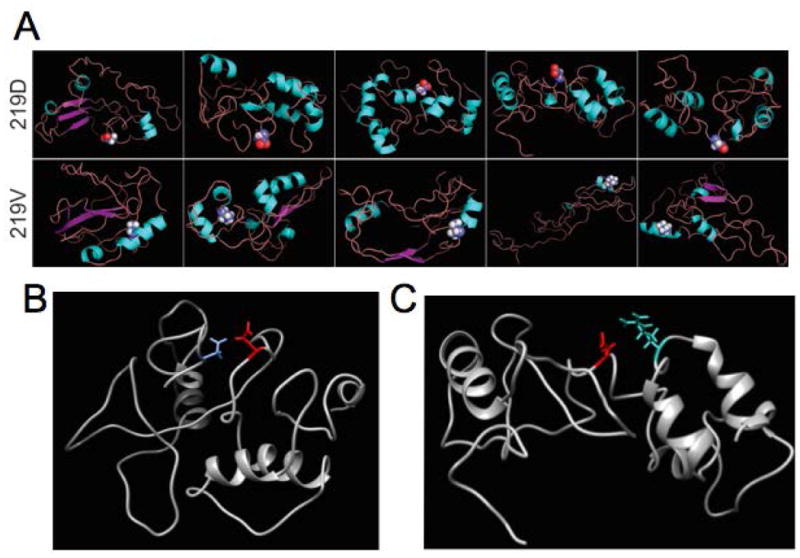
Figure 6. Protein secondary structure modeling
Ab inititio modeling of the segment surrounding p.Asp219 of hERG was performed using ROBETTA software and analyzed in CHIMERA. A) Demonstration of the top 5 predicted structures for both the wild-type p.Asp219 (top row) and the mutant p.Asp219Val hERG (bottom row). The 219 residue side chain is shown in spheres. All WT hERG structures demonstrated an unstructured area for the segment of the protein surrounding p.Asp219, while the mutant structures predict that p.Asp219Val lies in a helical formation in the protein. B) Model of wild type hERG segment adjacent to residue 219 with amino acid p.Asp144 (blue) predicted as a potential contact for p. Asp219. C) p.Arg269 (cyan) was also predicted as a potential contact for p.Asp219 in the wild type structure.

References

    1. Adzhubei IA, Schmidt S, Peshkin L, Ramensky VE, Gerasimova A, Bork P, Kondrashov AS, Sunyaev SR. A method and server for predicting damaging missense mutations. Nature methods. 2010;7:248–249. - PMC - PubMed
    1. Anderson CL, Delisle BP, Anson BD, Kilby JA, Will ML, Tester DJ, Gong Q, Zhou Z, Ackerman MJ, January CT. Most LQT2 mutations reduce Kv11.1 (hERG) current by a class 2 (trafficking-deficient) mechanism. Circulation. 2006;113:365–373. - PubMed
    1. Anderson CL, Kuzmicki CE, Childs RR, Hintz CJ, Delisle BP, January CT. Large-scale mutational analysis of Kv11.1 reveals molecular insights into type 2 long QT syndrome. Nature communications. 2014;5:5535. - PMC - PubMed
    1. Barros F, Dominguez P, de la Pena P. Cytoplasmic domains and voltage-dependent potassium channel gating. Frontiers in pharmacology. 2012;3:49. - PMC - PubMed
    1. Bian J, Cui J, McDonald TV. HERG K(+) channel activity is regulated by changes in phosphatidyl inositol 4,5-bisphosphate. Circulation research. 2001;89:1168–1176. - PubMed

Publication types

Substances

LinkOut - more resources