


Integrin antagonists are effective and safe for Crohn's disease: a meta-analysis
- PMID: 25914486
- PMCID: PMC4402324
- DOI: 10.3748/wjg.v21.i15.4744
Integrin antagonists are effective and safe for Crohn's disease: a meta-analysis
Abstract
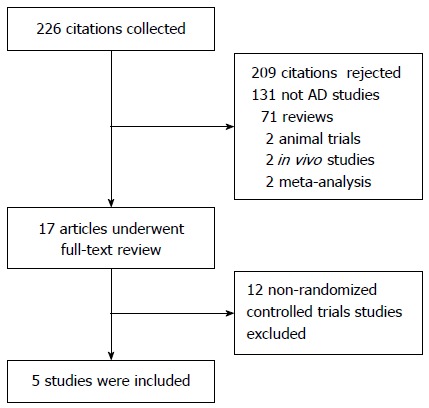
Aim: To evaluate the efficacy and safety of integrin antagonists, including natalizumab and vedolizumab, in Crohn's disease (CD).
Methods: We carried out a literature search in PubMed, MEDLINE, EMBASE and the Cochrane Library to screen for citations from January 1990 to August 2014. Data analysis was performed using Review Manager version 5.2.
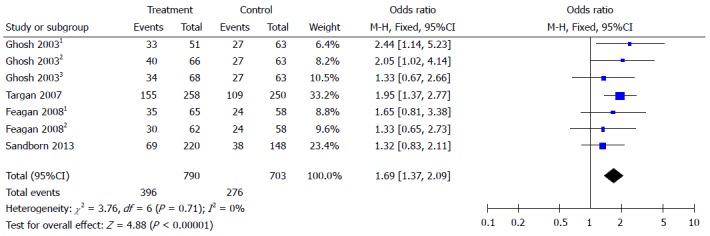
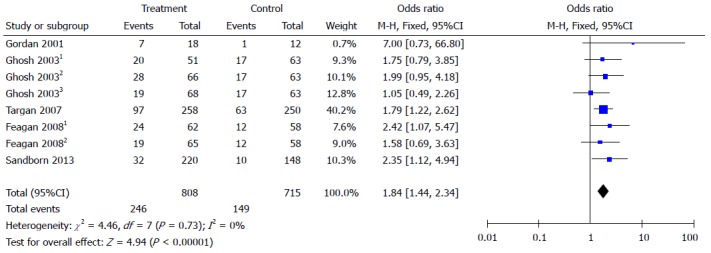
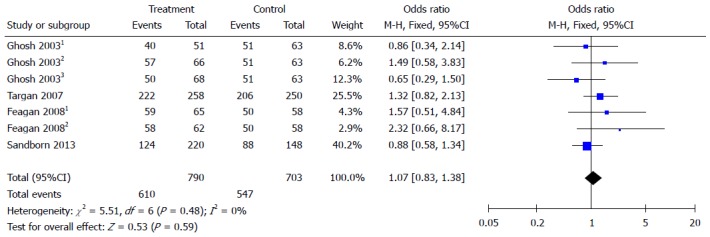
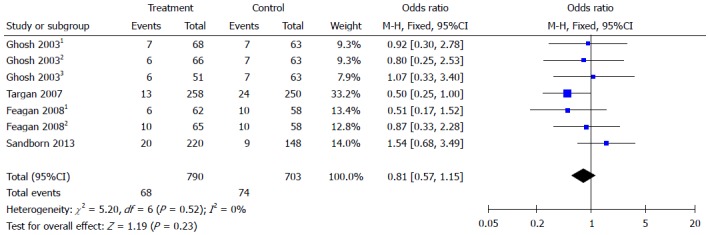
Results: A total of 1340 patients from five studies were involved in this meta-analysis. During 6-12 wk treatment, integrin antagonists increased the rate of clinical response and remission with OR = 1.69, 95%CI: 1.37-2.09 and 1.84, 95%CI: 1.44-2.34, respectively. No significant difference was found between integrin antagonists and placebo treatments regarding their adverse reactions (OR = 1.07, 95%CI: 0.83-1.38) and serious adverse reactions (OR = 0.81, 95%CI: 0.57-1.15).
Conclusion: The results prove the efficacy and safety of integrin antagonists for CD treatment, although the treatment strategies varied.
Keywords: Crohn’s disease; Drug efficacy; Drug safety; Integrin antagonist; Meta-analysis.
Figures
References
-
- Baumgart DC, Sandborn WJ. Crohn’s disease. Lancet. 2012;380:1590–1605. - PubMed
-
- Dudley-Brown S, Nag A, Cullinan C, Ayers M, Hass S, Panjabi S. Health-related quality-of-life evaluation of crohn disease patients after receiving natalizumab therapy. Gastroenterol Nurs. 2009;32:327–339. - PubMed
-
- Nielsen OH, Munck LK. Drug insight: aminosalicylates for the treatment of IBD. Nat Clin Pract Gastroenterol Hepatol. 2007;4:160–170. - PubMed
-
- De Cassan C, Fiorino G, Danese S. Second-generation corticosteroids for the treatment of Crohn’s disease and ulcerative colitis: more effective and less side effects? Dig Dis. 2012;30:368–375. - PubMed
-
- Lichtenstein GR, Feagan BG, Cohen RD, Salzberg BA, Diamond RH, Chen DM, Pritchard ML, Sandborn WJ. Serious infections and mortality in association with therapies for Crohn’s disease: TREAT registry. Clin Gastroenterol Hepatol. 2006;4:621–630. - PubMed
Publication types
MeSH terms
Substances
LinkOut - more resources
Full Text Sources
Other Literature Sources
Medical
