Review
. 2015 Jul;141(4):858-900.
doi: 10.1037/a0038498. Epub 2015 Apr 27.

The validity of the multi-informant approach to assessing child and adolescent mental health

Affiliations
Review

The validity of the multi-informant approach to assessing child and adolescent mental health

Andres De Los Reyes et al. Psychol Bull. 2015 Jul.

Abstract

Child and adolescent patients may display mental health concerns within some contexts and not others (e.g., home vs. school). Thus, understanding the specific contexts in which patients display concerns may assist mental health professionals in tailoring treatments to patients' needs. Consequently, clinical assessments often include reports from multiple informants who vary in the contexts in which they observe patients' behavior (e.g., patients, parents, teachers). Previous meta-analyses indicate that informants' reports correlate at low-to-moderate magnitudes. However, is it valid to interpret low correspondence among reports as indicating that patients display concerns in some contexts and not others? We meta-analyzed 341 studies published between 1989 and 2014 that reported cross-informant correspondence estimates, and observed low-to-moderate correspondence (mean internalizing: r = .25; mean externalizing: r = .30; mean overall: r = .28). Informant pair, mental health domain, and measurement method moderated magnitudes of correspondence. These robust findings have informed the development of concepts for interpreting multi-informant assessments, allowing researchers to draw specific predictions about the incremental and construct validity of these assessments. In turn, we critically evaluated research on the incremental and construct validity of the multi-informant approach to clinical child and adolescent assessment. In so doing, we identify crucial gaps in knowledge for future research, and provide recommendations for "best practices" in using and interpreting multi-informant assessments in clinical work and research. This article has important implications for developing personalized approaches to clinical assessment, with the goal of informing techniques for tailoring treatments to target the specific contexts where patients display concerns. (PsycINFO Database Record


Figures

Figure 1
Figure 1
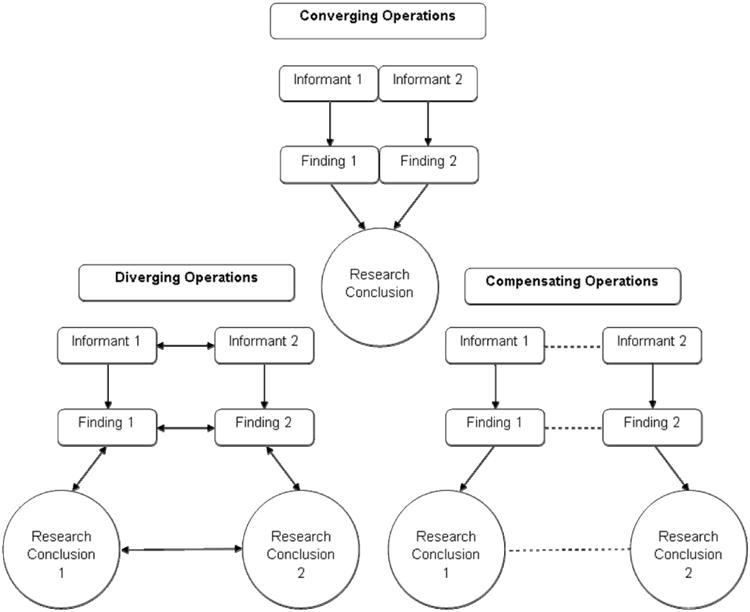
Graphical representation of the research concepts that comprise the Operations Triad Model. The top half (Figure 1a) represents Converging Operations: a set of measurement conditions for interpreting patterns of findings based on the consistency within which findings yield similar conclusions. The bottom half denotes two circumstances within which researchers identify discrepancies across empirical findings derived from multiple informants' reports and thus discrepancies in the research conclusions drawn from these reports. On the left (Figure 1b) is a graphical representation of Diverging Operations: a set of measurement conditions for interpreting patterns of inconsistent findings based on hypotheses about variations in the behavior(s) assessed. The solid lines linking informants' reports, empirical findings derived from these reports, and conclusions based on empirical findings denote the systematic relations among these three study components. Further, the presence of dual arrowheads in the figure representing Diverging Operations conveys the idea that one ties meaning to the discrepancies among empirical findings and research conclusions and thus how one interprets informants' reports to vary as a function of variation in the behaviors being assessed. Lastly, on the right (Figure 1c) is a graphical representation of Compensating Operations: a set of measurement conditions for interpreting patterns of inconsistent findings based on methodological features of the study's measures or informants. The dashed lines denote the lack of systematic relations among informants' reports, empirical findings, and research conclusions. Originally published in De Los Reyes, Thomas, et al. (2013). © Annual Review of Clinical Psychology. Copyright 2012 Annual Reviews. All rights reserved. The Annual Reviews logo, and other Annual Reviews products referenced herein are either registered trademarks or trademarks of Annual Reviews. All other marks are the property of their respective owner and/or licensor.
Figure 2
Figure 2
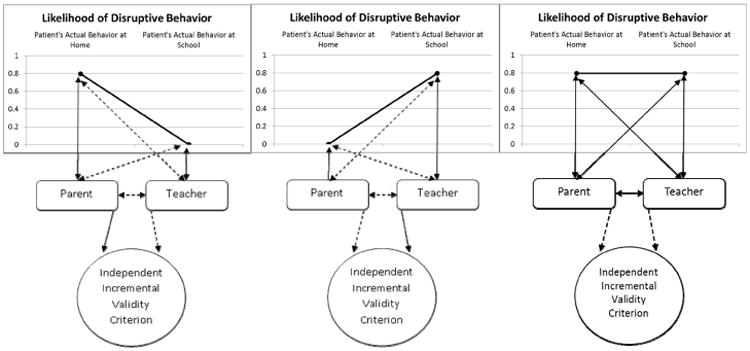
Graphical depiction of incremental and construct validity predictions that follow from the OTM and conceptual rationale for taking a multi-informant approach to mental health assessment.
Figure 3
Figure 3
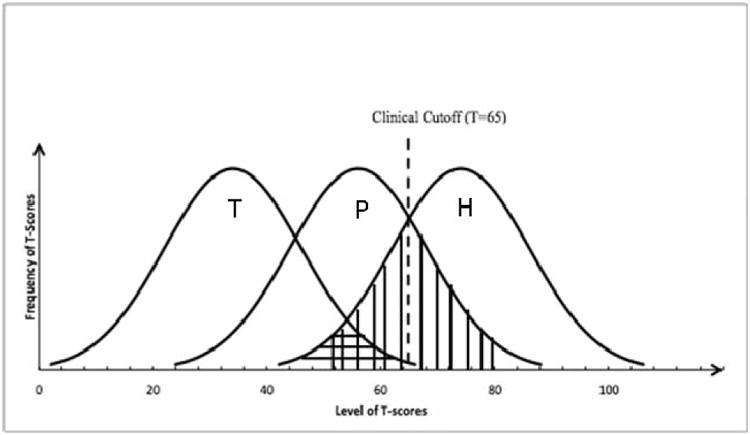
Graphical depiction of T-score distributions of teacher reports (left, labeled “T”), parent reports (center, labeled “P”), and independent home-based assessments of disruptive behavior (right, labeled “H”), in a hypothetical sample of young children.

References

    1. Achenbach TM. Definitely more than measurement error: But how should we understand and deal with informant discrepancies? Journal of Clinical Child and Adolescent Psychology. 2011;40:80–86. doi: 10.1080/15374416.2011.533416. - DOI - PubMed
    1. Achenbach TM. As others see us: Clinical and research implications of cross-informant correlations for psychopathology. Current Directions in Psychological Science. 2006;15:94–98. doi: 10.1111/j.0963-7214.2006.00414.x. - DOI
    1. Achenbach TM, Krukowski RA, Dumenci L, Ivanova MY. Assessment of adult psychopathology: Meta-analysis and implications of cross-informant correlations. Psychological Bulletin. 2005;131:361–382. doi: 10.1037/0033-2909.131.3.361. - DOI - PubMed
    1. Achenbach TM, McConaughy SH, Howell CT. Child/adolescent behavioral and emotional problems: Implications of cross-informant correlations for situational specificity. Psychological Bulletin. 1987;101:213–232. doi: 10.1037/0033-2909.101.2.213. - DOI - PubMed
    1. Achenbach TM, Rescorla L. Manual for the ASEBA school-age forms and profiles. Burlington, VT: University of Vermont Research Center for Children, Youth, and Families; 2001.