


Socioeconomic status and cardiovascular risk in urban South Asia: The CARRS Study
- PMID: 25917221
- PMCID: PMC5560768
- DOI: 10.1177/2047487315580891
Socioeconomic status and cardiovascular risk in urban South Asia: The CARRS Study
Abstract
Background: Although South Asians experience cardiovascular disease (CVD) and risk factors at an early age, the distribution of CVD risks across the socioeconomic spectrum remains unclear.
Methods: We analysed the 2011 Centre for Cardiometabolic Risk Reduction in South Asia survey data including 16,288 non-pregnant adults (≥20 years) that are representative of Chennai and Delhi, India, and Karachi, Pakistan. Socioeconomic status (SES) was defined by highest education (primary schooling, high/secondary schooling, college graduate or greater); wealth tertiles (low, middle, high household assets) and occupation (not working outside home, semi/unskilled, skilled, white-collar work). We estimated age and sex-standardized prevalence of behavioural (daily fruit/vegetables; tobacco use), weight (body mass index; waist-to-height ratio) and metabolic risk factors (diabetes, hypertension, hypercholesterolaemia; hypo-HDL; and hypertriglyceridaemia) by each SES category.
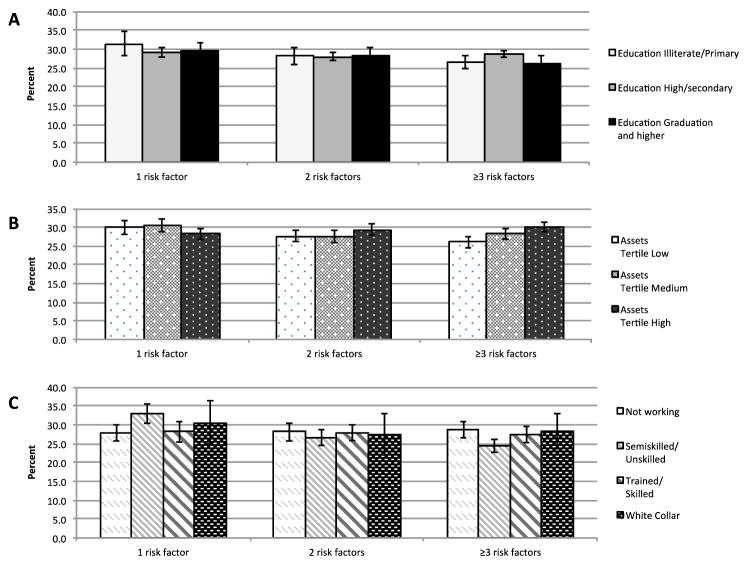
Results: Across cities, 61.2% and 16.1% completed secondary and college educations, respectively; 52.8% reported not working, 22.9% were unskilled; 21.3% were skilled and 3.1% were white-collar workers. For behavioural risk factors, low fruit/vegetable intake, smoked and smokeless tobacco use were more prevalent in lowest education, wealthy and occupation (for men only) groups compared to higher SES counterparts, while weight-related risks (body mass index 25.0-29.9 and ≥30 kg/m(2); waist-to-height ratio ≥0.5) were more common in higher educated and wealthy groups, and technical/professional men. For metabolic risks, a higher prevalence of diabetes, hypertension and dyslipidaemias was observed in more educated and affluent groups, with unclear patterns across occupation groups.
Conclusions: SES-CVD patterns are heterogeneous, suggesting customized interventions for different SES groups may be warranted. Different behavioural, weight, and metabolic risk factor prevalence patterns across SES indicators may signal on-going epidemiological transition in South Asia.
Keywords: Cardiovascular risk factors; South Asians; global cardiovascular health; socioeconomic status.
© The European Society of Cardiology 2015.
Conflict of interest statement
The authors have no conflicts of interest to disclose.
Figures
References
-
- IHME. The Global Burden of Disease: Generating Evidence, Guiding Policy - South Asia Regional Edition. Seattle, Washington: Institute for Health Metrics and Evaluation, University of Washington and Human Development Network, The World Bank; 2013.
-
- Joshi P, Islam S, Pais P, Reddy S, Dorairaj P, et al. Risk factors for early myocardial infarction in South Asians compared with individuals in other countries. Jama. 2007;297:286–294. - PubMed
-
- World Bank. HNP Stats. 2011. Population Projection Tables by Country and Group.
Publication types
MeSH terms
Grants and funding
LinkOut - more resources
Full Text Sources
Other Literature Sources
