Review
. 2015;7(4):399-410.
doi: 10.2217/imt.15.1.

Novel insights into anti-CD40/CD154 immunotherapy in transplant tolerance

Affiliations
Review

Novel insights into anti-CD40/CD154 immunotherapy in transplant tolerance

David F Pinelli et al. Immunotherapy. 2015.

Abstract

Since the discovery of the CD40-CD154 costimulatory pathway and its critical role in the adaptive immune response, there has been considerable interest in therapeutically targeting this interaction with monoclonal antibodies in transplantation. Unfortunately, initial promise in animal models gave way to disappointment in clinical trials following a number of thromboembolic complications. However, recent mechanistic studies have identified the mechanism of these adverse events, as well as detailed a myriad of interactions between CD40 and CD154 on a wide variety of immune cell types and the critical role of this pathway in generating both humoral and cell-mediated alloreactive responses. This has led to resurgence in interest and the potential resurrection of anti-CD154 and anti-CD40 antibodies as clinically viable therapeutic options.

Keywords: CD40; CD40L; Fc receptor; costimulation; thromboembolism; transplantation.


Figures
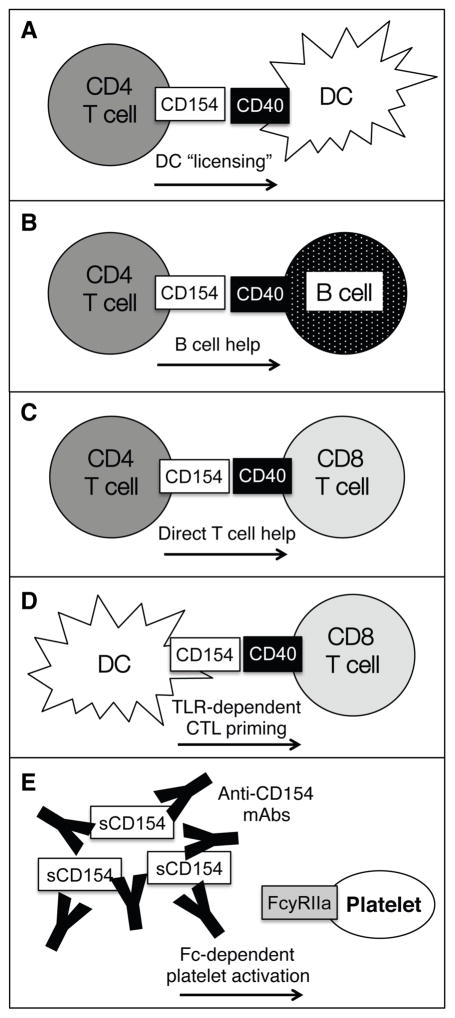
Figure 1
Figure 1. Complexities of CD40-CD154 Interactions in the Immune System
The TNF-family member CD40 and its ligand, CD40L (CD154), are expressed by a wide variety of cell types and the signaling induced by this binding leads to a range of potent immunostimulatory events. (A) Activated CD4+ T cells upregulate CD154, which binds to the CD40 expressed by dendritic cells. This leads to DC activation, which includes the production of proinflammatory cytokines such as IL-12. (B) CD4+ T cells and B cells undergo linked recognition, wherein T cells recognize their cognate peptide:MHC Class II complex expressed by B cells. T cells then provide costimulatory signals through B cell-expressed CD40, and this “T cell help” is critical for generating effective humoral responses. (C) CD4+ T cell-expressed CD154 can also provide direct help to CD8+ T cells through CD40, which has been suggested to play a role in the formation of CD8+ T cell memory. (D) CD154 is also inducibly expressed on DC following toll-like receptor ligation, and the interaction with CD40 expressed on CD8+ T cells can help generate potent pathogen-reactive CD8+ T cell responses. (E) A hypothesis for anti-CD154-associated thromboembolic complications centers on the expression of the activating Fc receptor FcγRIIa on human platelets, which can be crosslinked by immune complexes of soluble CD154 and anti-CD154 antibodies, leading to further platelet activation and undesired clotting events.

References

    1. Grewal IS, Flavell RA. CD40 and CD154 in cell-mediated immunity. Ann Rev Immunol. 1998;16:111–135. - PubMed
    1. Noelle RJ, Roy M, Shepherd DM, Stamenkovic I, Ledbetter JA, Aruffo A. A 39-kDa protein on activated helper T cells binds CD40 and transduces the signal for cognate activation of B cells. Proc Natl Acad Sci U S A. 1992;89(14):6550–6554. - PMC - PubMed
    1. Caux C, Massacrier C, Vanbervliet B, et al. Activation of human dendritic cells through CD40 cross-linking. J Exp Med. 1994;180(4):1263–1272. - PMC - PubMed
    1. Cella M, Scheidegger D, Palmer-Lehmann K, Lane P, Lanzavecchia A, Alber G. Ligation of CD40 on dendritic cells triggers production of high levels of interleukin-12 and enhances T cell stimulatory capacity: T-T help via APC activation. J Exp Med. 1996;184(2):747–752. - PMC - PubMed
    1. Liu D, Ferrer IR, Konomos M, Ford ML. Inhibition of CD8+ T cell-derived CD40 signals is necessary but not sufficient for Foxp3+ induced regulatory T cell generation in vivo. J Immunol. 2013;191(4):1957–1964. - PMC - PubMed

MeSH terms
