


Parental Reports of Stigma Associated with Child's Disorder of Sex Development
- PMID: 25918529
- PMCID: PMC4396550
- DOI: 10.1155/2015/980121
Parental Reports of Stigma Associated with Child's Disorder of Sex Development
Abstract
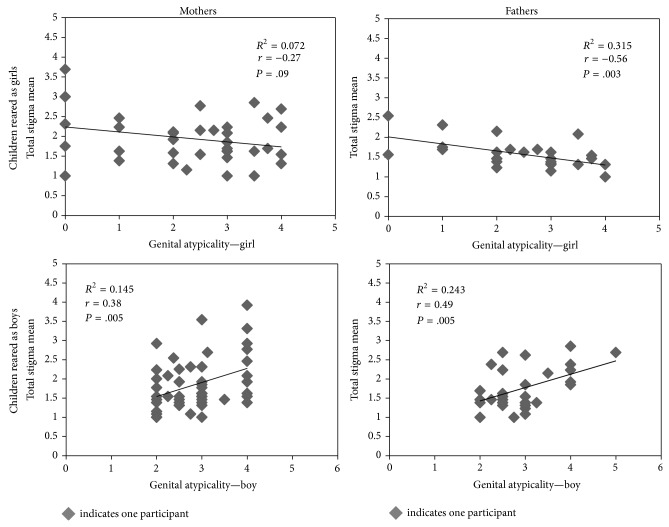
Disorders of sex development (DSD) are congenital conditions in which chromosomal, gonadal, or anatomic sex development is atypical. DSD-associated stigma is purported to threaten positive psychosocial adaptation. Parental perceptions of DSD-related stigma were assessed in 154 parents of 107 children (newborn-17 years) questionnaire comprising two scales, child-focused and parent-focused, and three subscales, perceived stigmatization, future worries, and feelings about the child's condition. Medical chart excerpts identified diagnoses and clinical management details. Stigma scale scores were generally low. Parents of children with DSD reported less stigma than parents of children with epilepsy; however, a notable proportion rated individual items in the moderate to high range. Stigma was unrelated to child's age or the number of DSD-related surgeries. Child-focused stigma scores exceeded parent-focused stigma and mothers reported more stigma than fathers, with a moderate level of agreement. Within 46,XY DSD, reported stigma was higher for children reared as girls. In conclusion, in this first quantitative study of ongoing experiences, DSD-related stigma in childhood and adolescence, while limited in the aggregate, is reported at moderate to high levels in specific areas. Because stigma threatens positive psychosocial adaptation, systematic screening for these concerns should be considered and, when reported, targeted for psychoeducational counseling.
Figures
References
-
- Meyer-Bahlburg H. F. L., Blizzard R. M. Conference proceedings: research on intersex: summary of a Planning Workshop. Endocrinologist. 2004;14(2):59–69. doi: 10.1097/01.ten.0000123701.61007.4e. - DOI
-
- Lee P. A., Witchel S. F. Genital surgery among females with congenital adrenal hyperplasia: changes over the past five decades. Journal of Pediatric Endocrinology and Metabolism. 2002;15(9):1473–1477. - PubMed
-
- Kessler S. J. Lessons from the Intersexed. Piscatway, NJ, USA: Rutgers University Press; 1998.
Grants and funding
LinkOut - more resources
Full Text Sources
Other Literature Sources
