. 2015 Dec;9(12):2697-711.
doi: 10.1038/ismej.2015.66. Epub 2015 Apr 28.

Metagenomic and lipid analyses reveal a diel cycle in a hypersaline microbial ecosystem

Affiliations

Metagenomic and lipid analyses reveal a diel cycle in a hypersaline microbial ecosystem

Karen Andrade et al. ISME J. 2015 Dec.

Abstract

Marine microbial communities experience daily fluctuations in light and temperature that can have important ramifications for carbon and nutrient cycling. Elucidation of such short time scale community-wide dynamics is hindered by system complexity. Hypersaline aquatic environments have lower species richness than marine environments and can be well-defined spatially, hence they provide a model system for diel cycle analysis. We conducted a 3-day time series experiment in a well-defined pool in hypersaline Lake Tyrrell, Australia. Microbial communities were tracked by combining cultivation-independent lipidomic, metagenomic and microscopy methods. The ratio of total bacterial to archaeal core lipids in the planktonic community increased by up to 58% during daylight hours and decreased by up to 32% overnight. However, total organism abundances remained relatively consistent over 3 days. Metagenomic analysis of the planktonic community composition, resolved at the genome level, showed dominance by Haloquadratum species and six uncultured members of the Halobacteriaceae. The post 0.8 μm filtrate contained six different nanohaloarchaeal types, three of which have not been identified previously, and cryo-transmission electron microscopy imaging confirmed the presence of small cells. Notably, these nano-sized archaea showed a strong diel cycle, with a pronounced increase in relative abundance over the night periods. We detected no eukaryotic algae or other photosynthetic primary producers, suggesting that carbon resources may derive from patchily distributed microbial mats at the sediment-water interface or from surrounding land. Results show the operation of a strong community-level diel cycle, probably driven by interconnected temperature, light abundance, dissolved oxygen concentration and nutrient flux effects.


Figures
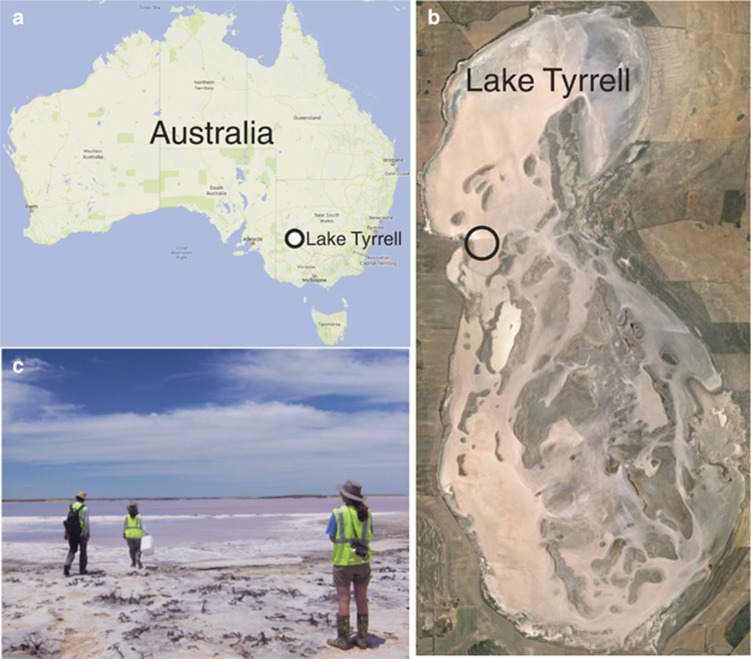
Figure 1
Figure 1
Location of the thallasohaline Lake Tyrell metagenomic sampling site. (a) Map showing the location of Lake Tyrrell, NW Victoria, Australia, indicated by a circle. (b) Sampling location in Lake Tyrrell, indicated by a circle. (c) Picture of the pool used for the time series study.
Figure 2
Figure 2
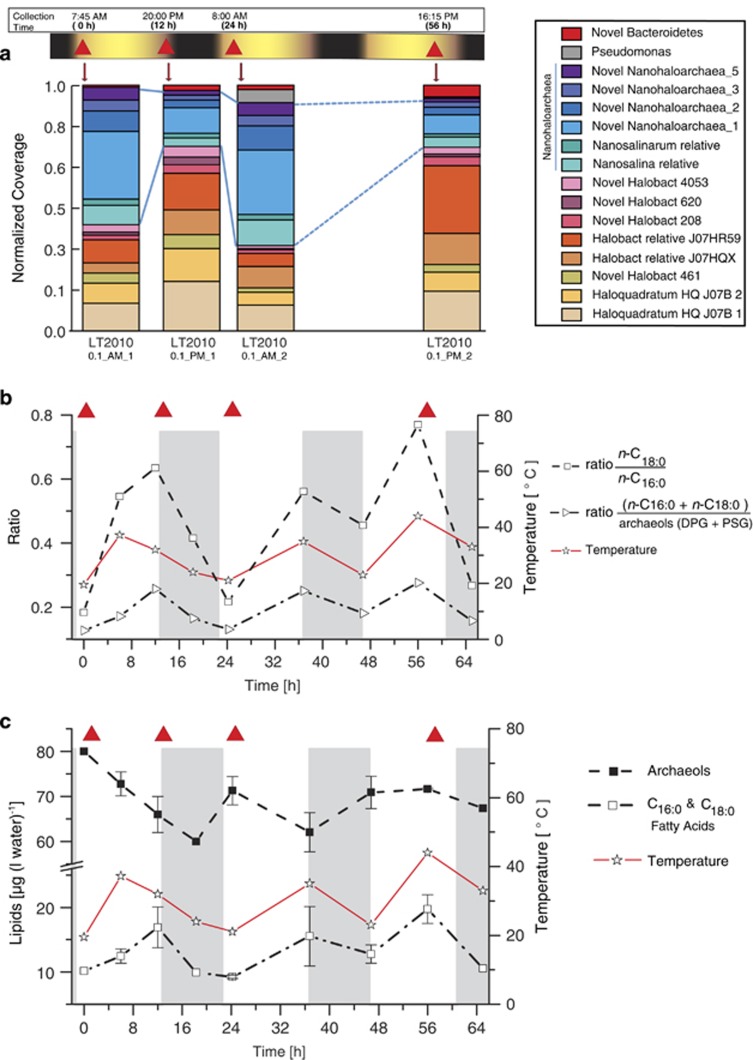
Results for GC-FID analysis of trimethylsilyl (TMS) derivatives from hydrolyzed filter samples and organism relative abundance in 0.1-μm filter metagenomic data sets. (a) Diel cycle trends in organism relative abundance in the hypersaline Lake Tyrell. Organism abundance was estimated from depth of metagenomic sequence coverage for marker scaffolds encoding ribosomal protein genes. The relative abundances of the 16 operational taxonomic units are displayed as stacked bar charts for the four 0.1-μm filter sample data sets. The collection time of each sample is shown at the top and highlighted with red triangles. The legend defined the taxonomic assignment for each operational taxonomic unit. Coverage was calculated by multiplying the total number of reads mapped by read length and dividing by individual scaffold length. The coverage was normalized to account for different numbers of reads per sample and converted to a per-sample percentage. (b) The ratio of the absolute abundance of n-C18:0 over n-C16:0 FAs (open boxes) highlighting diurnal variation of average bacterial membrane lipid chain length, and ratio of the abundance of bacterial versus archaeal lipids (open triangles). In (b) and (c), water temperature on each sampling point is given in °C and gray areas show hours without daylight. Points without error bars indicate that no replicate filtrates were collected at these time points because of sampling conditions in the field. Red triangles indicate time of collection of 0.1-μm filter sample used for metagenomic analyses. (c) Absolute lipid concentrations from saponified 0.7-μm filter samples. Curves show the sum of C16:0 and C18:0 FAs [μg (l lake water)-1] of bacterial origin, and archaeols (diphytanylglycerol (DPG) and phytanylsesterterpanyl glycerol (PSG)) of archaeal origin.
Figure 3
Figure 3
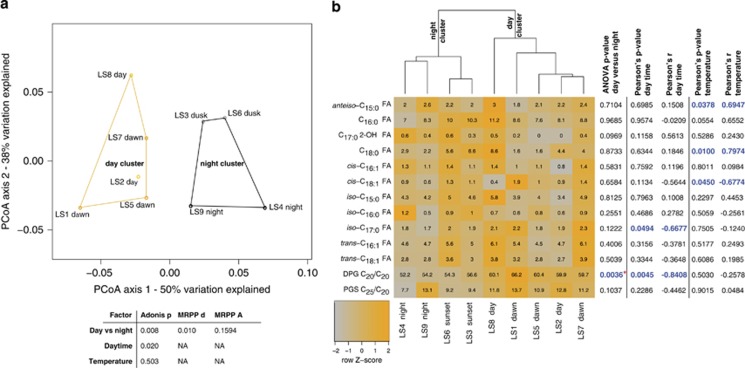
Results of multivariate and univariate statistical analyses of lipid abundances. (a) Principal coordinate analysis (PCoA) based on the Bray-Curtis index derived from absolute lipid abundances (LS, lipid sample). The ordination shows a separation of day and night samples along PCoA axis 1. Adonis P-values (Adonis p) and multi-response permutation procedure (MRPP) delta (MRPP d) are significant (<0.05) for these groupings and suggest a significant difference in community structure between day (day and dawn) and night (night and dusk) samples. Actual difference in the sample grouping is estimated by the chance corrected within-group agreement (MRPP A). The continuous variables daytime and temperature were also tested, whereas daytime was associated with a significant change in the community composition based on lipid abundances. (b) Heatmap combined with hierarchical clustering (based on Euclidean distance) and individual univariate analysis for each lipid signature. Samples show grouping into a day and night cluster and confirm findings from PCoA, Adonis and MRPP. Abundance of diphytanylglycerol (DPG) C20/C20 was significantly between day and night samples (*P-value was robust to Benjamini–Hochberg correction). Significant correlations with daytime or temperature were found for anteiso-C15:0 FA, C18:0 FA, cis-C18:1 FA, iso-C17:0 FA, and DPG C20/C20, all show in blue.
Figure 4
Figure 4
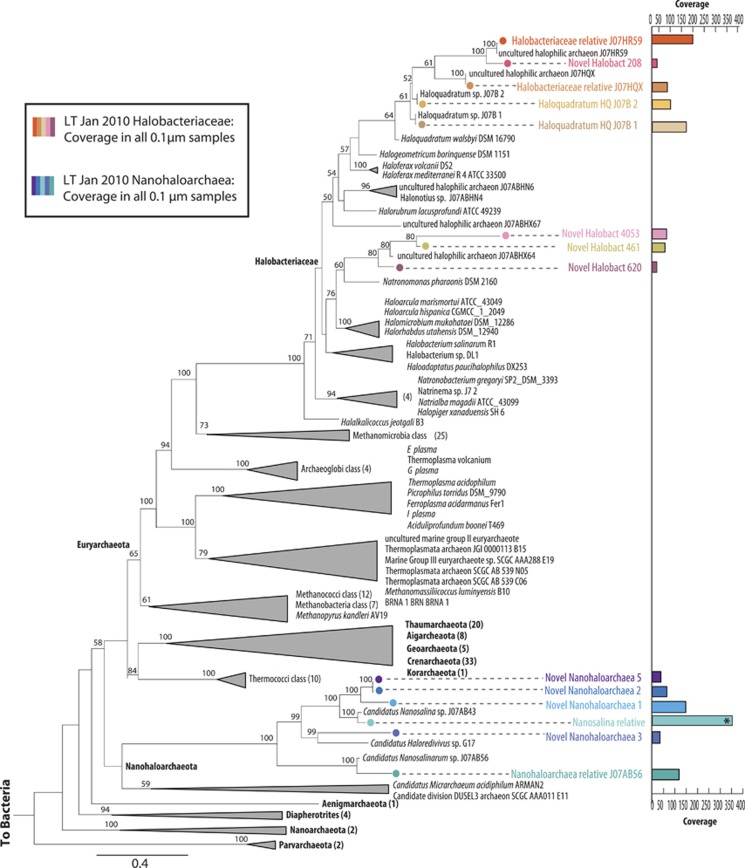
The 15 ribosomal protein concatenated phylogeny places the 14 archaeal operational taxonomic units as novel organisms compared with previously sequenced genomes in 0.1-μm samples. RAxML phylogenetic tree with 100 bootstrap resamplings rooted at the split between archaea and bacteria. Numbers in parentheses indicate number of sequences included in the analysis that are not show. Fourteen distinct archaeal ribosomal blocks were identified in all of the 0.1-μm data sets, all of which are novel at least at the species level. Organism colors are consistent with Figure 2. Six are Nanohaloarchaea (basal archaeal group on the tree), all shown in purple and a gradient of blue. The organism most closely related to Candidatus Nanosalina sp. J07AB43 is the most abundant organism on the 0.1-μm filters (in teal on this tree and marked with an asterisk).
Figure 5
Figure 5
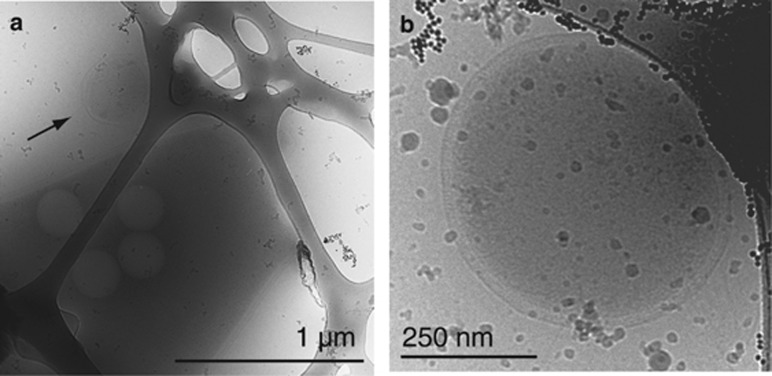
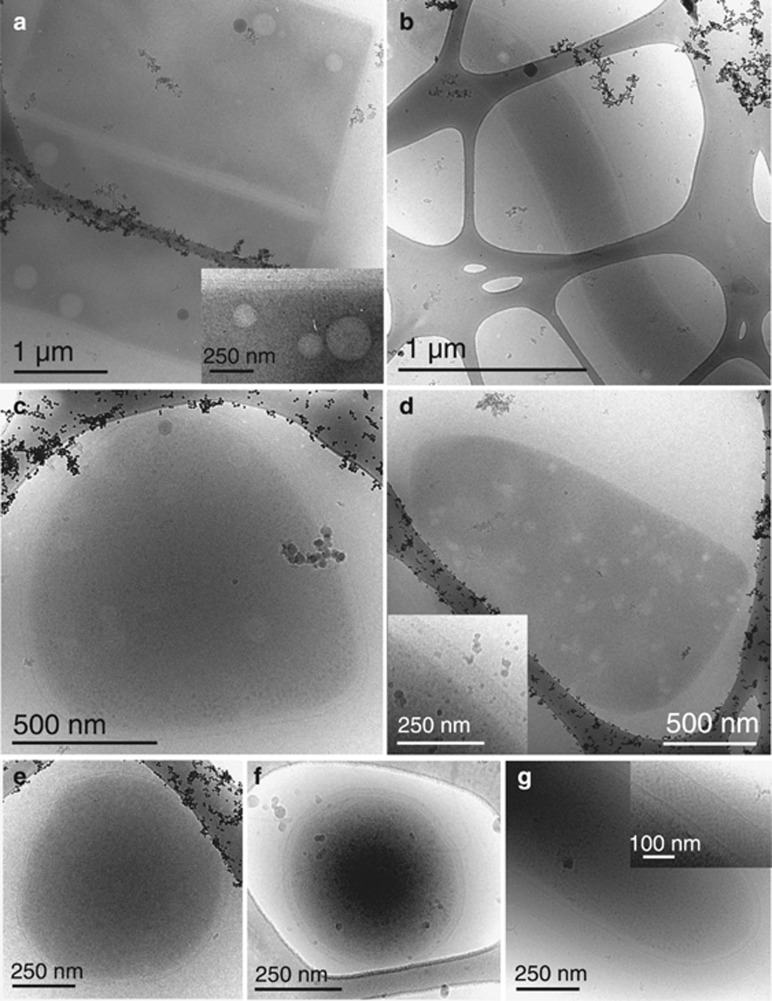
Cryo-transmission electron microscopy (TEM) images of planktonic cells recovered from lake water on the 0.1-μm filters confirm the presence of very small cells, likely members of the Nanohaloarchaea. In all images, the electron microscopy grid is evident in the background. (a) Cryo-TEM of an organism presumed to be a nanohaloarchaeon next to a larger putative Haloquadratum-like organism. (b) An organism presumed to be a member of the Nanohaloarchaea because of its small size and small contrast elements in the inner membrane, outer membrane and perisplasmic space, as have been seen in the ARMAN nanoarchaea (Comolli and Banfield, 2014).
Figure 6
Figure 6
Other prominent morphologies surveyed at Lake Tyrrell via cryo-transmission electron microscopy (TEM) imaging. (a) Rectangular prism-shaped cells with large vesicles and a three-layer cell wall, likely in the Haloquadratum genus, (b) long rod-like, (c) cocci with vesicles, (d) triangular with multiple vesicles and a three-layer outer membrane, (e) small cocci, (f) an organism presumed to be a nanohaloarchaeon and (g) rod-like organism with an exceptionally thick S-layer-like outer surface.
Figure 7
Figure 7
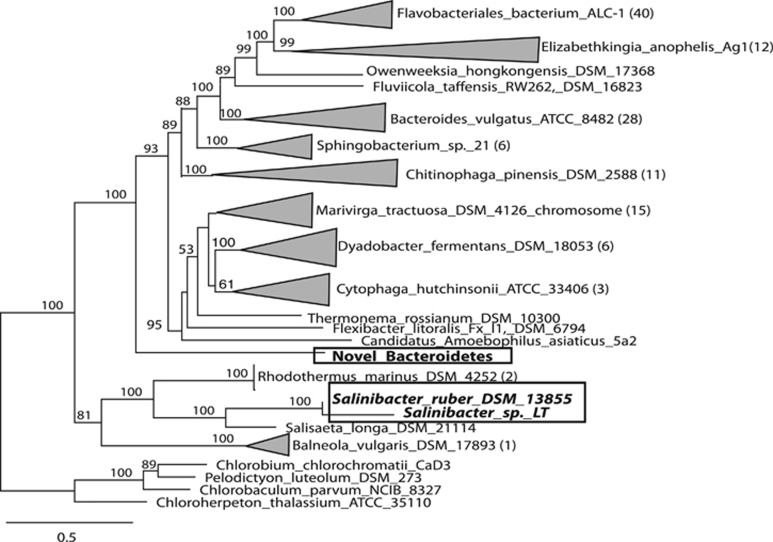
A 15 ribosomal protein concatenated phylogeny for the phylum Bacteroidetes. Rooted, RAxML phylogenetic tree with 100 bootstrap resamplings. Numbers in parentheses indicate number of sequences included in the analysis that are not show. This tree places the Lake Tyrell Bacteroidetes sp. as a novel member of a previously unsequenced class (bold). All sequenced Bacteroidetes genomes were included in the phylogeny. The boxes delineate the positions of the Lake Tyrell Bacteroidetes sp. and Salinibacter sp. (bold), the known halophiles within the Bacteroidetes, and highlight the evolutionary distance between these two groups.

References

    1. Allen EE, Banfield JF. (2005). Community genomics in microbial ecology and evolution. Nat Rev Microbiol 3: 489–498. - PubMed
    1. Baker BJ, Banfield JF. (2003). Microbial communities in acid mine drainage. FEMS Microbiol Ecol 44: 139–152. - PubMed
    1. Baliga NS. (2008). Systems biology - the scale of prediction. Science 320: 1297–1298. - PubMed
    1. Benjamini Y, Hochberg Y. (1995). Controlling the false discovery rate — a practical and powerful approach to multiple testing. J Roy Stat Soc B Met 57: 289–300.
    1. Butte W. (1983). Rapid method for the determination of fatty-acid profiles from fats and oils using trimethylsulfonium hydroxiden for trans-esterification. J Chromatogr 261: 142–145.

Publication types