Neural computations mediating one-shot learning in the human brain
- PMID: 25919291
- PMCID: PMC4412411
- DOI: 10.1371/journal.pbio.1002137
Neural computations mediating one-shot learning in the human brain
Abstract
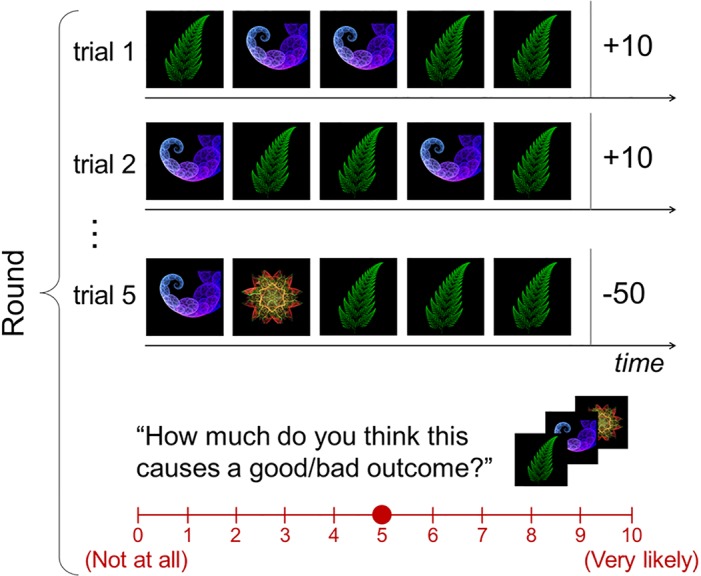
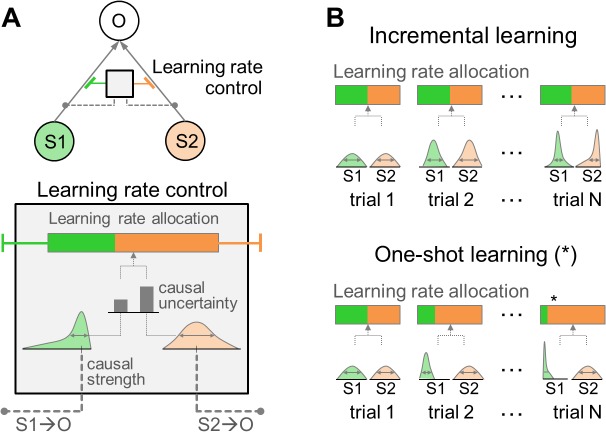
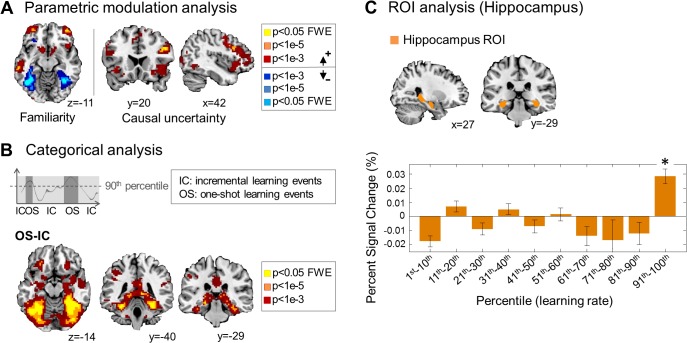
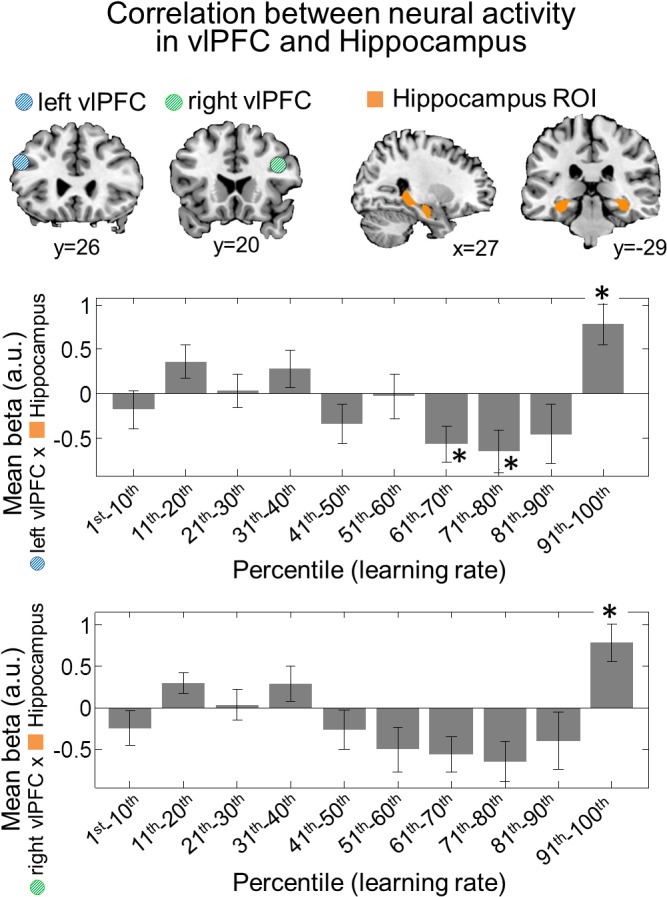
Incremental learning, in which new knowledge is acquired gradually through trial and error, can be distinguished from one-shot learning, in which the brain learns rapidly from only a single pairing of a stimulus and a consequence. Very little is known about how the brain transitions between these two fundamentally different forms of learning. Here we test a computational hypothesis that uncertainty about the causal relationship between a stimulus and an outcome induces rapid changes in the rate of learning, which in turn mediates the transition between incremental and one-shot learning. By using a novel behavioral task in combination with functional magnetic resonance imaging (fMRI) data from human volunteers, we found evidence implicating the ventrolateral prefrontal cortex and hippocampus in this process. The hippocampus was selectively "switched" on when one-shot learning was predicted to occur, while the ventrolateral prefrontal cortex was found to encode uncertainty about the causal association, exhibiting increased coupling with the hippocampus for high-learning rates, suggesting this region may act as a "switch," turning on and off one-shot learning as required.
Conflict of interest statement
The authors have declared that no competing interests exist.
Figures
Comment in
-
How one-shot learning unfolds in the brain.PLoS Biol. 2015 Apr 28;13(4):e1002138. doi: 10.1371/journal.pbio.1002138. eCollection 2015 Apr. PLoS Biol. 2015. PMID: 25919303 Free PMC article.
References
-
- Li F-F, Rob F, Perona P (2006) One-shot learning of object categories. IEEE Trans Pattern Anal Mach Intell 28: 594–611. - PubMed
-
- Garety P, Freeman D, Jolley S, Ross K, Waller H, et al. (2011) Jumping to conclusions: the psychology of delusional reasoning. Adv Psychiatr Treat 17: 332–339.
-
- Moore SC, Sellen JL (2006) Jumping to conclusions: a network model predicts schizophrenic patients’ performance on a probabilistic reasoning task. Cogn Affect Behav Neurosci 6: 261–269. - PubMed
-
- Schippers MC, Lange PAM Van (2006) The Psychological Benefits of Superstitious Rituals in Top Sport: A Study Among Top Sportspersons. J Appl Soc Psychol 36: 2532–2553.
Publication types
MeSH terms
Grants and funding
LinkOut - more resources
Full Text Sources
Other Literature Sources