. 2015 Apr 28;13(4):e1002137.
doi: 10.1371/journal.pbio.1002137. eCollection 2015 Apr.

Neural computations mediating one-shot learning in the human brain

Affiliations

Neural computations mediating one-shot learning in the human brain

Sang Wan Lee et al. PLoS Biol. .

Abstract

Incremental learning, in which new knowledge is acquired gradually through trial and error, can be distinguished from one-shot learning, in which the brain learns rapidly from only a single pairing of a stimulus and a consequence. Very little is known about how the brain transitions between these two fundamentally different forms of learning. Here we test a computational hypothesis that uncertainty about the causal relationship between a stimulus and an outcome induces rapid changes in the rate of learning, which in turn mediates the transition between incremental and one-shot learning. By using a novel behavioral task in combination with functional magnetic resonance imaging (fMRI) data from human volunteers, we found evidence implicating the ventrolateral prefrontal cortex and hippocampus in this process. The hippocampus was selectively "switched" on when one-shot learning was predicted to occur, while the ventrolateral prefrontal cortex was found to encode uncertainty about the causal association, exhibiting increased coupling with the hippocampus for high-learning rates, suggesting this region may act as a "switch," turning on and off one-shot learning as required.


Conflict of interest statement

The authors have declared that no competing interests exist.

Figures
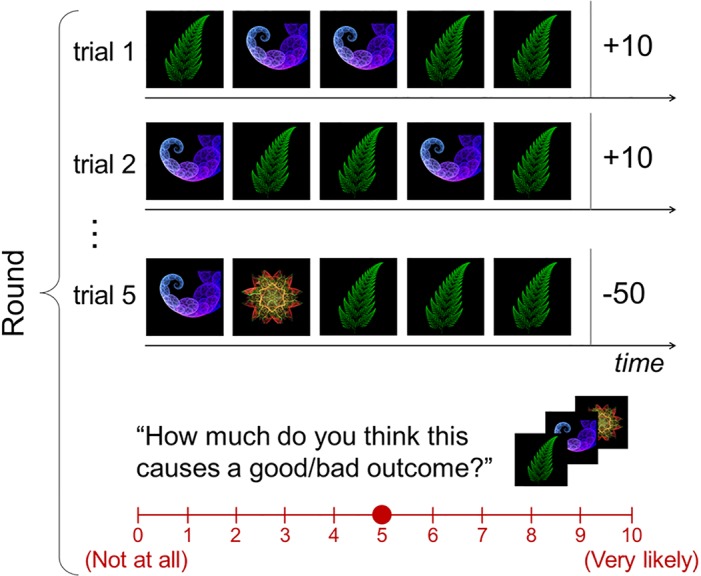
Fig 1
Fig 1. Causal learning task.
Task design. On each trial, participants are presented with a sequence of pictures that vary in the degree of frequency in which they are presented, followed by receiving one of two types of monetary outcome—non-novel and novel outcomes. Each picture and outcome is displayed for 1 and 2 s, respectively. The presentations of successive pictures and individual trials are separated by a variable temporal interval drawn from a uniform distribution between 1 to 4 s. After the fifth trial, they are asked to make ratings about each stimulus-outcome pair in turn. A maximum of 4 s is allowed for each submission. Participants were asked to complete 40 rounds.
Fig 2
Fig 2. Causal learning model.
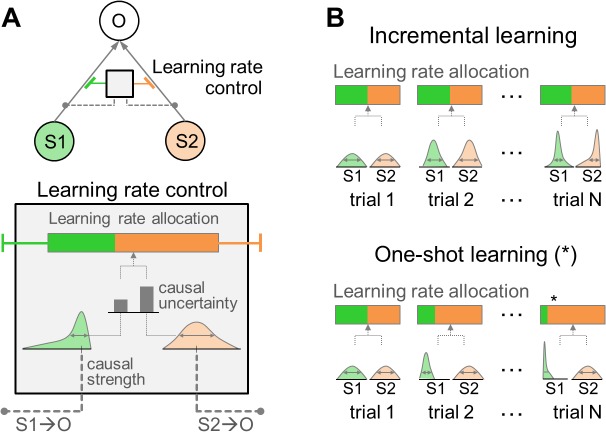
(A) Causal uncertainty model. The causal relationship between a stimulus (S1 or S2) and an outcome (O) can be encapsulated as a probability distribution, of which a mean and a variance are referred to as a “causal strength” and a “causal uncertainty,” respectively. The grey arrow indicates the causal relationship, and color indicates a category of causal relationship (green for the S1-O pair and orange for the S2-O pair). We hypothesized that the role of causal uncertainty is pivotal in determining the rate at which new information is taken into account to update one’s current predictions about the causal relationship. The learning rate for a particular stimulus is dictated by the process of determining how much causal uncertainty is greater for a given stimulus than for other stimuli in the environment (“learning rate allocation”). (B) Learning rate control of the causal learning model. Incremental learning: in a situation in which the causal uncertainty for both the S1-O and the S2-O is gradually resolved over the course of trials—such as, for example, when S2 is a probable cause of the O and the S1 is not—the variance of each probability distribution would decrease at an almost equal rate. Accordingly, both S1-O and S2-O would be assigned equal learning rates. One-shot learning: if the causal uncertainty for the S1-O is quickly resolved while the causal uncertainty for the S2-O remains unresolved, then the variance of the probability distribution for the S1-O pair would be smaller than that for the S2-O pair. It will lead to a situation in which the learning rate applied to the S2-O pair becomes much greater than that for the S1-O pair. This proactive strategy for causal learning allows the model to allocate learning rates in a way that rapidly reduces the amount of causal uncertainty left unresolved in the previous trial.
Fig 3
Fig 3. Behavioral results.
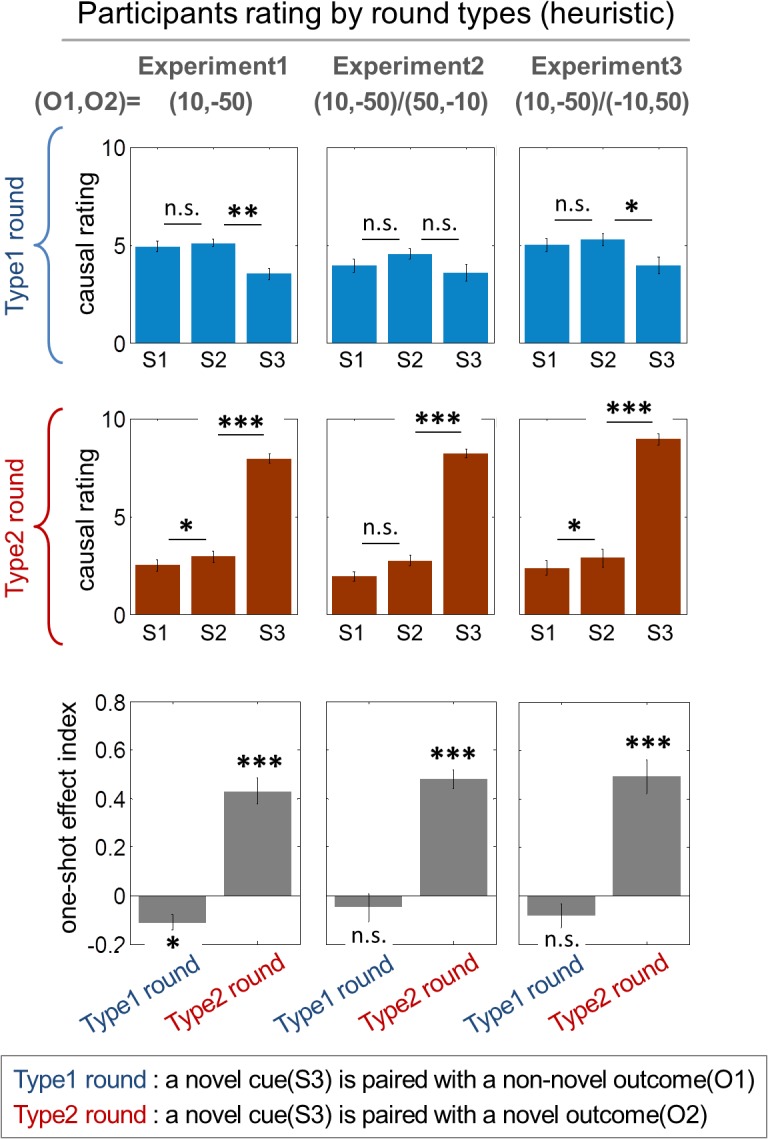
Participants rating patterns classified according to stimulus-outcome novelty pairings (heuristic causal judgment). O1,O2 indicates an outcome condition, where O1 refers to the amount of the non-novel outcome and O2 refers to the amount of the novel outcome. The type1 round and the type2 round refer to rounds in which a novel cue is paired with a non-novel outcome and with a novel outcome, respectively. S1 and S2 refer to the non-novel cues, and S3 refers to a novel cue that is presented only once each round. The first two rows (“causal rating”) show subjects’ causal ratings (scale: 0–10) describing the subjective judgment about the extent to which a given stimulus caused the novel outcome on each trial type as a function of stimulus novelty. Each column refers to the experiment in which different magnitudes of outcomes are used, as indicated by O1,O2. In the first experiment, participants performed a task while being scanned with fMRI. The second and the third experiment were follow-up behavioral experiments (see Materials and Methods; test statistics are provided in the main text). The third row (“one-shot effect index”) illustrates the quantification of the one-shot learning effect in the causal rating dataset. The one-shot effect index is defined as the causal rating for the novel cue minus the average causal ratings for the non-novel cues. The one-shot learning effect indices are significantly positive in the type2 rounds, whereas they are zero or negative in the type1 rounds. *: p < 1e-2, **: p < 1e-3, ***: p < 1e-4; paired-sample t test for underlined asterisks and one-sample t test for asterisks without an underline. Error bars are standard error of the mean (SEM) across subjects.
Fig 4
Fig 4. Model predictions.
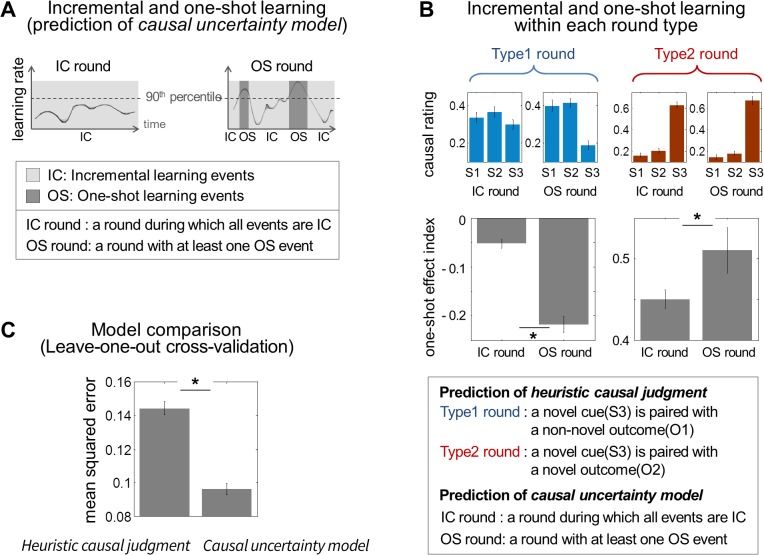
(A) Causal uncertainty model’s prediction about incremental and one-shot learning. Since the model provides event-by-event predictions about learning rate for each stimulus, we split events into two subtypes: “one-shot learning events” (OS), which refers to a stimulus presentation during which the model predicts rapid learning (>90th percentile) and “incremental learning events” (IC), which refers to a stimulus presentation during which the model predicts otherwise (<90th percentile). Accordingly, an “OS round” is defined as a round during which the model predicts occurrence of OS, and an “IC round” is defined as a round during which the model predicts no occurrence of OS. (B) The causal uncertainty model’s predictions that are beyond the predictions of the heuristic causal judgment, which draws a distinction between each round type—type1 and type2 rounds. For type1 rounds during which the model predicts occurrence of one-shot learning events (“OS round” in the type1 round), the corresponding one-shot effect index is significantly more negative than for type1 rounds during which the model predicts no occurrence of one-shot learning events (“IC round” in the type1 round), indicating that when one-shot learning occurs in the type1 rounds, with a high degree of certainty, participants attribute a novel outcome to non-novel stimuli, as opposed to the novel stimulus. On the other hand, for type2 rounds during which the model predicts the occurrence of one-shot learning events (refer to “OS round” in the type2 round), the corresponding one-shot effect index is greater than the type2 rounds during which the model predicts no occurrence of one-shot learning (refer to “IC round” in the type2 round). In both cases, one-shot effects are more dramatic when one-shot learning occurs during the round. *: p < 0.05; error bars are SEM across subjects. (C) Model comparison. Leave-one-out cross validation was used to validate the generalization performance of the models. The causal uncertainty model refers to the causal learning model proposed in the present study, and the heuristic causal judgment refers to the simpler heuristic model taking the stimulus-outcome novelty pairings into account assuming that causal uncertainty is high whenever stimulus and outcome novelty is high. *: p < 0.01; error bars are SEM across subjects.
Fig 5
Fig 5. Neural correlates of one-shot-learning–related computations.
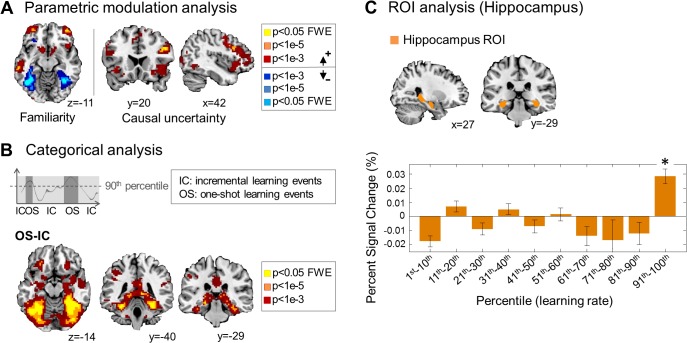
(A) Neural substrates of familiarity and uncertainty processing in one-shot learning. Anterior lateral prefrontal cortex, dorsal prefrontal cortex, and parietal lobe encode signals associated with cue familiarity, whereas the fusiform gyrus encodes a cue novelty signal. Ventrolateral prefrontal cortex and parts of dorsomedial prefrontal cortex encode causal uncertainty signals. Effects significant at p < 0.05 (FWE corrected) are shown in yellow. (B) Involvement of the hippocampal memory system during one-shot learning. “One-shot learning events” is the collection of events during which the model predicts rapid learning (>90th percentile), and “incremental learning events” is the collection of events during which the model predicts otherwise (<90th percentile). Shown are significant categorical effects for one-shot learning events (OS) > incremental learning events (IC). We did not find any significant categorical effects for IC > OS, even with the liberal threshold p = 0.01 uncorrected. Effects are significant in fusiform gyrus, hippocampus, and parahippocampal gyrus. (C) Region-of-interest (ROI) analysis. We used an anatomically defined hippocampus to construct an ROI mask [54] (top), which includes CA1–CA3, dentate gyrus, and the hippocampal-amygdala transition area. Blood-oxygen-level dependent (BOLD) activity in the hippocampal ROI increases significantly in OS (91st–100th percentile of learning rate) but not in IC (1st–90th percentile) (paired-sample t test p < 1e-8). The asterisk shows the statistical level at which the signal change is significantly different from the baseline after Bonferroni adjustment for multiple comparisons across the ten learning bins (one-sample t test; *: p < 1e-6). Error bars are SEM across subjects.
Fig 6
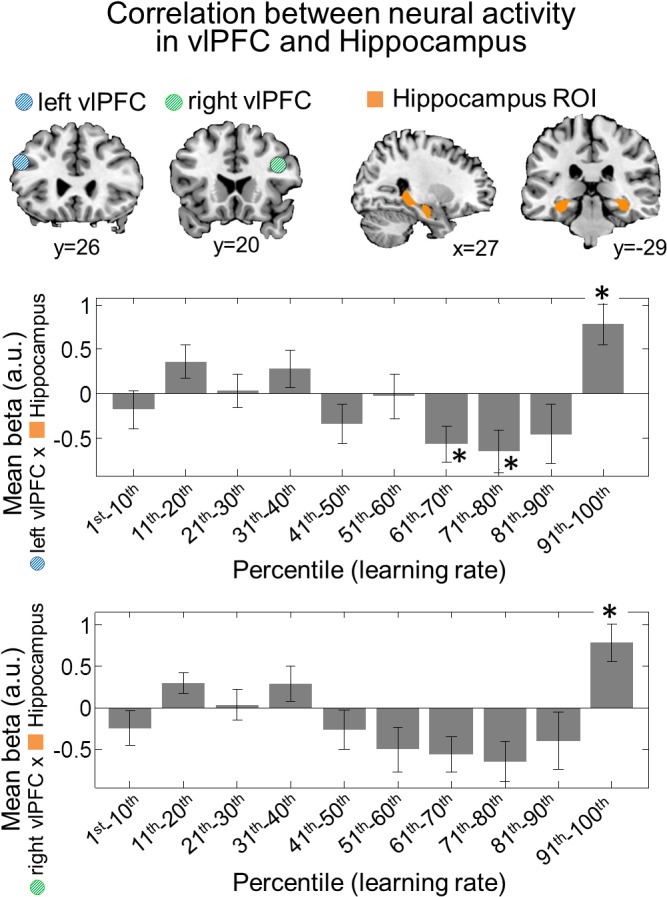
Fig 6. Functional correlation between prefrontal cortex and hippocampus activity.
The blue and green circles represent a 5-mm sphere region of the left and the right ventrolateral prefrontal cortex, respectively, the area identified as processing causal uncertainty information, from which the first eigenvariate of BOLD signals were extracted. The left and right hippocampus ROIs were anatomically defined [54]. Shown are the average beta values within the hippocampus ROIs when the BOLD activity of ventrolateral prefrontal cortex was used as a parametric modulator in the fMRI analysis. This enables correlations to be calculated between activity in ventrolateral prefrontal and hippocampus as a function of learning rate. We found significant positive correlations between the two areas during the events in which rapid learning is predicted by the model (91st–100th percentile of learning rate). The asterisks shows the statistical level at which the beta value is significantly different from zero after Bonferroni adjustment for multiple comparisons across the ten learning bins (one-sample t test; *: p < 1e-2). Error bars are SEM.

Comment in

References

    1. Li F-F, Rob F, Perona P (2006) One-shot learning of object categories. IEEE Trans Pattern Anal Mach Intell 28: 594–611. - PubMed
    1. Garety P, Freeman D, Jolley S, Ross K, Waller H, et al. (2011) Jumping to conclusions: the psychology of delusional reasoning. Adv Psychiatr Treat 17: 332–339.
    1. Moore SC, Sellen JL (2006) Jumping to conclusions: a network model predicts schizophrenic patients’ performance on a probabilistic reasoning task. Cogn Affect Behav Neurosci 6: 261–269. - PubMed
    1. Moutoussis M, Bentall RP, El-Deredy W, Dayan P (2011) Bayesian modelling of Jumping-to- Conclusions bias in delusional patients. Cogn Neuropsychiatry 16: 422–447. 10.1080/13546805.2010.548678 - DOI - PubMed
    1. Schippers MC, Lange PAM Van (2006) The Psychological Benefits of Superstitious Rituals in Top Sport: A Study Among Top Sportspersons. J Appl Soc Psychol 36: 2532–2553.

Publication types