


Prolonged Correction of Serum Phosphorus in Adults With X-Linked Hypophosphatemia Using Monthly Doses of KRN23
- PMID: 25919461
- PMCID: PMC4495171
- DOI: 10.1210/jc.2015-1551
Prolonged Correction of Serum Phosphorus in Adults With X-Linked Hypophosphatemia Using Monthly Doses of KRN23
Erratum in
-
Corrigendem.J Clin Endocrinol Metab. 2017 Jan 1;102(1):336. doi: 10.1210/jc.2016-3665. J Clin Endocrinol Metab. 2017. PMID: 28359107 Free PMC article. No abstract available.
Abstract
Context: In X-linked hypophosphatemia (XLH), elevated fibroblast growth factor 23 (FGF23) decreases the renal tubular maximum reabsorption rate of phosphate/glomerular filtration rate (TmP/GFR) and serum inorganic phosphorus (Pi), resulting in rickets and/or osteomalacia.
Objective: The objective was to test the hypothesis that monthly KRN23 (anti-FGF23 antibody) would safely improve serum Pi in adults with XLH.
Design: Two sequential open-label phase 1/2 studies were done.
Setting: Six academic medical centers were used.
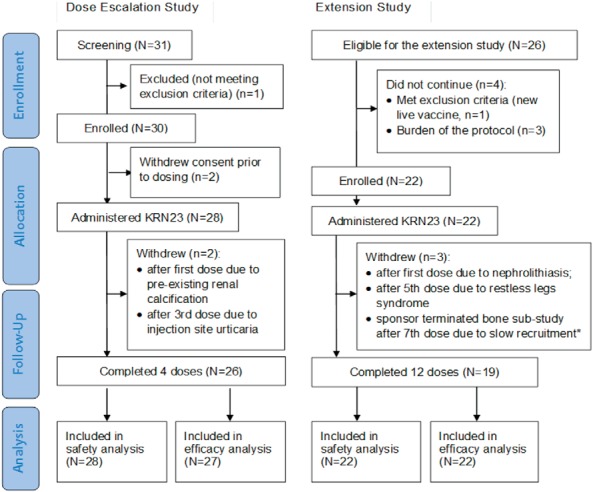
Participants: Twenty-eight adults with XLH participated in a 4-month dose-escalation study (0.05-0.6 mg/kg); 22 entered a 12-month extension study (0.1-1 mg/kg).
Intervention: KRN23 was injected sc every 28 days.
Main outcome measure: The main outcome measure was the proportion of subjects attaining normal serum Pi and safety.
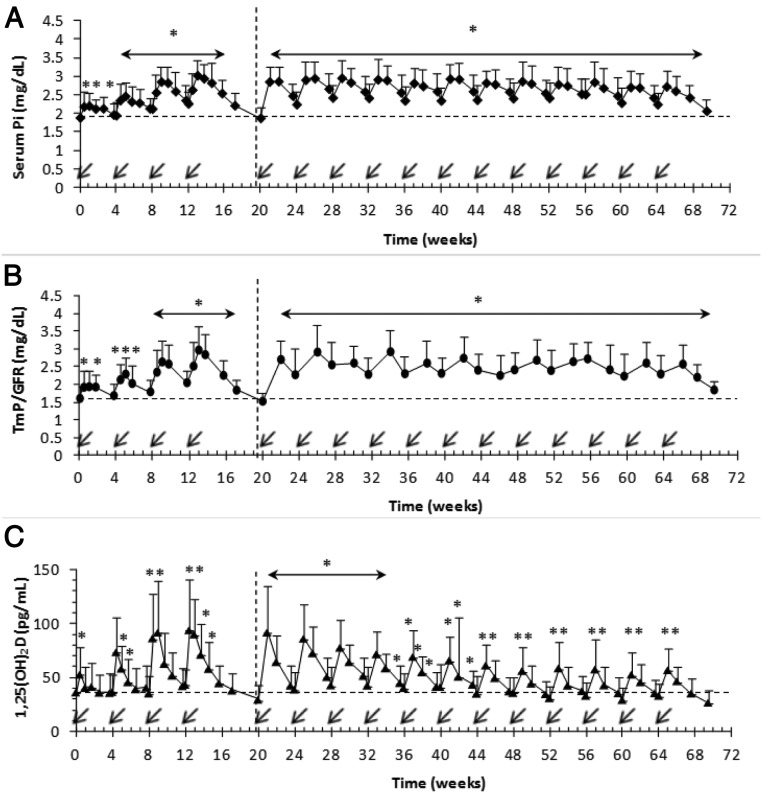
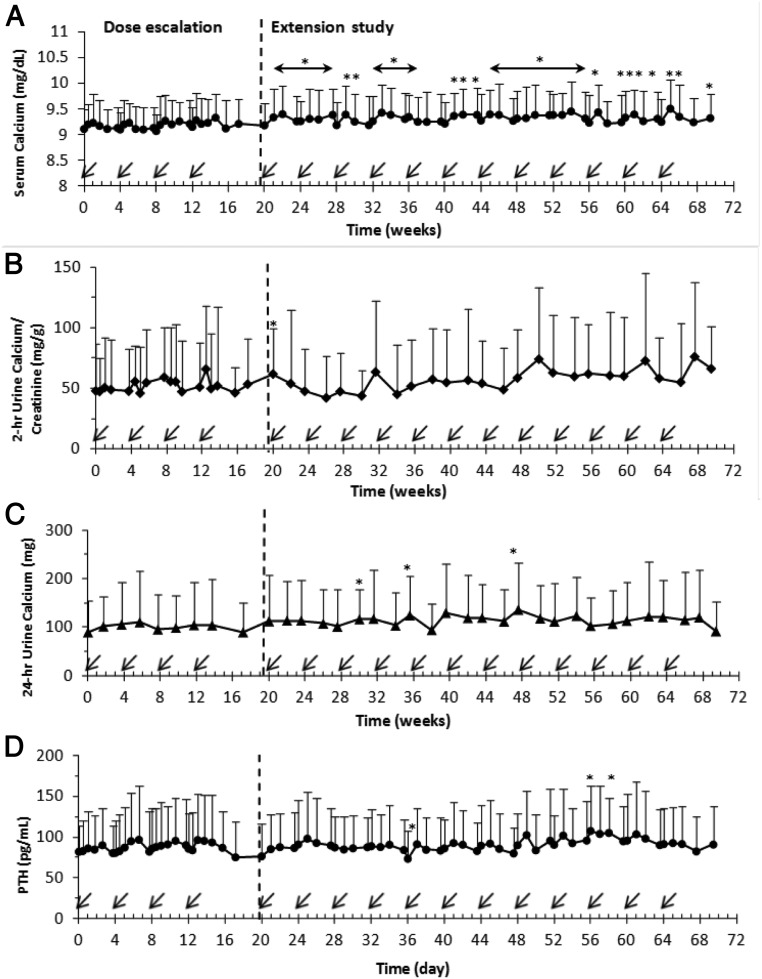
Results: At baseline, mean TmP/GFR, serum Pi, and 1,25-dihydroxyvitamin D [1,25(OH)2D] were 1.6 ± 0.4 mg/dL, 1.9 ± 0.3 mg/dL, and 36.6 ± 14.3 pg/mL, respectively. During dose escalation, TmP/GFR, Pi, and 1,25(OH)2D increased, peaking at 7 days for TmP/GFR and Pi and at 3-7 days for 1,25(OH)2D, remaining above (TmP/GFR, Pi) or near [1,25(OH)2D] pre-dose levels at trough. After each of the four escalating doses, peak Pi was between 2.5 and 4.5 mg/dL in 14.8, 37.0, 74.1, and 88.5% of subjects, respectively. During the 12-month extension, peak Pi was in the normal range for 57.9-85.0% of subjects, and ≥25% maintained trough Pi levels within the normal range. Serum Pi did not exceed 4.5 mg/dL in any subject. Although 1,25(OH)2D levels increased transiently, mean serum and urinary calcium remained normal. KRN23 treatment increased biomarkers of skeletal turnover and had a favorable safety profile.
Conclusions: Monthly KRN23 significantly increased serum Pi, TmP/GFR, and 1,25(OH)2D in all subjects. KRN23 has potential for effectively treating XLH.
Trial registration: ClinicalTrials.gov NCT01340482 NCT01571596.
Figures
References
-
- Burnett CH, Dent CE, Harper C, Warland BJ. Vitamin D-resistant rickets. Analysis of twenty-four pedigrees with hereditary and sporadic cases. Am J Med. 1964;36:222–232. - PubMed
-
- Imel EA, Econs MJ. Fibroblast growth factor 23: roles in health and disease. J Am Soc Nephrol. 2005;16:2565–2575. - PubMed
-
- Liu S, Quarles LD. How fibroblast growth factor 23 works. J Am Soc Nephrol. 2007;18(6):1637–1647. - PubMed
-
- Larsson T, Marsell R, Schipani E, et al. Transgenic mice expressing fibroblast growth factor 23 under the control of the α1(I) collagen promoter exhibit growth retardation, osteomalacia, and disturbed phosphate homeostasis. Endocrinology. 2004;145:3087–3094. - PubMed
-
- Shimada T, Urakawa I, Yamazaki Y, et al. FGF-23 transgenic mice demonstrate hypophosphatemic rickets with reduced expression of sodium phosphate cotransporter type IIa. Biochem Biophys Res Commun. 2004;314:409–414. - PubMed
Publication types
MeSH terms
Substances
Associated data
Grants and funding
LinkOut - more resources
Full Text Sources
Other Literature Sources
Medical
Research Materials
Miscellaneous
