


Common genetic variants in epigenetic machinery genes and risk of upper gastrointestinal cancers
- PMID: 25921222
- PMCID: PMC4598798
- DOI: 10.1093/ije/dyv050
Common genetic variants in epigenetic machinery genes and risk of upper gastrointestinal cancers
Abstract
Background: Populations in north central China are at high risk for oesophageal squamous cell carcinoma (ESCC) and gastric cancer (GC), and genetic variation in epigenetic machinery genes and pathways may contribute to this risk.
Methods: We used the adaptive multilocus joint test to analyse 192 epigenetic genes involved in chromatin remodelling, DNA methylation and microRNA biosynthesis in 1942 ESCC and 1758 GC cases [1126 cardia (GCA) and 632 non-cardia adenocarcinoma (GNCA)] and 2111 controls with Chinese ancestry. We examined potential function of risk alleles using in silico and expression quantitative trait loci (eQTLs) analyses.
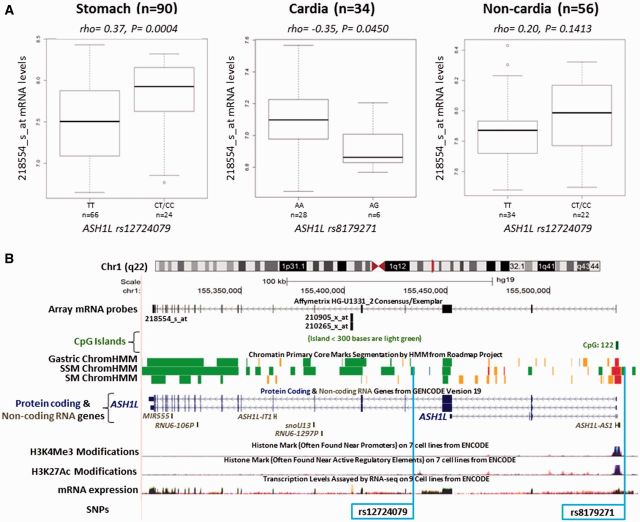
Results: Suggestive pathway-based associations were observed for the overall epigenetic (P-value(PATH) = 0.034) and chromatin remodelling (P-value(PATH) = 0.039) pathways with risk of GCA, but not GC, GNCA or ESCC. Overall, 37 different epigenetic machinery genes were associated with risk of one or more upper gastrointestinal (UGI) cancer sites (P-value(GENE )< 0.05), including 14 chromatin remodelling genes whose products are involved in the regulation of HOX genes. We identified a gastric eQTL (rs12724079; rho = 0.37; P = 0.0006) which regulates mRNA expression of ASH1L. Several suggestive eQTLs were also found in oesophageal (rs10898459 in EED), gastric cardia (rs7157322 in DICER1; rs8179271 in ASH1L), and gastric non-cardia (rs1790733 in PPP1CA) tissues.
Conclusions: Results of our analyses provide limited but suggestive evidence for a role of epigenetic gene variation in the aetiology of UGI cancer.
Keywords: DNA methylation; Epigenetics; SNP; chromatin remodelling; gastric cancer; gastric cardia; gastric non-cardia; gene-based; microRNA; oesophageal squamous cell carcinoma; pathway-based.
Published by Oxford University Press on behalf of the International Epidemiological Association 2015. This work is written by US Government employees and is in the public domain in the US.
Figures
References
-
- Ferlay J, Dikshit R, Eser S, et al. GLOBOCAN 2012 v1.0, Cancer Incidence and Mortality Worldwide: IARC CancerBase No. 11. Lyon, France: International Agency for Research on Cancer, 2013.
-
- Ke L. Mortality and incidence trends from esophagus cancer in selected geographic areas of China circa 1970-90. Int J Cancer 2002;102:271–74. - PubMed
-
- Lee CH, Wu DC, Lee JM, et al. Carcinogenetic impact of alcohol intake on squamous cell carcinoma risk of the oesophagus in relation to tobacco smoking. Eur J Cancer 2007;43:1188–99. - PubMed
-
- Pandeya N, Williams G, Green AC, et al. Alcohol consumption and the risks of adenocarcinoma and squamous cell carcinoma of the esophagus. Gastroenterology 2009;136:1215–24, e1–2. - PubMed
-
- Tran GD, Sun XD, Abnet CC, et al. Prospective study of risk factors for oesophageal and gastric cancers in the Linxian general population trial cohort in China. Int J Cancer 2005;113:456–63. - PubMed
Publication types
MeSH terms
Grants and funding
LinkOut - more resources
Full Text Sources
Other Literature Sources
Medical
Miscellaneous
