


Dying in the hospital setting: A systematic review of quantitative studies identifying the elements of end-of-life care that patients and their families rank as being most important
- PMID: 25921707
- PMCID: PMC4572388
- DOI: 10.1177/0269216315583032
Dying in the hospital setting: A systematic review of quantitative studies identifying the elements of end-of-life care that patients and their families rank as being most important
Abstract
Background: The majority of expected deaths occur in hospitals where optimal end-of-life care is not yet fully realised, as evidenced by recent reviews outlining experience of care. Better understanding what patients and their families consider to be the most important elements of inpatient end-of-life care is crucial to addressing this gap.
Aim and design: This systematic review aimed to ascertain the five most important elements of inpatient end-of-life care as identified by patients with palliative care needs and their families.
Data sources: Nine electronic databases from 1990 to 2014 were searched along with key internet search engines and handsearching of included article reference lists. Quality of included studies was appraised by two researchers.
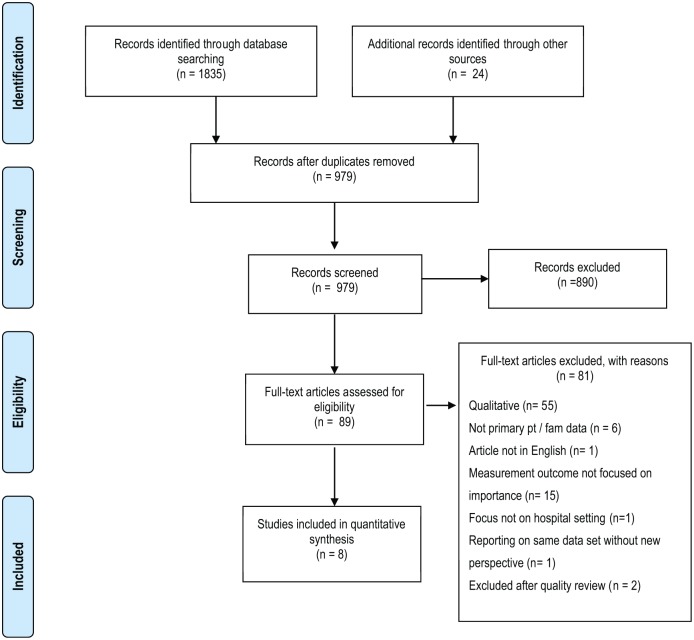
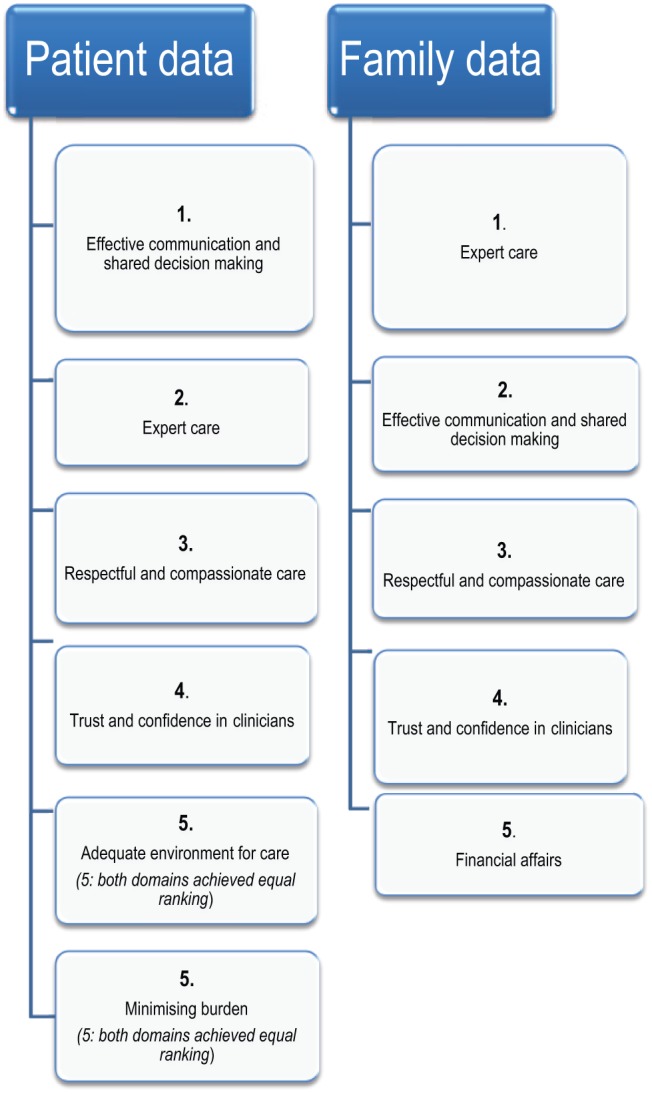
Results: Of 1859 articles, 8 met the inclusion criteria generating data from 1141 patients and 3117 families. Synthesis of the top five elements identified four common end-of-life care domains considered important to both patients and their families, namely, (1) effective communication and shared decision making, (2) expert care, (3) respectful and compassionate care and (4) trust and confidence in clinicians. The final domains differed with financial affairs being important to families, while an adequate environment for care and minimising burden both being important to patients.
Conclusion: This review adds to what has been known for over two decades in relation to patient and family priorities for end-of-life care within the hospital setting. The challenge for health care services is to act on this evidence, reconfigure care systems accordingly and ensure universal access to optimal end-of-life care within hospitals.
Keywords: Palliative care; consumer participation; hospital; satisfaction; terminal care.
© The Author(s) 2015.
Conflict of interest statement
Figures
Comment in
-
Palliative care in hospital: Why is it so difficult?Palliat Med. 2015 Oct;29(9):770-3. doi: 10.1177/0269216315600996. Epub 2015 Sep 1. Palliat Med. 2015. PMID: 26330453 No abstract available.
References
-
- Billingham MJ, Billingham SJ. Congruence between preferred and actual place of death according to the presence of malignant or non-malignant disease: a systematic review and meta-analysis. BMJ Support Palliat Care 2013; 3: 144–154. - PubMed
-
- Broad JB, Gott M, Kim H, et al. Where do people die? An international comparison of the percentage of deaths occurring in hospital and residential aged care settings in 45 populations, using published and available statistics. Int J Public Health 2013; 58: 257–267. - PubMed
-
- Tang ST, Chen C-H. Place of death and end-of-life care. In: Cohen J, Deliens L. (eds) A public health perspective on end of life care. New York: Oxford University Press, 2012, pp. 21–34.
-
- To T, Greene A, Agar M, et al. A point prevalence survey of hospital inpatients to define the proportion with palliation as the primary goal of care and the need for specialist palliative care. Intern Med J 2011; 41: 430–433. - PubMed
-
- Gott CM, Ahmedzai SH, Wood C. How many inpatients at an acute hospital have palliative care needs? Comparing the perspectives of medical and nursing staff. Palliat Med 2001; 15: 451–460. - PubMed
Publication types
MeSH terms
LinkOut - more resources
Full Text Sources
Other Literature Sources
Medical
Miscellaneous
