. 2015;16 Suppl 1(Suppl 1):S9.
doi: 10.1186/1471-2164-16-S1-S9. Epub 2015 Jan 15.

Use of both cumulus cells' transcriptomic markers and zona pellucida birefringence to select developmentally competent oocytes in human assisted reproductive technologies

Use of both cumulus cells' transcriptomic markers and zona pellucida birefringence to select developmentally competent oocytes in human assisted reproductive technologies

Mourad Assidi et al. BMC Genomics. 2015.

Abstract

Background: Selection of the best oocyte for subsequent steps of fertilization and embryo transfer was shown to be the crucial step in human infertility treatment procedure. Oocyte selection using morphological criteria mainly Zona pellucida (ZP) has been the gold standard method in assisted reproductive technologies (ART) clinics, but this selection approach has limitations in terms of accuracy, objectivity and constancy. Recent studies using OMICs-based approaches have allowed the identification of key molecular markers that quantitatively and non-invasively predict the oocyte quality for higher pregnancy rates and efficient infertility treatment. These biomarkers are a valuable reinforcement of the morphological selection criteria widely used in in vitro fertilization (IVF) clinics. In this context, this study was designed to investigate the relationship between transcriptomic predictors of oocyte quality found by our group and the conventional morphological parameters of oocyte quality mainly the ZP birefringence.

Results: Microarray data revealed that 48 and 27 differentially expressed candidate genes in cumulus cells (CCs) were respectively overexpressed and underexpressed in the ZGP (Zona Good Pregnant) versus ZBNP (Zona Bad Non Pregnant) groups. More than 70% of previously reported transcriptomic biomarkers of oocyte developmental competence were confirmed in this study. The analysis of possible association between ZP birefringence versus molecular markers approach showed an absence of correlation between them using the current set of markers.

Conclusions: This study suggested a new integrative approach that matches morphological and molecular approaches used to select developmentally competent oocytes able to lead to successful pregnancy and the delivery of healthy baby. For each ZP birefringence score, oocytes displayed a particular CCs' gene expression pattern. However, no correlations were found between the 7 gene biomarkers of oocyte developmental potential and the ZP birefringence score. Further studies using larger lists of candidate markers are required to identify suitable genes that are highly correlated with the morphological criteria, and therefore able to reinforce the accuracy of oocyte selection and the effectiveness of infertility treatment.


Figures

Figure 1
Figure 1
Real-time PCR analysis of differentially expressed genes in individual CCs of ZGP group versus ZBNP. Gene candidates were ranked according to their p-values, which were determined following a T-test analysis achieved on normalized data at α = 0.05
Figure 2
Figure 2
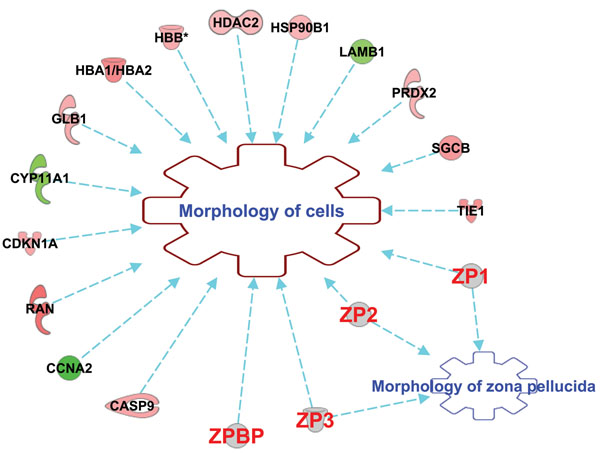
Main candidate genes differentially expressed in CCs and involved in both cell and ZP morphologies as revealed by IPA software. (Red): overexpressed genes. (Green): underexpressed genes. (Gray): ZP genes. Genes are CASP9 (caspase 9), CCNA2 (cyclin A2), RAN (RAN, member RAS oncogene family), CDKN1A (cyclin-dependent kinase inhibitor 1A), CYP11A1 (cytochrome P450, family 11, subfamily A, polypeptide 1), GLB1 (galactosidase, beta 1), HBA1/HBA2 (hemoglobin, alpha 1/ hemoglobin, alpha 2), HBB (hemoglobin, beta), HDAC2 (histone deacetylase 2), HSP90B1 (heat shock protein 90, beta, member 1), LAMB1 (laminin, beta 1), PRDX2 (peroxiredoxin 2), SGCB (sarcoglycan, beta), TIE1 (tyrosine kinase with immunoglobulin-like and EGF-like domains 1), ZP1 (zona pellucida glycoprotein 1 (sperm receptor)), ZP2 (zona pellucida glycoprotein 2 (sperm receptor)), ZP3 (zona pellucida glycoprotein 3 (sperm receptor)), and ZPBP (zona pellucida binding protein).
Figure 3
Figure 3
Gene network of differentially expressed candidates in CCs involved in both cell morphology and intracellular signalling pathways cross-talk. (Red): overexpressed genes. (Green): underexpressed genes. (White): other genes. Overexpressed genes are PRDX2 (peroxiredoxin 2), HBA1/HBA2 (hemoglobin, alpha 1/ hemoglobin, alpha 2), HBB (hemoglobin, beta), RAN (RAN, member RAS oncogene family), CASP9 (caspase 9), HDAC2 (histone deacetylase 2), HSP90B1 (heat shock protein 90, beta, member 1), TIE1 (tyrosine kinase with immunoglobulin-like and EGF-like domains 1), GLB1 (galactosidase, beta 1), CDKN1A (cyclin-dependent kinase inhibitor 1A) and RGS3 (regulator of G-protein signaling 3). Underexpressed genes are CCNA2 (cyclin A2) and CYP11A1 (cytochrome P450, family 11, subfamily A, polypeptide 1). Other genes are ADRB (Adrenoreceptor, Beta), Ck2 (casein Kinase II), PI3K (phosphatidylinositol-4,5-bisphosphate 3-kinase), PKC (protein Kinase C), MAPK and ERK1/2 (mitogen-activated protein kinase family), HSP70 (heat shock protein 70), RNA polymerase II, Insulin, AP1 (activator protein-1), CD3 and LH (luteinizing hormone).
Figure 4
Figure 4
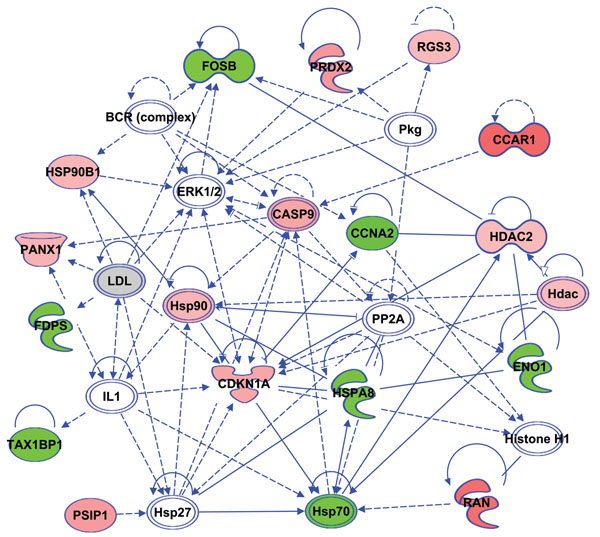
Gene network of several differentially expressed CCs genes involved in both apotosis and anti-inflammatory-like response. (Red): overexpressed genes. (Green): underexpressed genes. (White): other genes. Overexpressed genes are CCAR1 (cell division cycle and apoptosis regulator 1), RGS3 (regulator of G-protein signaling 3), PRDX2 (peroxiredoxin 2), HSP90 / HSP90B1 (heat shock protein 90, beta, member 1), PANX1 (pannexin 1), CASP9 (caspase 9), CDKN1A (cyclin-dependent kinase inhibitor 1A), PSIP1(PC4 and SFRS1 interacting protein 1), RAN (RAN, member RAS oncogene family) and HDAC / HDAC2 (histone deacetylase 2). Underexpressed genes are FOSB (FBJ murine osteosarcoma viral oncogene homolog B), FDPS (farnesyl diphosphate synthetase), TAX1BP1 (Tax1 (human T-cell leukemia virus type I) binding protein 1), HSPA8/ HSP70 (heat shock protein 70 kDa, protein 8), CCNA2 (cyclin A2) and ENO1 (Enolase 1, alpha). The other genes of the network are ERK1/2 (Extracellular signal-regulated kinase 1 /2, mitogen-activated protein kinase family), HSP27 (heat shock 27kDa protein), BCR (complex) (B-cell receptor complex), PP2A (protein phosphatase type 2a), Histone H1, PKG (protein kinase G), LDL (low density lipoprotein) and IL1 (interleukin 1).
Figure 5
Figure 5
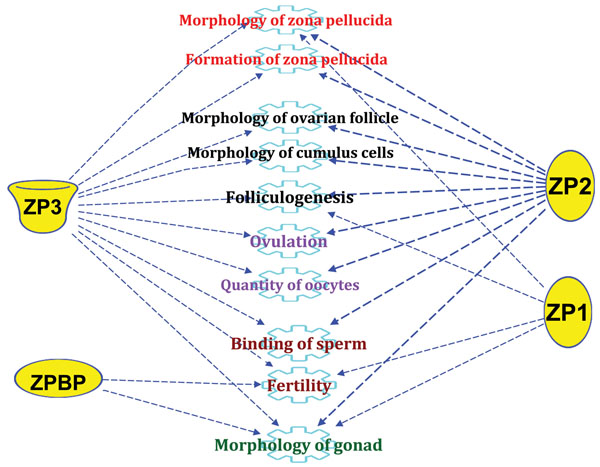
Main ZP genes’ functions related to ovarian function and oocyte quality following a functional analysis using the IPA software. ZP1 (zona pellucida glycoprotein 1 (sperm receptor)), ZP2 (zona pellucida glycoprotein 2 (sperm receptor)), ZP3 (zona pellucida glycoprotein 3 (sperm receptor)), and ZPBP (zona pellucida binding protein).
Figure 6
Figure 6
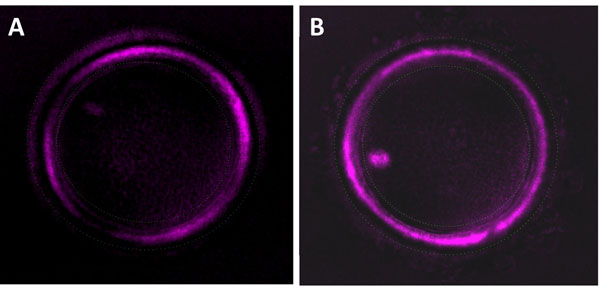
ZP birefringence classes as shown by the polscope. (A): is a low zona birefringence MII oocyte (LZB); (B): is a high zona birefringence MII oocyte (HZB).
Figure 7
Figure 7
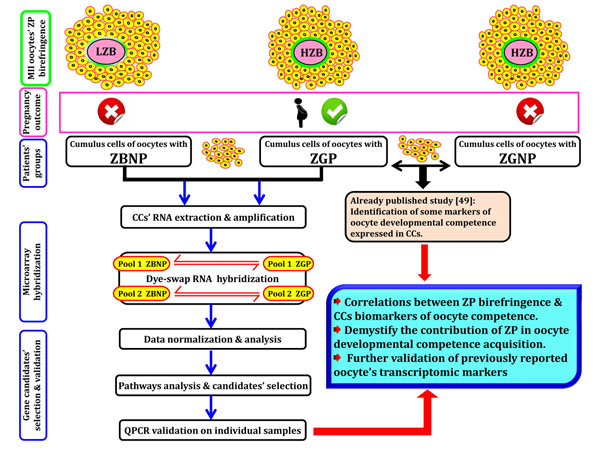
Study’s experimental design

References

    1. Zegers-Hochschild F, Adamson GD, de Mouzon J, Ishihara O, Mansour R, Nygren K, Sullivan E, Vanderpoel S. International Committee for Monitoring Assisted Reproductive Technology (ICMART) and the World Health Organization (WHO) revised glossary of ART terminology, 2009. Fertility and sterility. 2009;92(5):1520–1524. doi: 10.1016/j.fertnstert.2009.09.009. - DOI - PubMed
    1. Krisher RL. The effect of oocyte quality on development. J Anim Sci. 2004;82(E-Suppl):E14–23. - PubMed
    1. Feuerstein P, Cadoret V, Dalbies-Tran R, Guerif F, Bidault R, Royere D. Gene expression in human cumulus cells: one approach to oocyte competence. Hum Reprod. 2007;22(12):3069–3077. doi: 10.1093/humrep/dem336. - DOI - PubMed
    1. Sirard M-A, Assidi M. In: Oocyte Physiology and Development in Domestic Animals. Krisher RL, editor. Wiley-Blackwell; 2013. Screening for Oocyte Competence; pp. 191–206.
    1. Sirard MA, Richard F, Blondin P, Robert C. Contribution of the oocyte to embryo quality. Theriogenology. 2006;65(1):126–136. doi: 10.1016/j.theriogenology.2005.09.020. - DOI - PubMed

Publication types