


Differential DNA methylation in umbilical cord blood of infants exposed to mercury and arsenic in utero
- PMID: 25923418
- PMCID: PMC4622995
- DOI: 10.1080/15592294.2015.1046026
Differential DNA methylation in umbilical cord blood of infants exposed to mercury and arsenic in utero
Abstract
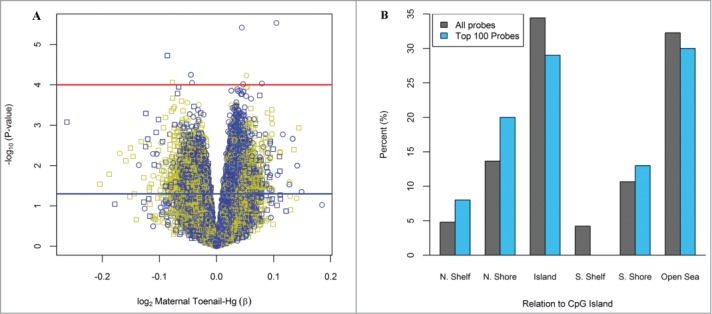
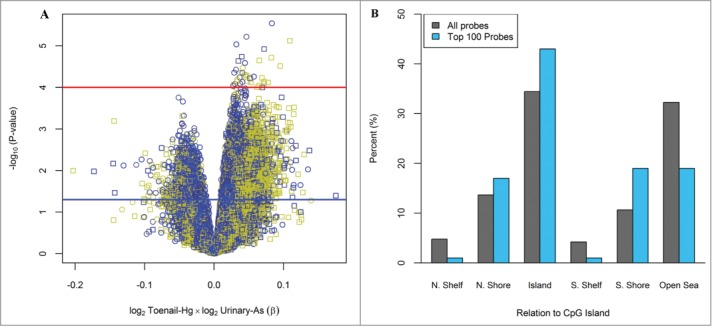
Mercury and arsenic are known developmental toxicants. Prenatal exposures are associated with adverse childhood health outcomes that could be in part mediated by epigenetic alterations that may also contribute to altered immune profiles. In this study, we examined the association between prenatal mercury exposure on both DNA methylation and white blood cell composition of cord blood, and evaluated the interaction with prenatal arsenic exposure. A total of 138 mother-infant pairs with postpartum maternal toenail mercury, prenatal urinary arsenic concentrations, and newborn cord blood were assessed using the Illumina Infinium Methylation450 array. White blood cell composition was inferred from DNA methylation measurements. A doubling in toenail mercury concentration was associated with a 2.5% decrease (95% CI: 5.0%, 1.0%) in the estimated monocyte proportion. An increase of 3.5% (95% CI: 1.0, 7.0) in B-cell proportion was observed for females only. Among the top 100 CpGs associated with toenail mercury levels (ranked on P-value), there was a significant enrichment of loci located in North shore regions of CpG islands (P = 0.049), and the majority of these loci were hypermethylated (85%). Among the top 100 CpGs for the interaction between arsenic and mercury, there was a greater than expected proportion of loci located in CpG islands (P = 0.045) and in South shore regions (P = 0.009) and all of these loci were hypermethylated. This work supports the hypothesis that mercury may be contributing to epigenetic variability and immune cell proportion changes, and suggests that in utero exposure to mercury and arsenic, even at low levels, may interact to impact the epigenome.
Keywords: DNA methylation; arsenic; epigenetics; illumina 450K; in-utero exposure; mercury; neurodevelopment.
Figures
References
-
- Lamborg CH, Hammerschmidt CR, Bowman KL, Swarr GJ, Munson KM, Ohnemus DC, Lam PJ, Heimbürger L-E, Rijkenberg MJ, Saito MA. A global ocean inventory of anthropogenic mercury based on water column measurements. Nature 2014; 512:65-8; PMID:25100482; http://dx.doi.org/10.1038/nature13563 - DOI - PubMed
-
- Tewalt SJ, Bragg LJ, Finkelman RB. Mercury in US Coal: abundance, distribution, and modes of occurrence. USGS Online Publication Directory: USGS, 2001. http://pubs.usgs.gov/fs/fs095-01/fs095-01.pdf.
-
- Vahter M, Åkesson A, Lind B, Björs U, Schütz A, Berglund M. Longitudinal study of methylmercury and inorganic mercury in blood and urine of pregnant and lactating women, as well as in umbilical cord blood. Environ Res 2000; 84:186-94; PMID:11068932; http://dx.doi.org/10.1006/enrs.2000.4098 - DOI - PubMed
-
- Oken E, Choi AL, Karagas MR, Mariën K, Rheinberger CM, Schoeny R, Sunderland E, Korrick S. Which fish should I eat? Perspectives influencing fish consumption choices. Environ Health Perspect 2012; 120:790; PMID:22534056; http://dx.doi.org/10.1289/ehp.1104500 - DOI - PMC - PubMed
-
- Freire C, Ramos R, Lopez-Espinosa M-J, Díez S, Vioque J, Ballester F, Fernández M-F. Hair mercury levels, fish consumption, and cognitive development in preschool children from Granada, Spain. Environ Res 2010; 110:96-104; PMID:19909946; http://dx.doi.org/10.1016/j.envres.2009.10.005 - DOI - PubMed
Publication types
MeSH terms
Substances
Grants and funding
LinkOut - more resources
Full Text Sources
Other Literature Sources
