


The pet factor--companion animals as a conduit for getting to know people, friendship formation and social support
- PMID: 25924013
- PMCID: PMC4414420
- DOI: 10.1371/journal.pone.0122085
The pet factor--companion animals as a conduit for getting to know people, friendship formation and social support
Abstract
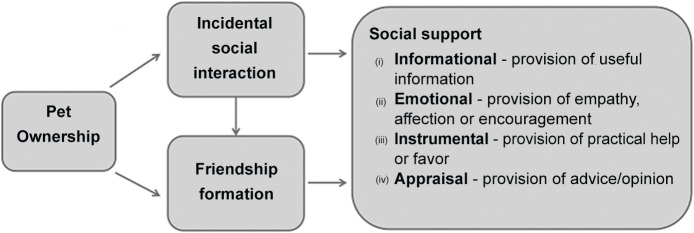
Background: While companion animals have been previously identified as a direct source of companionship and support to their owners, their role as a catalyst for friendship formation or social support networks among humans has received little attention. This study investigated the indirect role of pets as facilitators for three dimensions of social relatedness; getting to know people, friendship formation and social support networks.
Methods: A telephone survey of randomly selected residents in four cities, one in Australia (Perth; n = 704) and three in the U.S. (San Diego, n = 690; Portland, n = 634; Nashville, n = 664) was conducted. All participants were asked about getting to know people within their neighborhood. Pet owners were asked additional questions about the type/s of pet/s they owned, whether they had formed friendships as a result of their pet, and if they had received any of four different types of social support from the people they met through their pet.
Results: Pet owners were significantly more likely to get to know people in their neighborhood than non-pet owners (OR 1.61; 95%CI: 1.30, 1.99). When analyzed by site, this relationship was significant for Perth, San Diego and Nashville. Among pet owners, dog owners in the three U.S. cities (but not Perth) were significantly more likely than owners of other types of pets to regard people whom they met through their pet as a friend (OR 2.59; 95%CI: 1.94, 3.46). Around 40% of pet owners reported receiving one or more types of social support (i.e. emotional, informational, appraisal, instrumental) via people they met through their pet.
Conclusion: This research suggests companion animals can be a catalyst for several dimensions of human social relationships in neighborhood settings, ranging from incidental social interaction and getting to know people, through to formation of new friendships. For many pet owners, their pets also facilitated relationships from which they derived tangible forms of social support, both of a practical and emotionally supportive nature. Given growing evidence for social isolation as a risk factor for mental health, and, conversely, friendships and social support as protective factors for individual and community well-being, pets may be an important factor in developing healthy neighborhoods.
Conflict of interest statement
Figures
References
-
- Allen K, Shykoff B, Izzo J (2001) Pet ownership, but not ace inhibitor therapy, blunts home blood pressure responses to mental stress. Hypertension 38: 815–820. - PubMed
-
- Headey B, Grabka MM (2007) Pets and human health in Germany and Australia: National longitudinal results. Social Indicators Research 80: 297–311.
-
- Wells DL (2007) Domestic dogs and human health: An overview. British journal of health psychology 12: 145–156. - PubMed
-
- Headey B, Na F, Zheng R (2008) Pet dogs benefit owners’ health: A ‘natural experiment’in China. Social Indicators Research 87: 481–493.
Publication types
MeSH terms
LinkOut - more resources
Full Text Sources
Other Literature Sources
Medical
Miscellaneous
