


High genetic risk individuals benefit less from resistance exercise intervention
- PMID: 25924711
- PMCID: PMC4564316
- DOI: 10.1038/ijo.2015.78
High genetic risk individuals benefit less from resistance exercise intervention
Abstract
Objectives: Genetic factors have an important role in body mass index (BMI) variation, and also likely have a role in the weight loss and body composition response to physical activity/exercise. With the recent identification of BMI-associated genetic variants, it is possible to investigate the interaction of these genetic factors with exercise on body composition outcomes.
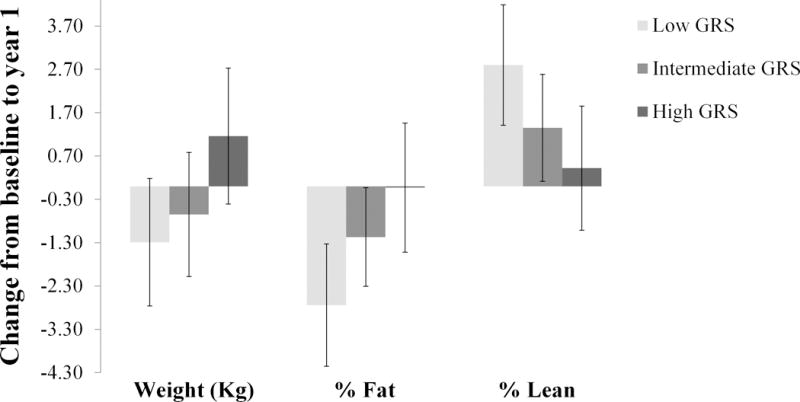
Methods: In a block-randomized clinical trial of resistance exercise among women (n=148), we examined whether the putative effect of exercise on weight and dual-energy x-ray absorptiometry-derived body composition measurements differs according to genetic risk for obesity. Approximately one-half of the sample was randomized to an intervention consisting of a supervised, intensive, resistance exercise program, lasting 1 year. Genetic risk for obesity was defined as a genetic risk score (GRS) comprised of 21 single-nucleotide polymorphisms (SNPs) known to be associated with BMI variation. We examined the interaction of exercise intervention and the GRS on anthropometric and body composition measurements after 1 year of the exercise intervention.
Results: We found statistically significant interactions for body weight (P=0.01), body fat (P=0.01), body fat % (P=0.02) and abdominal fat (P=0.02), whereby the putative effect of exercise is greater among those with a lower level of genetic risk for obesity. No single SNP appears to be a major driver of these interactions.
Conclusions: The weight-loss response to resistance exercise, including changes in body composition, differs according to an individual's genetic risk for obesity.
Conflict of interest statement
Figures
References
-
- Teixeira PJ, Going SB, Houtkooper LB, Metcalfe LL, Blew RM, Flint-Wagner HG, et al. Resistance training in postmenopausal women with and without hormone therapy. Med Sci Sports Exerc. 2003;35(4):555–62. - PubMed
-
- Stunkard AJ, Harris JR, Pedersen NL, McClearn GE. N Engl J Med [Internet] Department of Psychiatry, University of Pennsylvania; Philadelphia: 1990. May 24, The body-mass index of twins who have been reared apart. 322(0028-4793 (Print) LA – eng PT – Journal Article PT – Research Support, Non-U.S. Gov’t PT – Research Support, U.S. Gov’t, P.H.S SB – AIM SB – IM):1483–7. - PubMed
-
- Bouchard C, Dionne F, Simoneau J, Boulay M. Genetics of aerobic and anaerobic performances. Exerc Sport Sci Rev. 1992;20:27–58. - PubMed
-
- Bouchard C, Rankinen T. Individual differences in response to regular physical activity. Med Sci Sports Exerc. 2001;33(6 Suppl):S446–51. discussion S452–3. - PubMed
Publication types
MeSH terms
Grants and funding
LinkOut - more resources
Full Text Sources
Other Literature Sources
Medical
