


Predicting childhood effortful control from interactions between early parenting quality and children's dopamine transporter gene haplotypes
- PMID: 25924976
- PMCID: PMC4627898
- DOI: 10.1017/S0954579415000383
Predicting childhood effortful control from interactions between early parenting quality and children's dopamine transporter gene haplotypes
Abstract
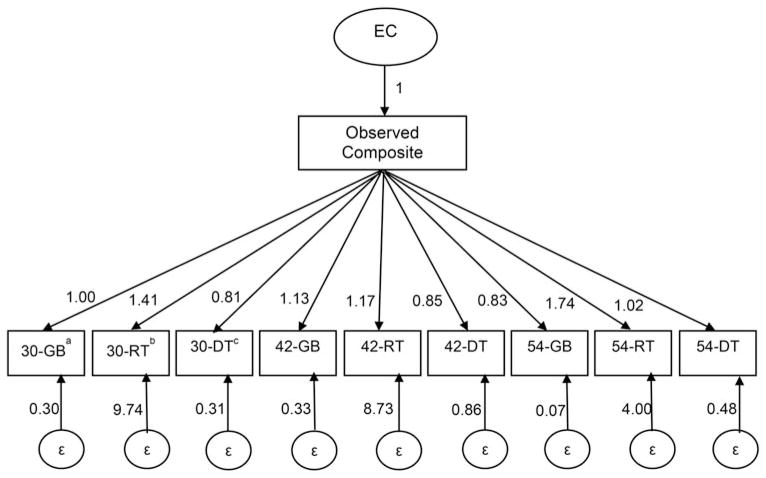
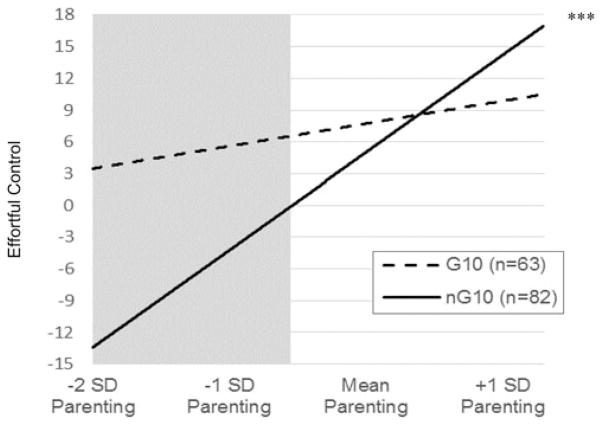
Children's observed effortful control (EC) at 30, 42, and 54 months (n = 145) was predicted from the interaction between mothers' observed parenting with their 30-month-olds and three variants of the solute carrier family C6, member 3 (SLC6A3) dopamine transporter gene (single nucleotide polymorphisms in intron8 and intron13, and a 40 base pair variable number tandem repeat [VNTR] in the 3'-untranslated region [UTR]), as well as haplotypes of these variants. Significant moderating effects were found. Children without the intron8-A/intron13-G, intron8-A/3'-UTR VNTR-10, or intron13-G/3'-UTR VNTR-10 haplotypes (i.e., haplotypes associated with the reduced SLC6A3 gene expression and thus lower dopamine functioning) appeared to demonstrate altered levels of EC as a function of maternal parenting quality, whereas children with these haplotypes demonstrated a similar EC level regardless of the parenting quality. Children with these haplotypes demonstrated a trade-off, such that they showed higher EC, relative to their counterparts without these haplotypes, when exposed to less supportive maternal parenting. The findings revealed a diathesis-stress pattern and suggested that different SLC6A3 haplotypes, but not single variants, might represent different levels of young children's sensitivity/responsivity to early parenting.
Figures


References
-
- Arbuckle JL. Full information estimation in the presence of incomplete data. In: Marcoulides GA, Schumacker RE, editors. Advanced structural equation modeling: Issues and techniques. Mahwah, NJ: Erlbaum; 1996. pp. 243–277.
-
- Asherson P, Brookes K, Franke B, Chen W, Gill M, Ebstein RP, et al. Confirmation that a specific haplotype of the dopamine transporter gene is associated with combined-type ADHD. American Journal of Psychiatry. 2007;164:674–677. - PubMed
-
- Bakermans-Kranenburg MJ, Dobrova-Krol N, van IJzendoorn M. Impact of institutional care on attachment disorganization and insecurity of Ukrainian preschoolers: Protective effect of the long variant of the serotonin transporter gene (5HTT) International Journal of Behavioral Development. 2012;36:11–18.
-
- Bannon MJ, Whitty CJ. Age-related and regional differences in dopamine transporter mRNA expression in human midbrain. Neurology. 1997;48:969–977. - PubMed
Publication types
MeSH terms
Substances
Grants and funding
LinkOut - more resources
Full Text Sources
Medical
