


Interfacing microbial styrene production with a biocompatible cyclopropanation reaction
- PMID: 25925138
- PMCID: PMC4494747
- DOI: 10.1002/anie.201502185
Interfacing microbial styrene production with a biocompatible cyclopropanation reaction
Abstract
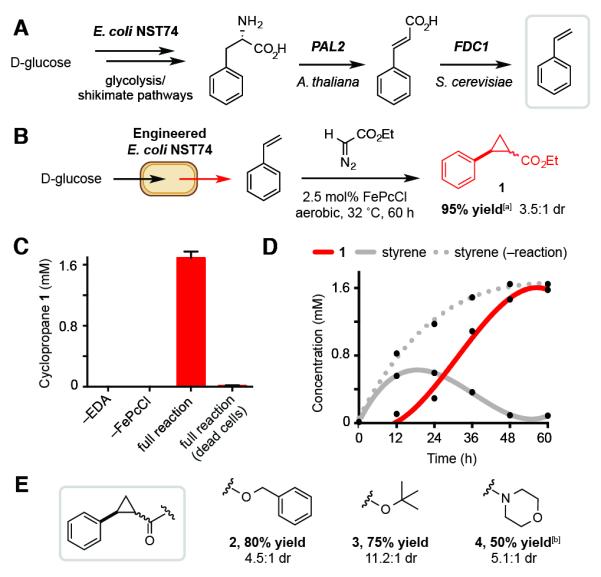
The introduction of new reactivity into living organisms is a major challenge in synthetic biology. Despite an increasing interest in both the development of small-molecule catalysts that are compatible with aqueous media and the engineering of enzymes to perform new chemistry in vitro, the integration of non-native reactivity into metabolic pathways for small-molecule production has been underexplored. Herein we report a biocompatible iron(III) phthalocyanine catalyst capable of efficient olefin cyclopropanation in the presence of a living microorganism. By interfacing this catalyst with E. coli engineered to produce styrene, we synthesized non-natural phenyl cyclopropanes directly from D-glucose in single-vessel fermentations. This process is the first example of the combination of nonbiological carbene-transfer reactivity with cellular metabolism for small-molecule production.
Keywords: iron; metabolism; phthalocyanine; synthetic biology; synthetic methods.
© 2015 WILEY-VCH Verlag GmbH & Co. KGaA, Weinheim.
Figures
References
-
- Keasling J. Science. 2010;330:1355–1358. - PubMed
- Lee JW, Na D, Park JM, Lee J, Choi S, Lee SY. Nat. Chem. Biol. 2012;8:536–546. - PubMed
- Becker J, Wittermann C. Angew. Chem. Int. Ed. 2015;54:3328–3350. Angew. Chem.2015, 127, 3383–3407. - PubMed
- Coelho PS, Arnold FH, Lewis JC. In: Comprehensive Organic Synthesis. Molander GA, Knochel P, editors. Vol. 9. Elsevier; Oxford, UK: 2014. pp. 390–420.
-
- Renata H, Wang ZJ, Arnold FH. Angew. Chem. Int. Ed. 2015;54:3351–3367. Angew. Chem.2015, 127, 3408–3426. - PMC - PubMed
- Coelho PS, Brustard EM, Kannan A, Arnold FH. Science. 2013;339:307–309. - PubMed
- McIntosh JA, Coelho PS, Farwell CC, Wang ZJ, Lewis JC, Brown TR, Arnold FH. Angew. Chem. Int. Ed. 2013;52:9309–9312. Angew. Chem.2013, 125, 9479–9482. - PMC - PubMed
- Hyster TK, Farwell CC, Buller AR, McIntosh JA, Arnold FH. J. Am. Chem. Soc. 2014;136:15505–15508. - PMC - PubMed
- Farwell CC, McIntosh JA, Hyster TK, Wang ZJ, Arnold FH. J. Am. Chem. Soc. 2014;136:8766–8771. - PMC - PubMed
- Heel T, McIntosh JA, Dodani SC, Meyerowitz JT, Arnold FH. ChemBioChem. 2014;15:2556–2562. - PMC - PubMed
- Bordeaux M, Tyagi V, Fasan R. Angew. Chem. Int. Ed. 2015;54:1744–1748. Angew. Chem.2015, 127, 1764–1768. - PMC - PubMed
- Singh R, Kolev JN, Sutera PA, Fasan R. ACS Catal. 2015;5:1685–1691. - PMC - PubMed
- Tyagi V, Bonn RB, Fasan R. Chem. Sci. 2015;6:2488–2494. - PMC - PubMed
- Sreenilayam G, Fasan R. Chem. Commun. 2015;51:1532–1534. - PMC - PubMed
-
- Sirasani G, Tong L, Balskus EP. Angew. Chem. Int. Ed. 2014;53:7785–7788. Angew. Chem.2014, 126, 7919–7922. - PMC - PubMed
- Lee Y, Umeano A, Balskus EP. Angew. Chem. Int. Ed. 2013;52:11800–11803. Angew. Chem.2013, 125, 12016–12019. - PMC - PubMed
- Wallace S, Balskus EP. Curr. Opin. Biotechnol. 2014;30:1–8. - PMC - PubMed
- Wallace S, Schultz EE, Balskus EP. Curr. Opin. Chem. Biol. 2015;25:71–79. - PMC - PubMed
-
- Meyer D, Neumann P, Ficner R, Tittmann K. Nat. Chem. Biol. 2013;9:488–490. - PubMed
Publication types
MeSH terms
Substances
Grants and funding
LinkOut - more resources
Full Text Sources
Other Literature Sources
