. 2015 May 1:15:335.
doi: 10.1186/s12885-015-1368-9.

Transient elevation of glycolysis confers radio-resistance by facilitating DNA repair in cells

Affiliations

Transient elevation of glycolysis confers radio-resistance by facilitating DNA repair in cells

Anant Narayan Bhatt et al. BMC Cancer. .

Abstract

Background: Cancer cells exhibit increased glycolysis for ATP production (the Warburg effect) and macromolecular biosynthesis; it is also linked with therapeutic resistance that is generally associated with compromised respiratory metabolism. Molecular mechanisms underlying radio-resistance linked to elevated glycolysis remain incompletely understood.

Methods: We stimulated glycolysis using mitochondrial respiratory modifiers (MRMs viz. di-nitro phenol, DNP; Photosan-3, PS3; Methylene blue, MB) in established human cell lines (HEK293, BMG-1 and OCT-1). Glucose utilization and lactate production, levels of glucose transporters and glycolytic enzymes were investigated as indices of glycolysis. Clonogenic survival, DNA repair and cytogenetic damage were studied as parameters of radiation response.

Results: MRMs induced the glycolysis by enhancing the levels of two important regulators of glucose metabolism GLUT-1 and HK-II and resulted in 2 fold increase in glucose consumption and lactate production. This increase in glycolysis resulted in resistance against radiation-induced cell death (clonogenic survival) in different cell lines at an absorbed dose of 5 Gy. Inhibition of glucose uptake and glycolysis (using fasentin, 2-deoxy-D-glucose and 3-bromopyruvate) in DNP treated cells failed to increase the clonogenic survival of irradiated cells, suggesting that radio-resistance linked to inhibition of mitochondrial respiration is glycolysis dependent. Elevated glycolysis also facilitated rejoining of radiation-induced DNA strand breaks by activating both non-homologous end joining (NHEJ) and homologous recombination (HR) pathways of DNA double strand break repair leading to a reduction in radiation-induced cytogenetic damage (micronuclei formation) in these cells.

Conclusions: These findings suggest that enhanced glycolysis generally observed in cancer cells may be responsible for the radio-resistance, partly by enhancing the repair of DNA damage.


Figures
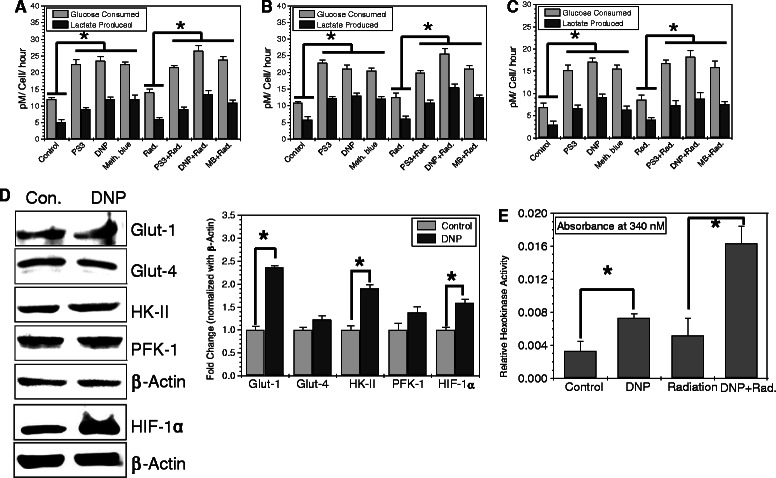
Figure 1
Figure 1
Mitochondrial respiratory modifiers (MRMs; PS3, DNP & MB) induces glycolysis. Glucose consumption and lactate production observed every hour till 4 hours of the drug treatment is presented as average per hour in BMG-1 (A), OCT-1 (B) and HEK293 (C) cells. (D) Protein expression profile of glucose transporter, glycolytic enzymes and transcriptional regulator of glycolysis HIF1α is shown in BMG-1 cells. The data shows western blots and their derived quantitative values from the densitometry. (E) Relative hexokinase enzymatic activity in un-irradiated and irradiated (5 Gy γ-rays) BMG-1 cells is presented as absorbance at 340 nm obtained from coupled enzymatic assay. The concentration of different treatments used was as follows, PS3, 25 μg/ml; DNP, 1 μM; MB, 25 μM. The data shown are the mean values (±1 SD) of nine observations from three independent experiments. Statistical significance *p < 0.05.
Figure 2
Figure 2
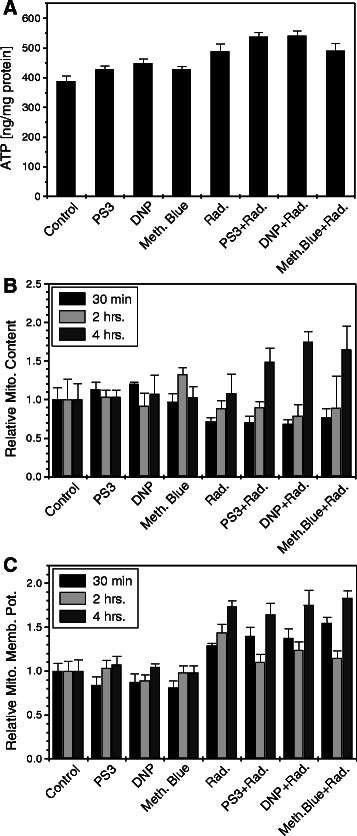
MRMs did not induce differential changes in energy and mitochondrial status in either un-irradiated or irradiated (5 Gy γ-rays) BMG-1 cells. (A) Shows MRMs induced glycolysis compensate the ATP production, equally in all the modifiers. (B) & (C) shows that the effects of MRMs on mitochondrial mass and membrane potential are also similar. The concentrations of different MRMs used were as follows, PS3, 25 μg/ml; DNP, 1 μM; MB, 25 μM.
Figure 3
Figure 3
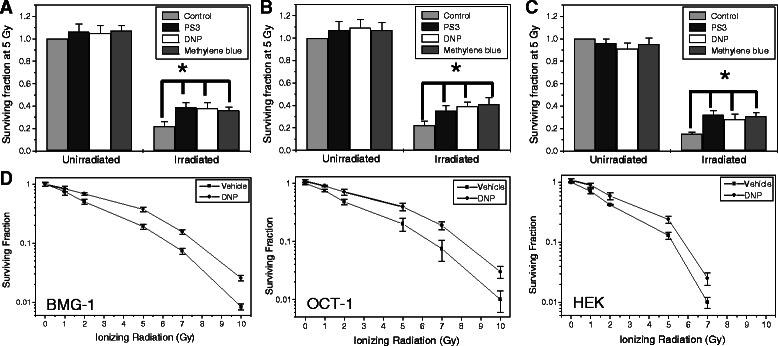
MRMs induces radio-resistance. Enhanced radio-resistance (clonogenic survival; macro-colony assay) observed due to MRMs (PS3, DNP and MB) induced glycolysis in BMG-1 (A), OCT-1 (B) and HEK293 (C). The figure (D) represents the dose response curve of BMG-1, OCT-1 and HEK293 cells against radiation in DNP and vehicle treated cells. The concentrations of MRMs used were as follows, PS3, 25 μg/ml; DNP, 1 μM; MB, 25 μM. After treatment cells were incubated for 4 hours in liquid holding before plating for macro colony formation. Surviving fraction of un-irradiated and irradiated samples was calculated by considering the plating efficiency of un-irradiated control as 1. The data shown are the mean values (±1 SD) of nine observations from three independent experiments. Statistical significance *p < 0.05.
Figure 4
Figure 4
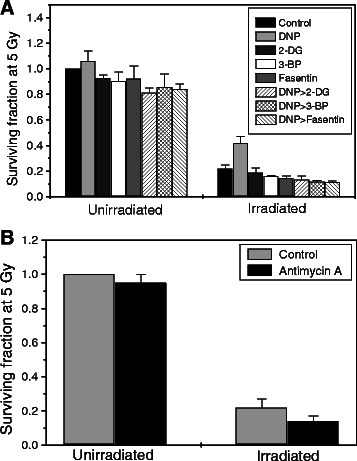
Glycolytic inhibitors reverse MRMs induced radio-resistance. Inhibition of glycolysis by 2-DG (5 mM), 3-BP (5 μM) and fasentin (25 μM) followed by DNP treatment before irradiation (5 Gy) reverses glycolysis induced radio-resistance in BMG-1 cells (A). Both DNP and inhibitors of glycolysis/ glucose transporter were added simultaneously before irradiation. Inhibition of mitochondrial respiration without up-regulating glycolysis (using 5 μg/ ml Antimycin A) does not confer radio-resistance in BMG-1 cells (B). The data shown are the mean values (±1 SD) of nine observations from three independent experiments. Differences were statistically significant (*p < 0.05).
Figure 5
Figure 5
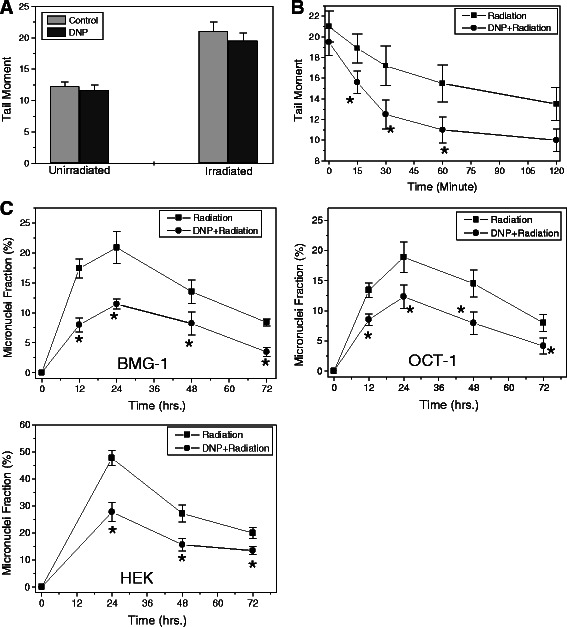
DNP induced glycolysis facilitates repair of radiation-induced DNA double strand breaks. Effects of DNP (1 μM) induced glycolysis on the induction (A) and kinetics of repair (B) of radiation (5 Gy) induced DNA damage assayed using single-cell gel electrophoresis in BMG-1 cells. (C) Reduction in the radiation induced cytogenetic damage (micronuclei expression) observed in glycolysis stimulated (DNP treated) BMG-1, OCT-1 and HEK293 cells. The data shown are the mean values (±1 SD) of three independent experiments. Differences were statistically significant (*p < 0.05).
Figure 6
Figure 6
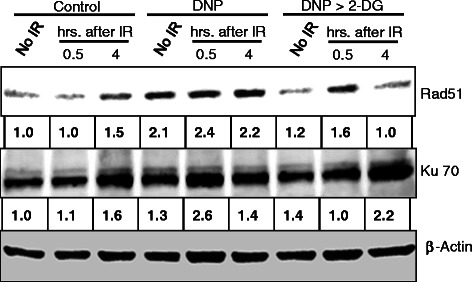
Time dependent changes in the levels of DNA repair proteins (Rad51 and Ku-70) observed following irradiation (5 Gy) showing the effects of DNP (1 μM) and DNP > 2-DG (5 mM) in BMG-1 cells. Numbers shown below the bands in the western blots represent the values normalized with respective β-actin using densitometry on Imagequant 5.2 program and represents the fold change relative to unirradiated control of each group.

References

    1. Haffty BG, Glazer PM. Molecular markers in clinical radiation oncology. Oncogene. 2003;22:5915–25. doi: 10.1038/sj.onc.1206704. - DOI - PubMed
    1. Gatenby RA, Gillies RJ. Why do cancers have high aerobic glycolysis? Nat Rev Cancer. 2004;4:891–9. doi: 10.1038/nrc1478. - DOI - PubMed
    1. Simonnet H, Alazard N, Pfeiffer K, Gallou C, Beroud C, Demont J, et al. Low mitochondrial respiratory chain content correlates with tumor aggressiveness in renal cell carcinoma. Carcinogenesis. 2002;23:759–68. doi: 10.1093/carcin/23.5.759. - DOI - PubMed
    1. Santamaria G, Martinez-Diez M, Fabregat I, Cuezva JM. Efficient execution of cell death in non-glycolytic cells requires the generation of ROS controlled by the activity of mitochondrial H-ATP synthase. Carcinogenesis. 2006;27:925–35. doi: 10.1093/carcin/bgi315. - DOI - PubMed
    1. Schwaab J, Horisberger K, Ströbel P, Bohn B, Gencer D, Kähler G, et al. Erben Expression of Transketolase like gene 1 (TKTL1) predicts disease-free survival in patients with locally advanced rectal cancer receiving neoadjuvant chemoradiotherapy. BMC Cancer. 2011;11:363. doi: 10.1186/1471-2407-11-363. - DOI - PMC - PubMed

Publication types