


Adherence to multiple micronutrient powder among young children in rural Bangladesh: a cross-sectional study
- PMID: 25925874
- PMCID: PMC4424501
- DOI: 10.1186/s12889-015-1752-z
Adherence to multiple micronutrient powder among young children in rural Bangladesh: a cross-sectional study
Abstract
Background: Multiple micronutrient powder (MMNP) can be sprinkled onto any semisolid food and can be given to young children to address iron deficiency anemia. The female community health volunteers of BRAC (an NGO) known as Shasthya Shebikas (SS) sell MMNP sachets during their regular household visits. Currently there are no data on adherence or real uptake of MMNP by children. The objective of the study was to assess adherence to MMNP and associated factors among children aged 6-59 months in rural Bangladesh.
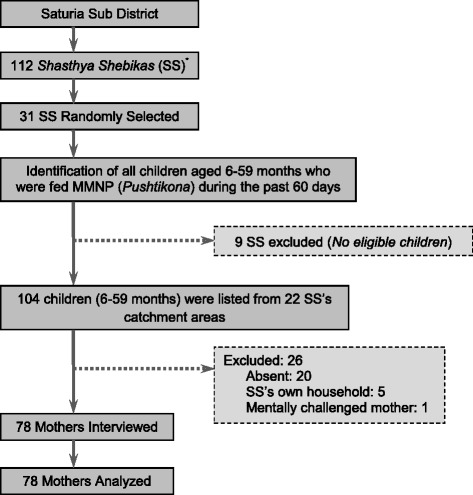
Methods: A cross sectional study was conducted in Saturia Sub-district among 78 children aged 6-59 months who were fed MMNP supplied by BRAC SS in the past 60 days. A one stage cluster sampling technique was used to select mothers with eligible children. Semi-structured questionnaire was used for interviews. A logistic regression model was developed to obtain adjusted odds ratios (AOR) with 95% CI.
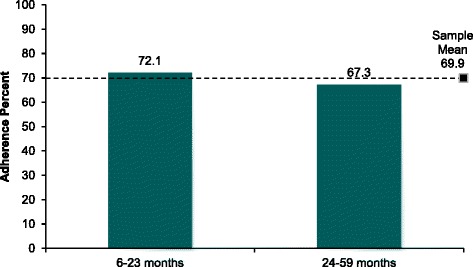
Results: Sample mean adherence was calculated to be 70%. In multivariate analysis, age of mother in years (AOR = 0.74, 95% CI: 0.61-0.88), households belonging to poorer (AOR = 0.01, 95% CI: 0.00-0.68), middle (AOR = 0.04, 95% CI: 0.00-0.35) and richer (AOR = 0.11, 95% CI: 0.01-0.84) wealth quintiles and mothers who prefer to feed flexibly (AOR = 0.03, 95% CI: 0.00-0.26) were significantly associated with high adherence. Further, for every one unit increase in visit by BRAC SS in the past 60 days, the odds of having high adherence significantly increased by 55% (AOR = 1.55, 95% CI: 1.09-2.20).
Conclusions: SS are the key to improving adherence through regular visits to households of MMNP users. However, expanding coverage beyond the vicinity of the SS's household is a challenge. Perception of families whose children have low adherence should be studied.
Figures
References
-
- De Benoist B, McLean E, Egli I, Cogswell M. Worldwide prevalence of anaemia 1993–2005: WHO global database on anaemia. Geneva: World Health Organization; 2008.
-
- Micronutrient deficiencies: Iron deficiency anaemia [http://www.who.int/nutrition/topics/ida/en/index.html].
-
- Grantham-McGregor S, Ani C. A review of studies on the effect of iron deficiency on cognitive development in children. J Nutr. 2001;131(2S-2):649S–666S. - PubMed
-
- Lozoff B, De Andraca I, Castillo M, Smith JB, Walter T, Pino P. Behavioral and developmental effects of preventing iron-deficiency anemia in healthy full-term infants. Pediatrics. 2003;112(4):846–854. - PubMed
MeSH terms
Substances
LinkOut - more resources
Full Text Sources
Other Literature Sources
Medical
Miscellaneous
