. 2015 Apr 19:13:154.
doi: 10.1186/s12957-015-0563-0.

An automatically contamination-avoiding technique for intracorporeal esophagojejunostomy using a transorally inserted anvil during laparoscopic total gastrectomy for gastric cancer

Affiliations

An automatically contamination-avoiding technique for intracorporeal esophagojejunostomy using a transorally inserted anvil during laparoscopic total gastrectomy for gastric cancer

Yan-Feng Hu et al. World J Surg Oncol. .

Abstract

Background: Intracorporeal Roux-en-Y esophagojejunostomy during laparoscopic total gastrectomy for gastric cancer remains a challenging manipulation due to the uncontrolled direction of the jejunal side or unintended embedded tissues, although several methods have been introduced. In this study, we simplified the procedure based on a surgical string fixing technique using a transorally inserted anvil (OrVil™; Covidien Ltd., Mansfield, MA, USA).

Methods: From March 2012 to September 2013, 14 consecutive patients underwent simplified intracorporeal Roux-en-Y esophagojejunostomy using OrVil™ during laparoscopic total gastrectomy for gastric cancer at our hospital. Clinicopathologic characteristics and surgical outcomes of these patients were retrospectively analyzed.

Results: All of the procedures were successful completed with no complication or conversion to open surgery. The mean overall operative time was 193.8 ± 41.8 min, whereas the mean reconstruction time was 32.6 ± 4.6 min. The mean estimated blood loss was 105.7 ± 65.4 ml. The mean diameter of anastomosis measured by upper gastrointestinal contrast X-ray test at 1 month after operation was 2.3 cm. During a median follow-up period of 12 months, neither local recurrence nor anastomosis-related morbidity was observed.

Conclusions: Our preliminary results suggested that this automatically contamination-avoiding technique based on a surgical-string-fixing strategy using OrVil™ during laparoscopic total gastrectomy for gastric cancer might be feasible and safe and provide a simple solution for intracorporeal Roux-en-Y esophagojejunostomy.


Figures
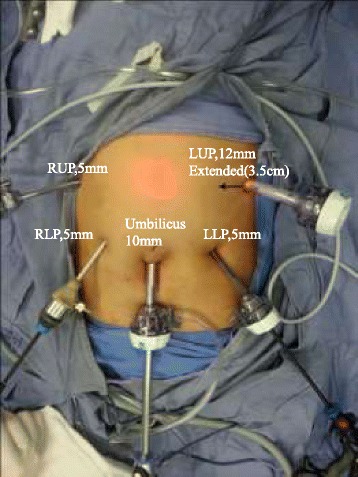
Figure 1
Figure 1
Placement of the trocars. The left upper port site will be extended transversely to an incision length of 3 to 4 cm for extraction of the specimen and insertion of the circular stapler before anastomosis. RUP, right upper port; LUP, left upper port; RLP, right lower port; LLP, left lower port.
Figure 2
Figure 2
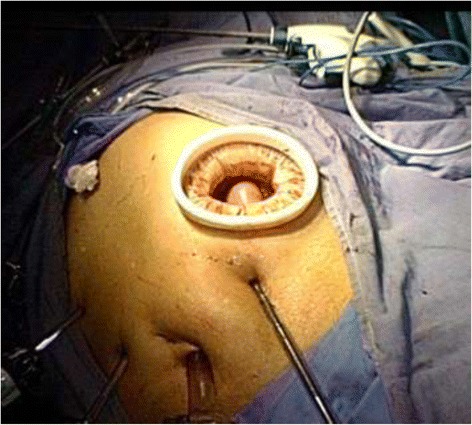
Minilaparotomy at the left upper quadrant for specimen retrieval and stapler insertion.
Figure 3
Figure 3
Placement of the anvil head. (a) The tube of the anvil head was inserted transorally (picture downloaded from the website of Covidien). (b) A small hole was made at the esophageal stump. (c) The thread was cut after fixation of the anvil head.
Figure 4
Figure 4
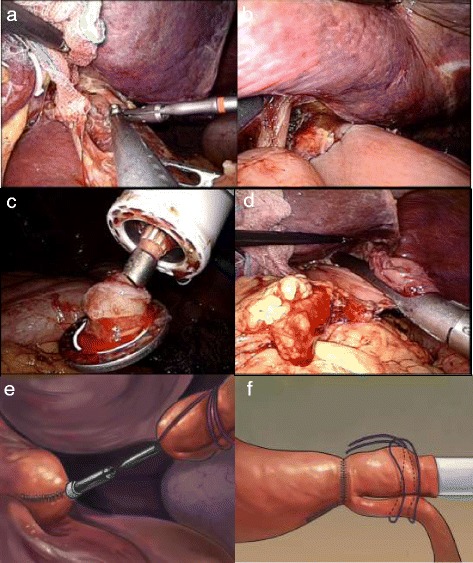
A self-made single-site access system. (a) The circular stapler passed through the glove. (b) The stapler, jejunal stump, and loop were fixed by the silk string. (c) A slipknot was made to fix the shaft. (d) Establishment of the pneumoperitoneum by the self-made single-site access system. (e) Schematic of making a slipknot using a silk string. (f) Schematic of making a surgical knot to the center rod. Red arrow points to the silk suture. The knot was released automatically during firing of the stapler without additional cutting.
Figure 5
Figure 5
Intracorporeal anastomotic technique using a circular stapler. (a) Connection of the shaft and anvil. (b) Approximation of the shaft and anvil. The knot was released automatically during firing of the stapler. (c) The stapler was carefully removed. (d) The jejunal stump was closed using a linear stapler. (e) Schematic of approximation between the anvil and center rod. (f) Schematic of automatically removing an anchoring string during firing.
Figure 6
Figure 6
Upper gastrointestinal contrast X-ray check of esophagojejunostomy at postoperative 1 month.

References

    1. Kinoshita T, Oshiro T, Ito K, Shibasaki H, Okazumi S, Katoh R. Intracorporeal circular-stapled esophagojejunostomy using hand-sewn purse-string suture after laparoscopic total gastrectomy. Surg Endosc. 2010;24:2908–12. doi: 10.1007/s00464-010-1041-y. - DOI - PubMed
    1. Jeong O, Park YK. Intracorporeal circular stapling esophagojejunostomy using the transorally inserted anvil (OrVil™) after laparoscopic total gastrectomy. Surg Endosc. 2009;23:2624–30. doi: 10.1007/s00464-009-0461-z. - DOI - PubMed
    1. Nagai E, Ohuchida K, Nakata K, Miyasaka Y, Maeyama R, Toma H, et al. Feasibility and safety of intracorporeal esophagojejunostomy after laparoscopic total gastrectomy: inverted T-shaped anastomosis using linear staplers. Surgery. 2013;153:732–8. doi: 10.1016/j.surg.2012.10.012. - DOI - PubMed
    1. Kim HI, Cho I, Jang DS, Hyung WJ. Intracorporeal esophagojejunostomy using a circular stapler with a new purse-string suture technique during laparoscopic total gastrectomy. J Am Coll Surg. 2013;216:e11–6. doi: 10.1016/j.jamcollsurg.2012.10.008. - DOI - PubMed
    1. Kunisaki C, Makino H, Oshima T, Fujii S, Kimura J, Takagawa R, et al. Application of the transorally inserted anvil (OrVil™) after laparoscopy-assisted total gastrectomy. Surg Endosc. 2011;25:1300–5. doi: 10.1007/s00464-010-1367-5. - DOI - PubMed

Publication types