


Efficient Detection of Carbapenemase Activity in Enterobacteriaceae by Matrix-Assisted Laser Desorption Ionization-Time of Flight Mass Spectrometry in Less Than 30 Minutes
- PMID: 25926485
- PMCID: PMC4473196
- DOI: 10.1128/JCM.03467-14
Efficient Detection of Carbapenemase Activity in Enterobacteriaceae by Matrix-Assisted Laser Desorption Ionization-Time of Flight Mass Spectrometry in Less Than 30 Minutes
Abstract
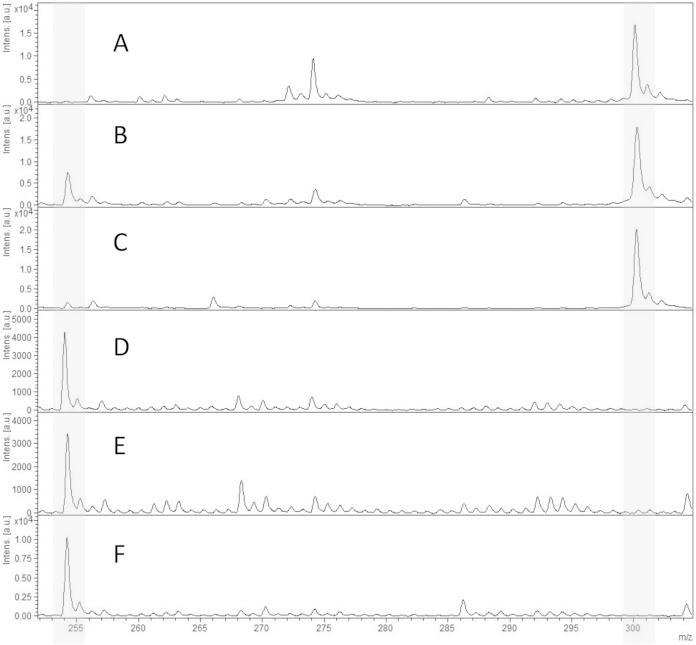
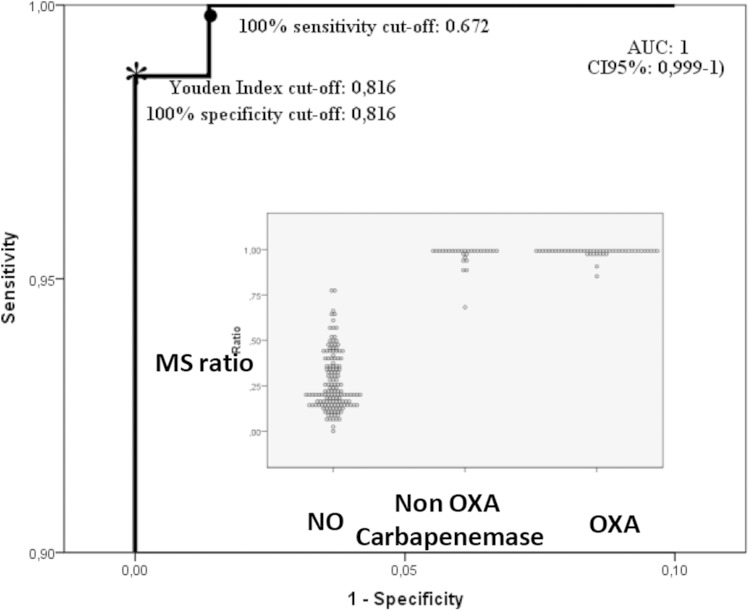
The recognition of carbapenemase-producing Enterobacteriaceae (CPE) isolates is a major laboratory challenge, and their inappropriate or delayed detection may have negative impacts on patient management and on the implementation of infection control measures. We describe here a matrix-assisted laser desorption ionization-time of flight (MALDI-TOF)-based method to detect carbapenemase activity in Enterobacteriaceae. After a 20-min incubation of the isolate with 0.5 mg/ml imipenem at 37°C, supernatants were analyzed by MALDI-TOF in order to identify peaks corresponding to imipenem (300 Da) and an imipenem metabolite (254 Da). A total of 223 strains, 77 CPE (OXA-48 variants, KPC, NDM, VIM, IMI, IMP, and NMC-A) and 146 non-CPE (cephalosporinases, extended-spectrum β-lactamases [ESBLs], and porin defects), were tested and used to calculate a ratio of imipenem hydrolysis: mass spectrometry [MS] ratio = metabolite/(imipenem + metabolite). An MS ratio cutoff was statistically determined to classify strains as carbapenemase producers (MS ratio of ≥0.82). We validated this method first by testing 30 of our 223 isolates (15 CPE and 15 non-CPE) 10 times to calculate an intraclass correlation coefficient (ICC of 0.98), showing the excellent repeatability of the method. Second, 43 strains (25 CPE and 18 non-CPE) different from the 223 strains used to calculate the ratio cutoff were used as external controls and blind tested. They yielded sensitivity and specificity of 100%. The total cost per test is <0.10 U.S. dollars (USD). This easy-to-perform assay is time-saving, cost-efficient, and highly reliable and might be used in any routine laboratory, given the availability of mass spectrometry, to detect CPE.
Copyright © 2015, American Society for Microbiology. All Rights Reserved.
Figures
References
-
- World Health Organization. 2014. Antimicrobial resistance: global report on surveillance. http://www.who.int/drugresistance/documents/surveillancereport/en/.
-
- ECDC/Joint Technical Report EMEA. 2009. The bacterial challenge: time to react. http://www.ecdc.europa.eu/en/publications/Publications/Forms/ECDC_DispFo....
-
- Cantón R, Akova M, Carmeli Y, Giske CG, Glupczynski Y, Gniadkowski M, Livermore DM, Miriagou V, Naas T, Rossolini GM, Samuelsen O, Seifert H, Woodford N, Nordmann P. 2012. Rapid evolution and spread of carbapenemases among Enterobacteriaceae in Europe. Clin Microbiol Infect 18:413–431. doi:10.1111/j.1469-0691.2012.03821.x. - DOI - PubMed
Publication types
MeSH terms
Substances
LinkOut - more resources
Full Text Sources
Other Literature Sources
Research Materials
Miscellaneous
