


Weight bearing or non-weight bearing after surgically fixed ankle fractures, the WOW! Study: study protocol for a randomized controlled trial
- PMID: 25927626
- PMCID: PMC4433015
- DOI: 10.1186/s13063-015-0714-1
Weight bearing or non-weight bearing after surgically fixed ankle fractures, the WOW! Study: study protocol for a randomized controlled trial
Abstract
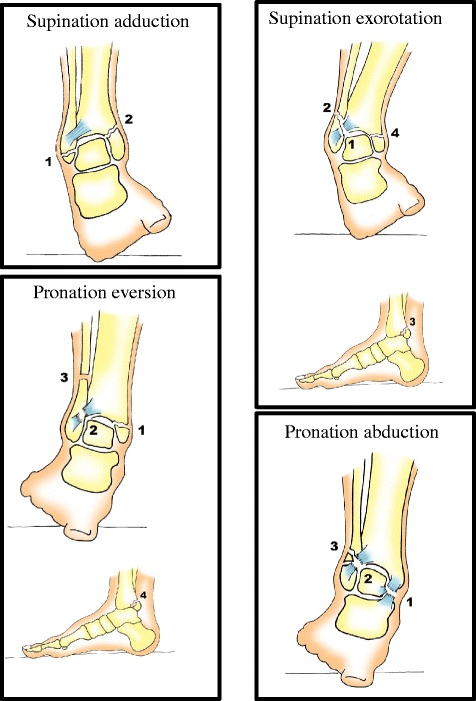
Background: The optimal post-operative care regimen after surgically fixed Lauge Hansen supination exorotation injuries remains to be established. This study compares whether unprotected weight bearing as tolerated is superior to protected weight bearing and unprotected non-weight bearing in terms of functional outcome and safety.
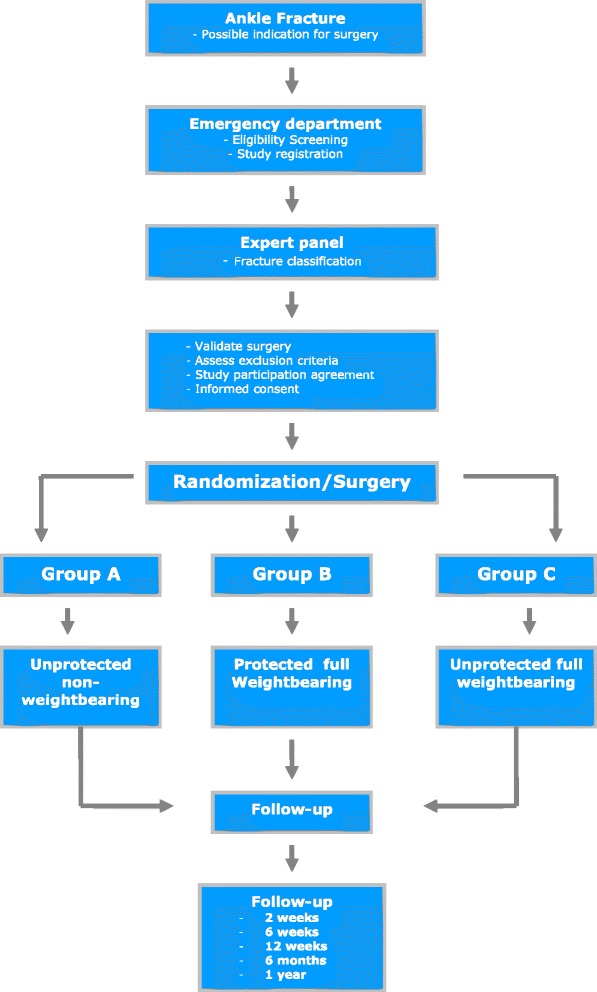
Methods/design: The WOW! Study is a prospective multicenter clinical trial. Patients between 18 and 65 years of age with a Lauge Hansen supination exorotation type 2, 3 or 4 ankle fractures requiring surgical treatment are eligible for inclusion. An expert panel validates the classification and inclusion eligibility. After surgery, patients are randomized to either the 1) unprotected non-weight-bearing, 2) protected weight-bearing, or 3) unprotected weight-bearing group. The primary outcome measure is ankle-specific disability measured by the Olerud-Molander ankle score. Secondary outcomes are 1) quality of life (e.g., return to work and resumption of sport), 2) complications, 3) range of motion, 4) calf wasting, and 5) maximum pressure load after 3 months and 1 year.
Discussion: This trial is designed to compare the effectiveness and safety of unprotected weight bearing with two commonly used post-operative treatment regimens after internal fixation of specified, intrinsically stable but displaced ankle fractures. An expert panel has been established to evaluate every potential subject, which ensures that every patient is strictly screened according to the inclusion and exclusion criteria and that there is a clear indication for surgical fixation.
Trial registration: The WOW! Study is registered in the Dutch Trial Register ( NTR3727 ). Date of registration: 28-11-2012.
Figures
References
-
- Donken CC, Al-Khateeb H, Verhofstad MH, Van Laarhoven CJ. Surgical versus conservative interventions for treating ankle fractures in adults. Cochrane Database Syst Rev. 2012;8 - PubMed
Publication types
MeSH terms
Associated data
LinkOut - more resources
Full Text Sources
Other Literature Sources
Medical
