


Validation of Portuguese version of Quality of Erection Questionnaire (QEQ) and comparison to International Index of Erectile Function (IIEF) and RAND 36-Item Health Survey
- PMID: 25928522
- PMCID: PMC4752069
- DOI: 10.1590/S1677-5538.IBJU.2015.01.21
Validation of Portuguese version of Quality of Erection Questionnaire (QEQ) and comparison to International Index of Erectile Function (IIEF) and RAND 36-Item Health Survey
Abstract
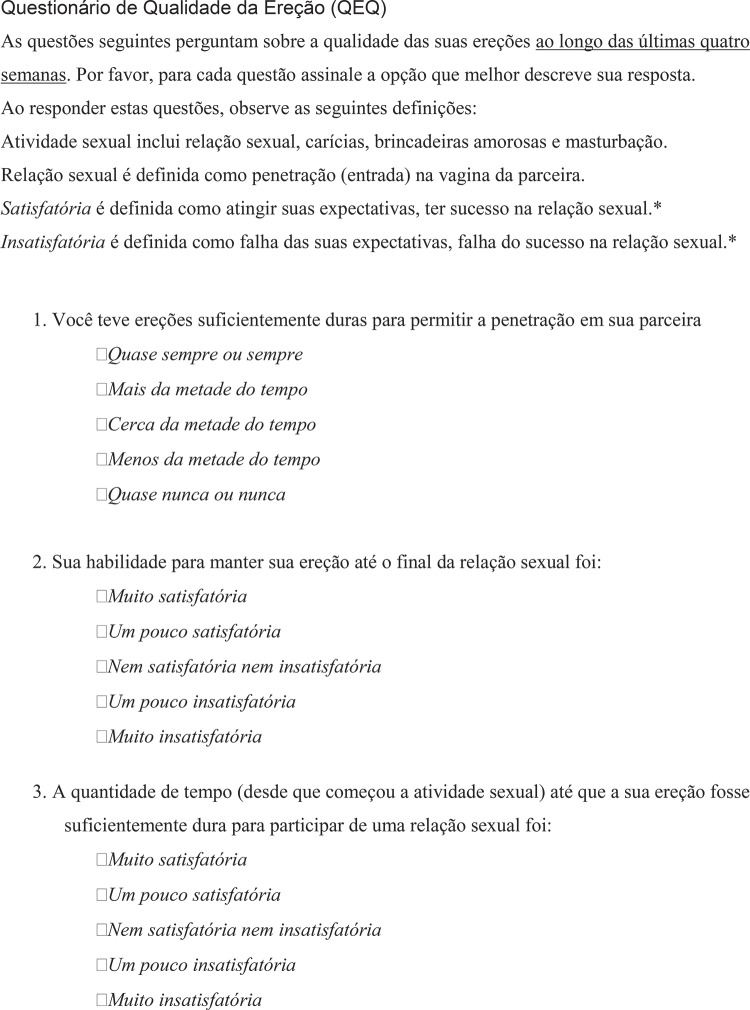
Purpose: To validate the Quality of Erection Questionnaire (QEQ) considering Brazilian social-cultural aspects.
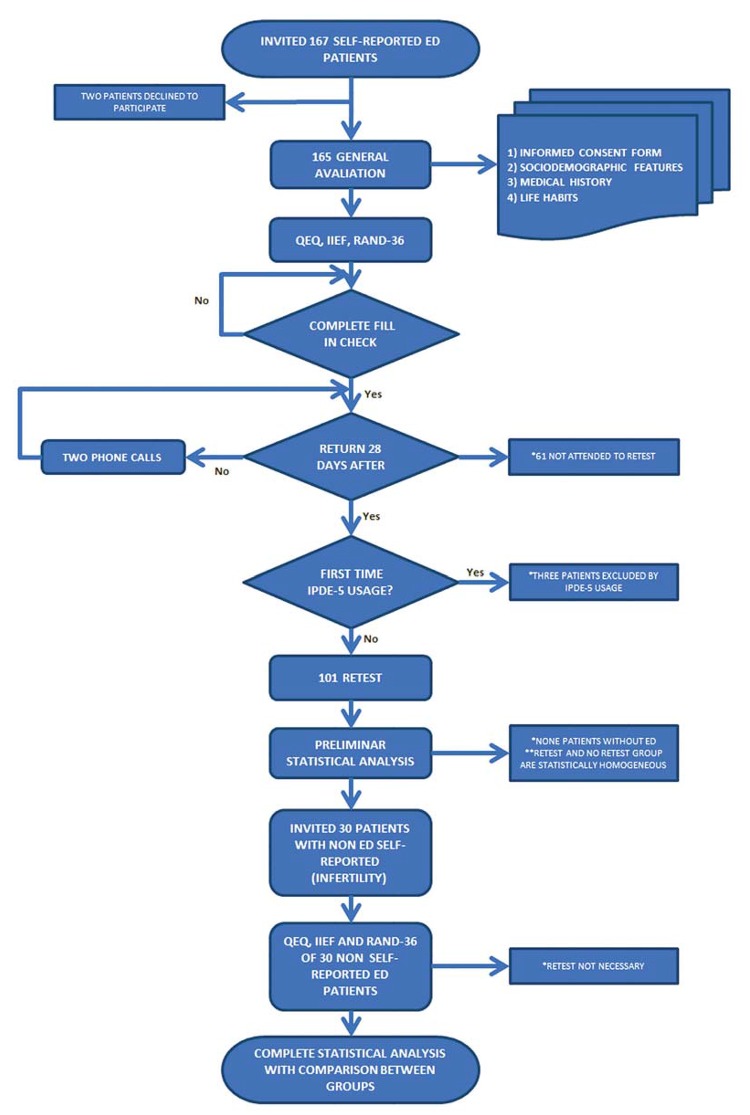
Materials and methods: To determine equivalence between the Portuguese and the English QEQ versions, the Portuguese version was back-translated by two professors who are native English speakers. After language equivalence had been determined, urologists considered the QEQ Portuguese version suitable. Men with self-reported erectile dysfunction (ED) and infertile men who had a stable sexual relationship for at least 6 months were invited to answer the QEQ, the International Index of Erectile Function (IIEF) and the RAND 36-Item Health Survey (RAND-36). The questionnaires were presented together and answered without help in a private room. Internal consistency (Cronbach's α), test-retest reliability (Spearman), convergent validity (Spearman correlation) coefficients and known-groups validity (the ability of the QEQ Portuguese version to differentiate erectile dysfunction severity groups) were assessed.
Results: We recruited 197 men (167 ED patients and 30 non-ED patients), mean age of 53.3 and median of 55.5 years (23-82 years). The Portuguese version of the QEQ had high internal consistency (Cronbach α=0.93), high stability between test and retest (ICC 0.83, with IC 95%: 0.76-0.88, p<0.001) and Spearman correlation coefficient r=0.82 (p<0.001), which demonstrated the high correlation between the QEQ and IIEF results. The correlations between the QEQ and RAND-36 were significantly low in ED (r=0.20, p=0.01) and non-ED patients (r=0.37, p=0.04).
Conclusion: The QEQ Portuguese version presented good psychometric properties and high convergent validity in relation to IIEF. The low correlations between the QEQ and the RAND-36, as well as between the IIEF and the RAND-36 indicated IIEF and QEQ specificity, which may have resulted from the patients' psychological adaptations that minimized the impact of ED on Quality of Life (QoL) and reestablished the well-being feeling.
Conflict of interest statement
CONFLICT OF INTEREST
None declared.
Figures
References
-
- Moreira ED, Jr, Abdo CHN, Torres EB, Lobo CFL, Fitipaldi JAS. Prevalência e fatores de risco da disfunção erétil no Brasil: resultados do estudo multicêntrico de comportamento sexual. Rev Bras Med. 2001;58:515–522.
-
- Feldman HA, Goldstein I, Hatzichristou DG, Krane RJ, McKinlay JB. Impotence and its medical and psychosocial correlates: results of the Massachusetts Male Aging Study. J Urol. 1994;151:54–61. - PubMed
-
- Schouten BW, Bosch JL, Bernsen RM, Blanker MH, Thomas S, Bohnen AM. Incidence rates of erectile dysfunction in the Dutch general population. Effects of definition, clinical relevance and duration of follow-up in the Krimpen Study. Int J Impot Res. 2005;17:58–62. - PubMed
-
- Martín-Morales A, Moncada Iribarren I, Cruz Navarro N, Sanz Terrada B, Cassinello Hervás A, Chan M, et al. Efficacy and safety of two dosing regimens with Tadalafil in Spanish men with erectile dysfunction: results from the SURE study in 14 European countries. Actas Urol Esp. 2006;30:791–800. - PubMed
Publication types
MeSH terms
LinkOut - more resources
Full Text Sources
Medical
