


Lyme disease bacterium does not affect attraction to rodent odour in the tick vector
- PMID: 25928557
- PMCID: PMC4417542
- DOI: 10.1186/s13071-015-0856-8
Lyme disease bacterium does not affect attraction to rodent odour in the tick vector
Abstract
Background: Vector-borne pathogens experience a conflict of interest when the arthropod vector chooses a vertebrate host that is incompetent for pathogen transmission. The qualitative manipulation hypothesis suggests that vector-borne pathogens can resolve this conflict in their favour by manipulating the host choice behaviour of the arthropod vector.
Methods: European Lyme disease is a model system for studying this conflict because Ixodes ricinus is a generalist tick species that vectors Borrelia pathogens that are specialized on different classes of vertebrate hosts. Avian specialists like B. garinii cannot survive in rodent reservoir hosts and vice versa for rodent specialists like B. afzelii. The present study tested whether Borrelia genospecies influenced the attraction of field-collected I. ricinus nymphs to rodent odours.
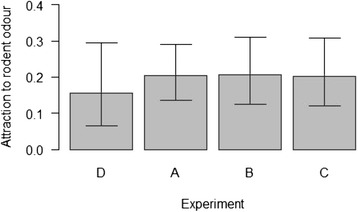
Results: Nymphs were significantly attracted to questing perches that had been scented with mouse odours. However, there was no difference in questing behaviour between nymphs infected with rodent- versus bird-specialized Borrelia genospecies.
Conclusion: Our study suggests that the tick, and not the pathogen, controls the early stages of host choice behaviour.
Figures

References
-
- Gern L, Humair P. Ecology of Borrelia burgdorferi sensu lato in Europe. Lyme Borreliosis Biology, Epidemiology and Control. CABI Int. 2002;6:149–174.
-
- Hoogstraal H, Aeschlimann A. Tick-host specificity. Bulletin de la société entomologique suisse. 1982;55:5–32.
-
- Ostfeld RS, Keesing F. Biodiversity series: the function of biodiversity in the ecology of vector-borne zoonotic diseases. Can J Zool. 2000;78(12):2061–2078. doi: 10.1139/z00-172. - DOI
Publication types
MeSH terms
LinkOut - more resources
Full Text Sources
Other Literature Sources
Medical
