


Current situation of scrub typhus in South Korea from 2001-2013
- PMID: 25928653
- PMCID: PMC4416255
- DOI: 10.1186/s13071-015-0858-6
Current situation of scrub typhus in South Korea from 2001-2013
Abstract
Background: The bacteria Orientia tsutsugamushi is the causative agent of scrub typhus, mite-borne disease, which causes an acute febrile illness in patients. An epidemiologic study was conducted to understand the characteristics of scrub typhus in South Korea.
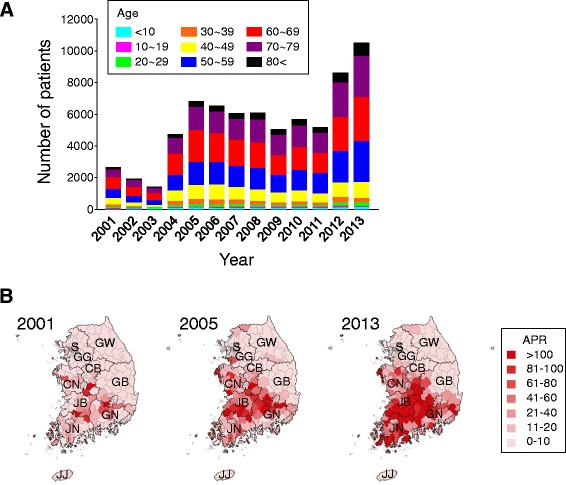
Findings: Reporting of tsutsugamushi disease is mandatory in South Korea since 1994. To investigate the prevalence of tsutsugamushi disease from 2001 to 2013, medical records from the Korea Center for Disease Control and Prevention were reviewed. In total, 70,914 cases were reported during 2001-2013. Of these, 37.16% (26,349) were male and 62.84% (44,565) were female. The highest number of cases was in the 60-69-year-old age group (19,484; 27.48%), and 72.22% (51,212) were in the 50-79-year-old age group. There were 65,100 cases (91.80%) reported during October (24,964; 35.20%) and November (40,136; 56.60%). An almost four-fold increase in the number of patients was observed in 2013 (10,485 cases) compared to 2001 (2,637 cases). The highest number of patients was reported in the Jeonbuk (9,425; 13.29%) and lowest in the Jeju (362; 0.51%).
Conclusions: A rapid increase in the incidence of patients with tsutsugamushi disease was observed in most areas from 2001 to 2013, with the majority of cases reported in the western and southern coast.
Figures
References
-
- Munro-Faure A, Missen MD. Scrub typhus in Korea. J R Army Med Corps. 1951;97:227–31. - PubMed
-
- Lee JS, Ahn C, Kim YK, Lee MH. Thirteen cases of rickettsial infection including 9 cases of tsutsugamushi disease first confirmed in Korea. J Korean Med Assoc. 1986;29:430–8.
-
- Kim E, Park YS, Kim JM, Hong CS, Moon YM. Six cases of tsutsugamushi disease. Korean J Infect Dis. 1987;19:179–86.
Publication types
MeSH terms
LinkOut - more resources
Full Text Sources
Other Literature Sources
