


Factors Influencing Physical Therapists' Use of Standardized Measures of Walking Capacity Poststroke Across the Care Continuum
- PMID: 25929532
- PMCID: PMC4625060
- DOI: 10.2522/ptj.20140267
Factors Influencing Physical Therapists' Use of Standardized Measures of Walking Capacity Poststroke Across the Care Continuum
Abstract
Background: The use of standardized assessment tools is an element of evidence-informed rehabilitation, but physical therapists report administering these tools inconsistently poststroke. An in-depth understanding of physical therapists' approaches to walking assessment is needed to develop strategies to advance assessment practice.
Objectives: The objective of this study was to explore the methods physical therapists use to evaluate walking poststroke, reasons for selecting these methods, and the use of assessment results in clinical practice.
Design: A qualitative descriptive study involving semistructured telephone interviews was conducted.
Methods: Registered physical therapists assessing a minimum of 10 people with stroke per year in Ontario, Canada, were purposively recruited from acute care, rehabilitation, and outpatient settings. Interviews were audiotaped and transcribed verbatim. Transcripts were coded line by line by the interviewer. Credibility was optimized through triangulation of analysts, audit trail, and collection of field notes.
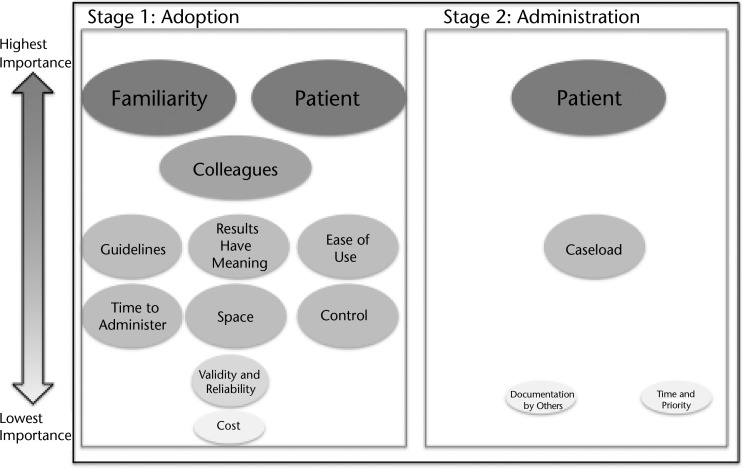
Results: Study participants worked in acute care (n=8), rehabilitation (n=11), or outpatient (n=9) settings and reported using movement observation and standardized assessment tools to evaluate walking. When selecting methods to evaluate walking, physical therapists described being influenced by a hierarchy of factors. Factors included characteristics of the assessment tool, the therapist, the workplace, and patients, as well as influential individuals or organizations. Familiarity exerted the primary influence on adoption of a tool into a therapist's assessment repertoire, whereas patient factors commonly determined daily use. Participants reported using the results from walking assessments to communicate progress to the patient and health care professionals.
Conclusions: Multilevel factors influence physical therapists' adoption and daily administration of standardized tools to assess walking. Findings will inform knowledge translation efforts aimed at increasing the standardized assessment of walking poststroke.
© 2015 American Physical Therapy Association.
Figures
References
-
- The Internet Stroke Center. Stroke statistics. 2013. Available at: http://www.strokecenter.org/patients/about-stroke/stroke-statistics/ Accessed May 20, 2015.
-
- Jorgensen HS, Nakayama H, Raaschou HO, Olsen TS. Recovery of walking function in stroke patients: the Copenhagen Stroke Study. Arch Phys Med Rehabil. 1995;76:27–32. - PubMed
-
- Michael KM, Allen JK, Macko RF. Reduced ambulatory activity after stroke: the role of balance, gait, and cardiovascular fitness. Arch Phys Med Rehabil. 2005;86:1552–1556. - PubMed
-
- Mayo NE, Wood-Dauphinée S, Côté R, et al. Activity, participation, and quality of life 6 months poststroke. Arch Phys Med Rehabil. 2002;83:1035–1042. - PubMed
-
- Elsworth C, Dawes H, Sackley C, et al. A study of perceived facilitators to physical activity. International Journal of Therapy and Rehabilitation. 2009;16:17–24.
Publication types
MeSH terms
Grants and funding
LinkOut - more resources
Full Text Sources
Other Literature Sources
Medical
