


Risk of Mortality Associated With QT and JT Intervals at Different Levels of QRS Duration (from the Third National Health and Nutrition Examination Survey)
- PMID: 25929581
- PMCID: PMC5244257
- DOI: 10.1016/j.amjcard.2015.03.038
Risk of Mortality Associated With QT and JT Intervals at Different Levels of QRS Duration (from the Third National Health and Nutrition Examination Survey)
Abstract
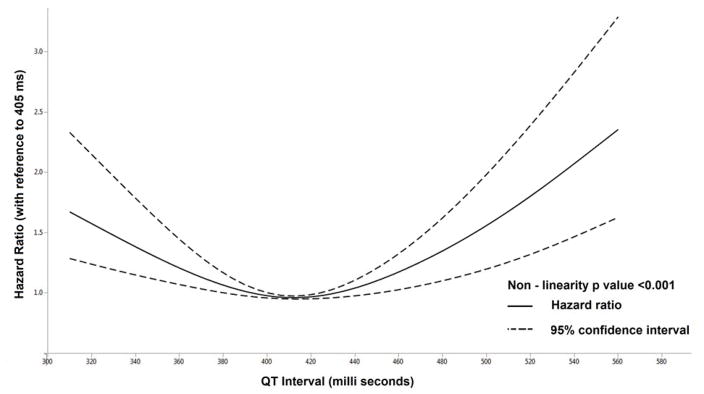
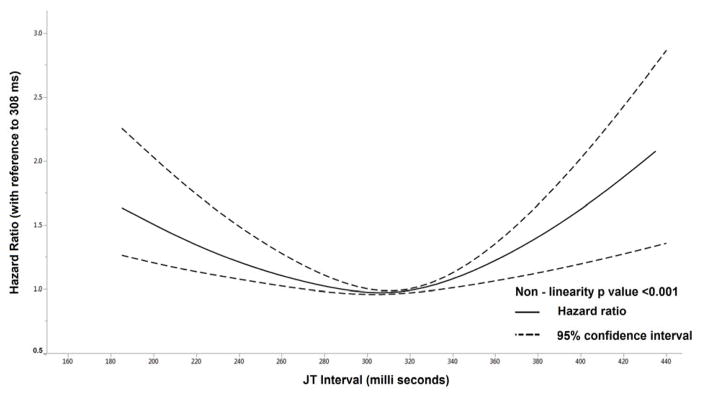
QT prolongation in the setting of QRS >120 ms is believed to be triggered by prolonged depolarization rather than repolarization. Hence, JT interval is suggested as an alternative to QT interval when QRS duration is prolonged. It is unclear, however, if JT and QT intervals portend similar risk of mortality for different durations of QRS. We examined the association between QT and JT, separately, with all-cause mortality across different levels of QRS duration in 8,025 participants (60 ± 13 years, 41% white and 54% women) from the Third National Health and Nutrition Examination Survey. At baseline (1986 to 1994), 486 participants (6%) had QRS duration ≥120 ms. During a follow-up of up to 18 years, 3,045 deaths (38%) occurred. There were significant nonlinear relations of QT and JT intervals with mortality (p <0.001). Hence, QT and JT were categorized as prolonged (>95th percentile), shortened (<5th percentile), and normal (reference group). In multivariate-adjusted Cox regression models, prolonged JT (hazard ratio [HR] 4.75, 95% confidence interval [CI] 1.86 to 12.11) was associated with increased risk of mortality more than prolonged QT (HR 1.50, 95% CI 1.03 to 2.17) in participants with QRS ≥120 ms (interaction p = 0.02). In participants with QRS duration <120 ms, prolonged QT and JT were equally predictive of all-cause mortality (HR 1.27, 95% CI 1.06 to 1.54, and HR 1.31, 95% CI 1.10 to 1.55, respectively). Similar patterns were observed with shortened QT and JT intervals. In conclusion, although both QT and JT intervals are predictive of mortality, JT is more predictive in the setting of QRS duration >120 ms supporting the use of JT interval in patients with prolonged QRS.
Copyright © 2015 Elsevier Inc. All rights reserved.
Figures
References
-
- Fagher K, Nilsson A, Londahl M. Heart rate-corrected qt interval prolongation as a prognostic marker for 3-year survival in people with type 2 diabetes undergoing above-ankle amputation. Diab Med. 2015;32:679–685. - PubMed
-
- Villa A, Bacchetta A, Milani O, Omboni E. Qt interval prolongation as predictor of early mortality in acute ischemic stroke patients. Am J Emerg Med. 2001;19:332–333. - PubMed
-
- Veglio M, Sivieri R, Chinaglia A, Scaglione L, Cavallo-Perin P. Qt interval prolongation and mortality in type 1 diabetic patients: A 5-year cohort prospective study. Neuropathy study group of the italian society of the study of diabetes, piemonte affiliate. Diab Care. 2000;23:1381–1383. - PubMed
-
- Montanez A, Ruskin JN, Hebert PR, Lamas GA, Hennekens CH. Prolonged qtc interval and risks of total and cardiovascular mortality and sudden death in the general population: A review and qualitative overview of the prospective cohort studies. Arch Intern Med. 2004;164:943–948. - PubMed
Publication types
MeSH terms
Grants and funding
LinkOut - more resources
Full Text Sources
Other Literature Sources
Medical
