. 2015 Jul:269:224-32.
doi: 10.1016/j.expneurol.2015.04.013. Epub 2015 Apr 27.

Androgen-dependent loss of muscle BDNF mRNA in two mouse models of SBMA

Affiliations

Androgen-dependent loss of muscle BDNF mRNA in two mouse models of SBMA

Katherine Halievski et al. Exp Neurol. 2015 Jul.

Abstract

Transgenic expression of neurotrophic factors in skeletal muscle has been found to protect mice from neuromuscular disease, including spinal bulbar muscular atrophy (SBMA), triggering renewed interest in neurotrophic factors as therapeutic agents for treating neuromuscular disease. Because SBMA is an androgen-dependent disease, and brain-derived neurotrophic factor (BDNF) mediates effects of androgens on neuromuscular systems, we asked whether BDNF expression is impaired in two different transgenic (Tg) mouse models of SBMA, the so called "97Q" and "myogenic" SBMA models. The 97Q model globally overexpresses a full length human AR with 97 glutamine repeats whereas the myogenic model of SBMA overexpresses a wild-type rat androgen receptor (AR) only in skeletal muscle fibers. Using quantitative PCR, we find that muscle BDNF mRNA declines in an androgen-dependent manner in both models, paralleling changes in motor function, with robust deficits (6-8 fold) in both fast and slow twitch muscles of impaired Tg males. Castration rescues or reverses disease-related deficits in muscle BDNF mRNA in both models, paralleling its effect on motor function. Moreover, when disease is acutely induced in Tg females, both motor function and muscle BDNF mRNA expression plummet, with the deficit in muscle BDNF emerging before overt motor dysfunction. That androgen-dependent motor dysfunction is tightly associated with a robust and early down-regulation of muscle BDNF mRNA suggests that BDNF delivered to skeletal muscle may have therapeutic value for SBMA.

Keywords: Motoneuron disease; Neurodegenerative disease; Neuromuscular disease; Neurotrophic factor; Neurotrophin.


Figures

Figure 1
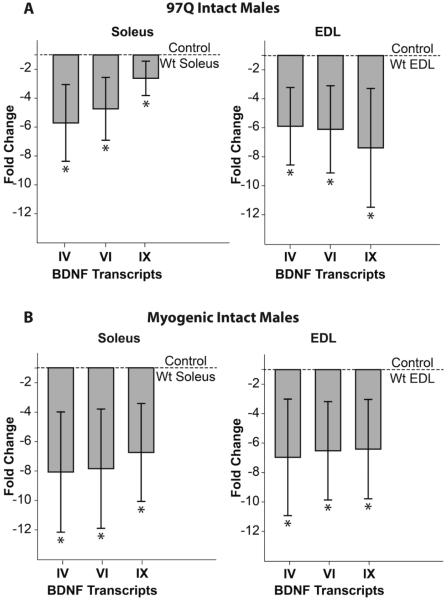
Figure 1. 97Q and myogenic transgenic (Tg) males show comparable disease-related deficits in BDNF transcripts in skeletal muscle
Both slow twitch soleus and fast twitch extensor digitorum longus (EDL) muscles of motor-impaired mice show significant deficits in all three BDNF transcripts (noncoding IV and VI and the coding IX) based on qPCR (A, B). Since the disease-causing AR is expressed only in muscle fibers of myogenic mice, these data indicate that AR can act directly in muscle fibers to down-regulate BDNF mRNA (A), possibly triggering dysfunction not only in skeletal muscles, but in the motoneurons too. All plotted values are relative to Wt controls (dashed line). Error bars represent standard error of the mean. n=6-7/group. * p<0.01 from Wt control
Figure 2
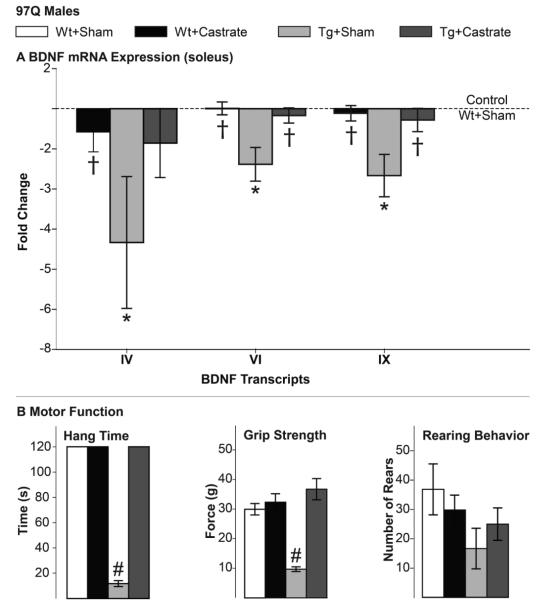
Figure 2. Presymptomatic castration rescues 97Q males from deficits in both muscle BDNF mRNA and motor function
Deficits in muscle BDNF mRNA and motor function of gonadally-intact, end-stage 97Q Tg males are not evident in 97Q males castrated at puberty. Both BDNF expression and motor function of castrated Tg males is comparable to Wt males. Note that we find the same deficits in BDNF mRNA in gonadally-intact 97Q males as in the first experiment (Fig. 1A) and that castration of Wt males has no effect on BDNF mRNA (A), nor motor function. Error bars represent standard error of the mean. n=6/group. A) * p<0.01 from Wt+Sham, † p<0.05 from Tg+Sham. B) # p<0.05 Tg+Castrate versus Tg+Sham.
Figure 3
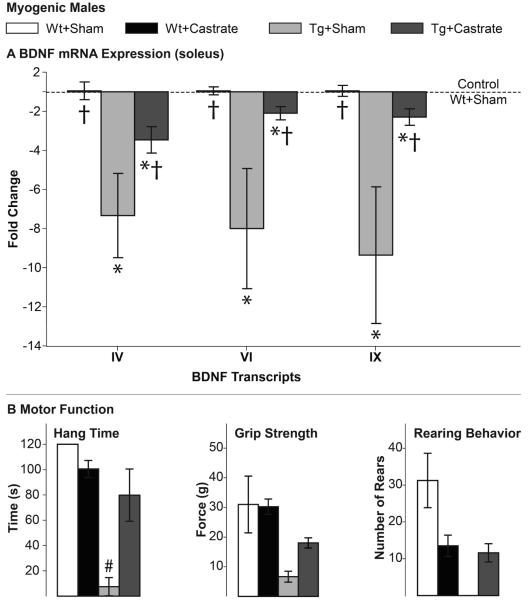
Figure 3. Castration reverses deficits in both muscle BDNF mRNA expression and motor function of chronically diseased myogenic males
Deficits in muscle BDNF (A) and motor function (B) found in gonadally intact Tg males are largely reversed by castration, indicating that both defects are androgen-dependent. Note that we find comparable BDNF deficits in gonadally-intact Tg males as seen in first experiment (Fig 1B) and that castration of Wt males affects neither BDNF expression nor motor function based on hang times and grip strength but does lower rearing behavior, an androgen-dependent measure of anxiety. That castration did not reverse the rearing deficit in Tg males may reflect increased anxiety-like behavior and not an effect on motor function per se. Error bars represent standard error of the mean. n=4-5/group. A) * p<0.01 from Wt+Sham, † p<0.05 from Tg+Sham. B) # p<0.05 Tg+Castrate versus Tg+Sham.
Figure 4
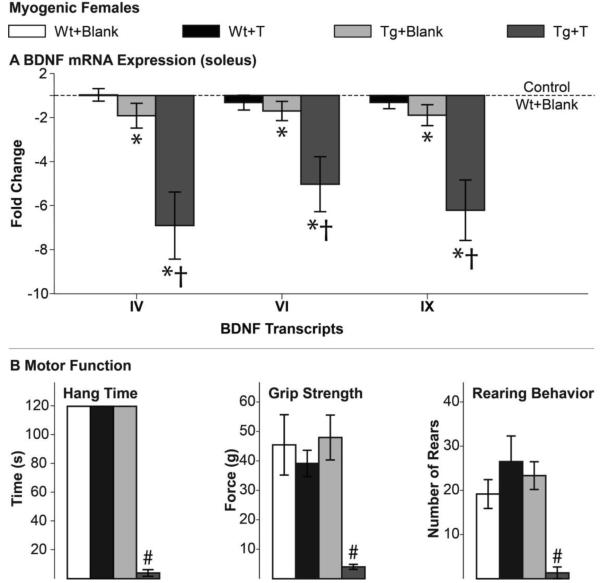
Figure 4. Androgen treatment of myogenic females induces significant losses in both muscle BDNF mRNA and motor function
Exposing asymptomatic myogenic Tg females to testosterone (T) for only 5 days induces a significant, more than 6-fold, decrease in muscle BDNF transcript levels (A) compared to either T-treated Wt controls or asymptomatic control-treated Tg females (Tg+Blank). Androgen’s effect on BDNF expression in muscle of Tg females correlates with a robust induction of motor dysfunction (B). Control treated Tg females show a small but significant deficit (< 2 fold) in muscle BDNF mRNA compared to Wt controls (Wt+Blank, dashed line, A) despite having normal motor function, suggesting that a small deficit in BDNF mRNA in asymptomatic Tg females may prime the system for rapid collapse once exposed to male levels of androgens. Error bars represent standard error of the mean. A) * indicates p<0.05 from Wt+Blank, † indicates p<0.05 from Tg+Blank. B) # p<0.05 Tg+Blank versus Tg+T.
Figure 5
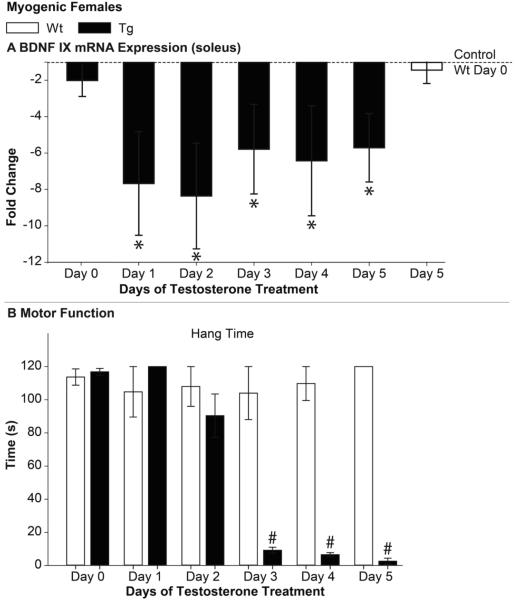
Figure 5. Androgen induces the deficit in muscle BDNF mRNA before detectable motor dysfunction in acutely diseased myogenic females
Muscle BDNF mRNA was significantly reduced after only one day of testosterone (T) treatment (A). Importantly, this deficit preceded the loss in overt motor function; deficits in hang time were evident starting at three days of T treatment but not before. The magnitude of the deficit at 24 hours was not only comparable to that at 5 days of T treatment in Tg females but also comparable to that of chronically affected myogenic and 97Q Tg males (Fig. 1), suggesting that a defect in BDNF mRNA expression in muscle is an early event in disease progression and might trigger the loss in overt motor function. Error bars represent standard error of the mean. n=4-6/group. A) * indicates p<0.05 from Wt Day 0. B) # p<0.05 Wt versus Tg.

References

    1. Aid T, Kazantseva A, Piirsoo M, Palm K, Timmusk T. Mouse and rat BDNF gene structure and expression revisited. J. Neurosci. Res. 2007;85(3):525–535. doi: 10.1002/jnr.21139. - PMC - PubMed
    1. Bosco DA, Morfini G, Karabacak NM, Song Y, Gros-Louis F, Pasinelli P, Brown RH., Jr. Wild-type and mutant SOD1 share an aberrant conformation and a common pathogenic pathway in ALS. Nat. Neurosci. 2010;13(11):1396–1403. doi: 10.1038/nn.2660. - PMC - PubMed
    1. Chahin N, Sorenson EJ. Serum creatine kinase levels in spinobulbar muscular atrophy and amyotrophic lateral sclerosis. Muscle Nerve. 2009;40(1):126–129. doi: 10.1002/mus.21310. - PubMed
    1. Chevalier-Larsen ES, O'Brien CJ, Wang H, Jenkins SC, Holder L, Lieberman AP, Merry DE. Castration restores function and neurofilament alterations of aged symptomatic males in a transgenic mouse model of spinal and bulbar muscular atrophy. J. Neurosci. 2004;24(20):4778–4786. doi: 10.1523/JNEUROSCI.0808-04.2004. - PMC - PubMed
    1. Clow C, Jasmin BJ. Brain-derived neurotrophic factor regulates satellite cell differentiation and skeltal muscle regeneration. Molecular biology of the cell. 2010;21(13):2182–2190. doi: 10.1091/mbc.E10-02-0154. - PMC - PubMed

Publication types