


Delivery of self training and education for stressful situations (DESTRESS-PC): a randomized trial of nurse assisted online self-management for PTSD in primary care
- PMID: 25929985
- PMCID: PMC4762212
- DOI: 10.1016/j.genhosppsych.2015.04.007
Delivery of self training and education for stressful situations (DESTRESS-PC): a randomized trial of nurse assisted online self-management for PTSD in primary care
Abstract
Objective: This randomized controlled trial examined the effectiveness of a nurse assisted online cognitive-behavioral self-management intervention for war-related posttraumatic stress disorder (PTSD), compared to optimized usual primary care PTSD Treatment (OUC) to reduce PTSD symptoms.
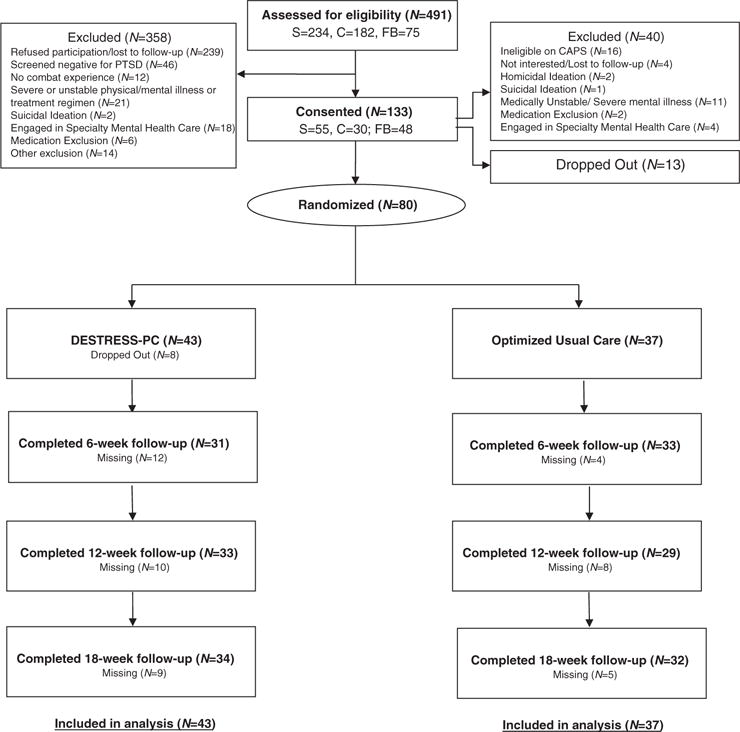
Method: Participants were 80 veterans of recent military conflicts with PTSD as assessed by the PTSD Checklist (PCL) seeking primary care treatment at one of three Veterans Affairs (VA) and four Army clinics. DESTRESS-PC consisted of logins to a secure website three times per week for 6 weeks with monitoring by a study nurse. All participants received nurse care management in the form of phone check-ins every two weeks and feedback to their primary care providers. Blinded raters assessed outcomes 6, 12, and 18 weeks post-randomization.
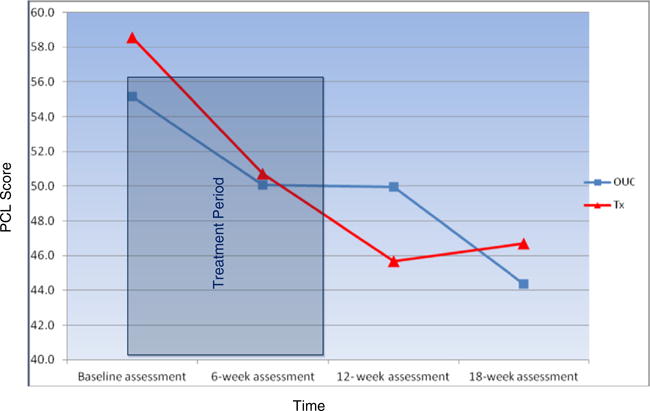
Results: DESTRESS-PC was associated with a significantly greater decrease in PTSD symptoms compared to OUC (F(3, 186)=3.72, p=.012). The effect was largest at the 12-week assessment (∆PCL=12.6±16.6 versus 5.7±12.5, p<0.05) with the treatment effect disappearing by the 18-week follow-up. Notably, there was a dose effect; number of logins correlated significantly with PTSD outcomes, with more logins associated with greater PTSD symptom improvement. None of the secondary outcomes (depression, anxiety, somatic symptoms, and functional status) showed statistically significant improvement; however, the treatment effect on depression approached significance (F(3, 186)=2.17, p=.093).
Conclusions: DESTRESS-PC shows promise as a means of delivering effective, early PTSD treatment in primary care. Larger trials are needed.
Keywords: Depression; Military mental health; Posttraumatic Stress Disorder; Primary care; Telehealth.
Copyright © 2015 Elsevier Inc. All rights reserved.
Figures
References
-
- Kessler RC, Sonnega A, Bromet E, Hughes M, Nelson CB. Posttraumatic stress disorder in the National Comorbidity Survey. Arch Gen Psychiatry. 1995;52(12):1048–60. - PubMed
-
- Wang PS, Berglund P, Olfson M, Pincus HA, Wells KB, Kessler RC. Failure and delay in initial treatment contact after first onset of mental disorders in the National Comorbidity Survey Replication. Arch Gen Psychiatry. 2005;62(6):603–13. - PubMed
-
- Hoge CW, Castro CA, Messer SC, McGurk D, Cotting DI, Koffman RL. Combat duty in Iraq and Afghanistan, mental health problems, and barriers to care. N Engl J Med. 2004;351(1):13–22. - PubMed
-
- Hoge CW, Auchterlonie JL, Milliken CS. Mental health problems, use of mental health services, and attrition from military service after returning from deployment to Iraq or Afghanistan. JAMA. 2006;295(9):1023–32. - PubMed
Publication types
MeSH terms
Grants and funding
LinkOut - more resources
Full Text Sources
Other Literature Sources
Medical
Miscellaneous
