


A computed tomography radiogenomic biomarker predicts microvascular invasion and clinical outcomes in hepatocellular carcinoma
- PMID: 25930992
- PMCID: PMC4654334
- DOI: 10.1002/hep.27877
A computed tomography radiogenomic biomarker predicts microvascular invasion and clinical outcomes in hepatocellular carcinoma
Abstract
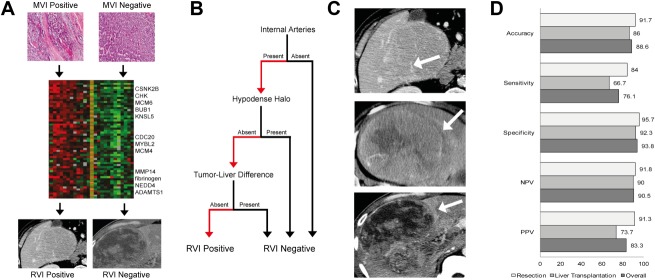
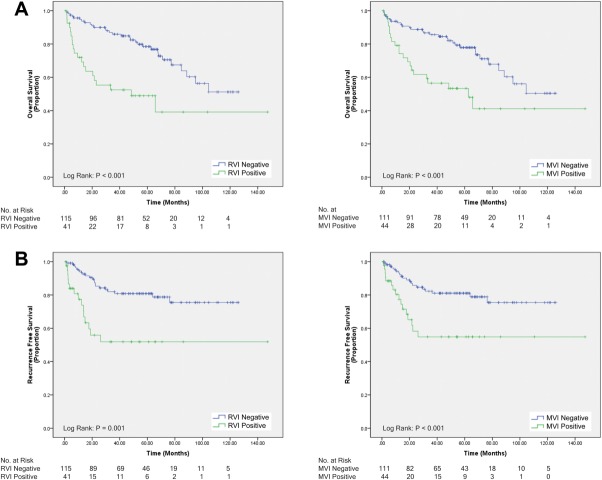
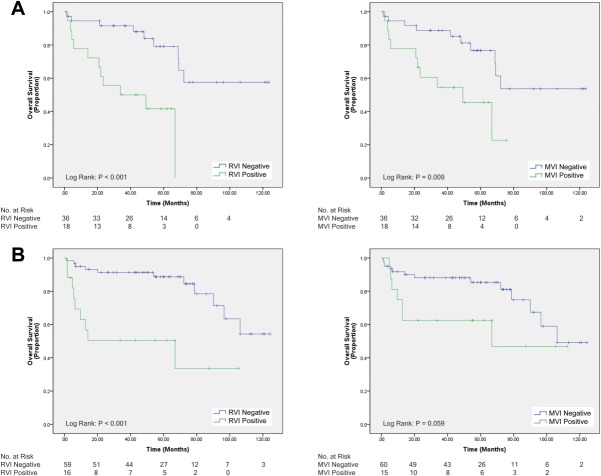
Microvascular invasion (MVI) in hepatocellular carcinoma (HCC) is an independent predictor of poor outcomes subsequent to surgical resection or liver transplantation (LT); however, MVI currently cannot be adequately determined preoperatively. Radiogenomic venous invasion (RVI) is a contrast-enhanced computed tomography (CECT) biomarker of MVI derived from a 91-gene HCC "venous invasion" gene expression signature. Preoperative CECTs of 157 HCC patients who underwent surgical resection (N = 72) or LT (N = 85) between 2000 and 2009 at three institutions were evaluated for the presence or absence of RVI. RVI was assessed for its ability to predict MVI and outcomes. Interobserver agreement for scoring RVI was substantial among five radiologists (κ = 0.705; P < 0.001). The diagnostic accuracy, sensitivity, and specificity of RVI in predicting MVI was 89%, 76%, and 94%, respectively. Positive RVI score was associated with lower overall survival (OS) than negative RVI score in the overall cohort (P < 0.001; 48 vs. >147 months), American Joint Committee on Cancer tumor-node-metastasis stage II (P < 0.001; 34 vs. >147 months), and in LT patients within Milan criteria (P < 0.001; 69 vs. >147 months). Positive RVI score also portended lower recurrence-free survival at 3 years versus negative RVI score (P = 0.001; 27% vs. 62%).
Conclusion: RVI is a noninvasive radiogenomic biomarker that accurately predicts histological MVI in HCC surgical candidates. Its presence on preoperative CECT is associated with early disease recurrence and poor OS and may be useful for identifying patients less likely to derive a durable benefit from surgical treatment.
© 2015 by the American Association for the Study of Liver Diseases.
Figures
Comment in
-
Reply.Hepatology. 2016 Aug;64(2):692-3. doi: 10.1002/hep.28618. Epub 2016 Jun 23. Hepatology. 2016. PMID: 27113496 No abstract available.
-
The effect of cirrhosis on radiogenomic biomarker's ability to predict microvascular invasion and outcome in hepatocellular carcinoma.Hepatology. 2016 Aug;64(2):691-2. doi: 10.1002/hep.28620. Epub 2016 May 31. Hepatology. 2016. PMID: 27113641 No abstract available.
References
-
- Ferlay J, Shin HR, Bray F, Forman D, Mathers C, Parkin DM. Estimates of worldwide burden of cancer in 2008: GLOBOCAN 2008. Int J Cancer. 2010;127:2893–2917. - PubMed
-
- Forner A, Llovet JM, Bruix J. Hepatocellular carcinoma. Lancet. 2012;379:1245–1255. - PubMed
-
- Zimmerman MA, Ghobrial RM, Tong MJ, Hiatt JR, Cameron AM, Hong J, Busuttil RW. Recurrence of hepatocellular carcinoma following liver transplantation: a review of preoperative and postoperative prognostic indicators. Arch Surg. 2008;143:182–188. - PubMed
-
- Nakashima Y, Nakashima O, Tanaka M, Okuda K, Nakashima M, Kojiro M. Portal vein invasion and intrahepatic micrometastasis in small hepatocellular carcinoma by gross type. Hep Res. 2003;26:142–147. - PubMed
Publication types
MeSH terms
Substances
LinkOut - more resources
Full Text Sources
Other Literature Sources
Medical