Review
. 2015 Nov;1356(1):1-21.
doi: 10.1111/nyas.12763. Epub 2015 Apr 30.

Toll-like receptor signaling in primary immune deficiencies

Affiliations
Review

Toll-like receptor signaling in primary immune deficiencies

Paul J Maglione et al. Ann N Y Acad Sci. 2015 Nov.

Abstract

Toll-like receptors (TLRs) recognize common microbial or host-derived macromolecules and have important roles in early activation of the immune system. Patients with primary immune deficiencies (PIDs) affecting TLR signaling can elucidate the importance of these proteins to the human immune system. Defects in interleukin-1 receptor-associated kinase-4 and myeloid differentiation factor 88 (MyD88) lead to susceptibility to infections with bacteria, while mutations in nuclear factor-κB essential modulator (NEMO) and other downstream mediators generally induce broader susceptibility to bacteria, viruses, and fungi. In contrast, TLR3 signaling defects are specific for susceptibility to herpes simplex virus type 1 encephalitis. Other PIDs induce functional alterations of TLR signaling pathways, such as common variable immunodeficiency in which plasmacytoid dendritic cell defects enhance defective responses of B cells to shared TLR agonists. Dampening of TLR responses is seen for TLRs 2 and 4 in chronic granulomatous disease (CGD) and X-linked agammaglobulinemia (XLA). Enhanced TLR responses, meanwhile, are seen for TLRs 5 and 9 in CGD, TLRs 4, 7/8, and 9 in XLA, TLRs 2 and 4 in hyper IgE syndrome, and for most TLRs in adenosine deaminase deficiency.

Keywords: Toll-like receptors; human immunology; infection; primary immune deficiency.


Figures

Figure 1
Figure 1
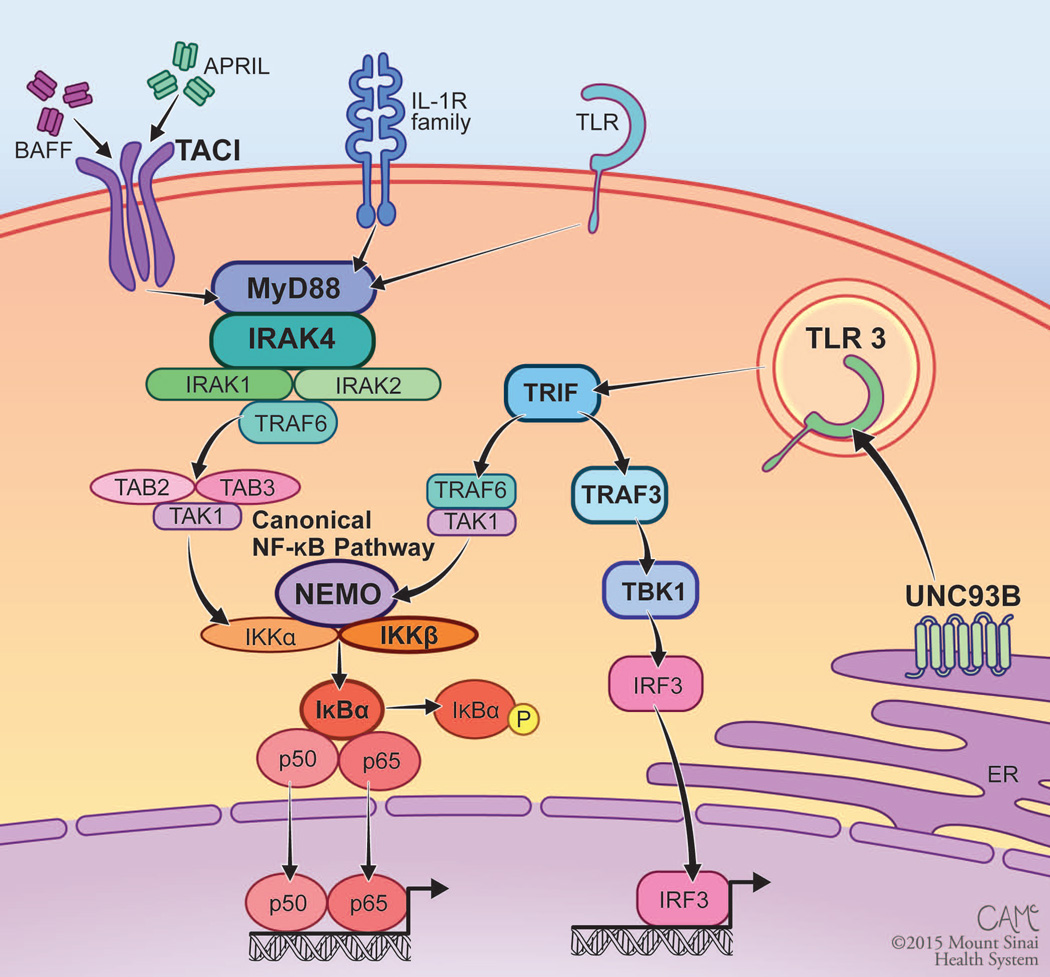
TLR and NF-κB signaling disrupted by PID. The canonical NF-κB pathway is utilized by numerous immunologic receptors, including the IL-R family, TLRs, and TACI. Signal transduction is mediated through an IKK complex that results in phosphorylation and degradation of IκBα, allowing for nuclear localization of NF-κB. TLR3 signals through TRIF to both activate the canonical NF-κB pathway and induce type I interferon production through IRF3. Genes in which mutations cause known PID are in bold type. Figure courtesy of Courtney A. McKenna © 2015 Mount Sinai Health System.
Figure 2
Figure 2
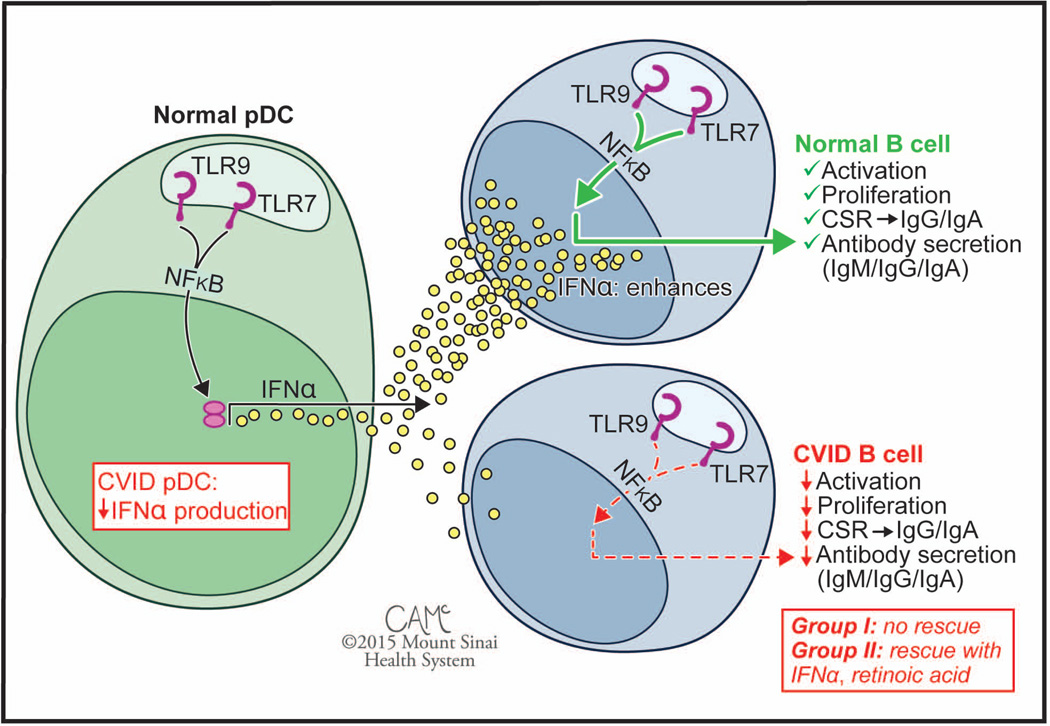
Cell type specific functional defects of TLR signaling in. CVID. While the normal pDC response to stimulation with TLR7 and TLR9 agonists is secretion of high levels of IFN-α, pDCs of subjects with CVID show defective responses. Similarly, while normal B cells are sensitive to stimulation with TLR7 and TLR9 agonists, patient B cells show defective responses. The B cell defect is correctable in less severely affected Group II patients with the addition of exogenous IFN-α or retinoic acid, but these fail to rescue B cells from Group I patients. Patients are subdivided into Group I (<0.55% SWMB, associated with non-infectious complications) and less severely affected Group II (>0.55% SWMB, associated with better clinical course). CVID, common variable immunodeficiency; SWMB, class switched memory B cells. Figure courtesy of Courtney A. McKenna © 2015 Mount Sinai Health System.
Figure 3
Figure 3
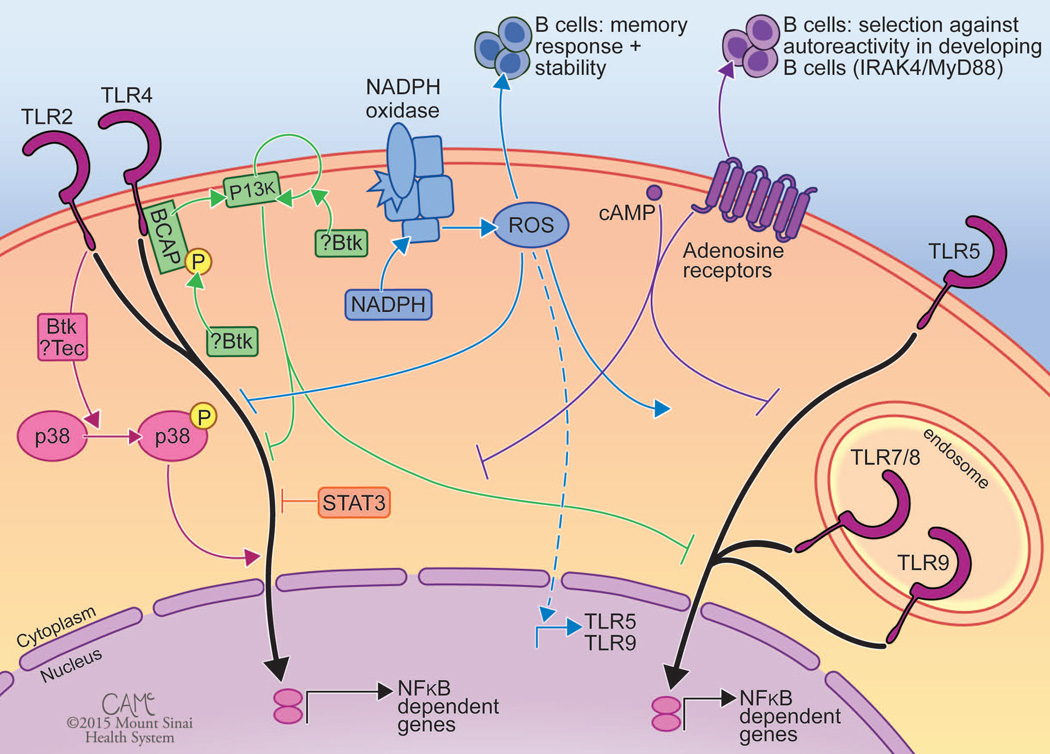
The functional alterations in TLR signaling seen in various PIDs highlight crosstalk with regulatory pathways. TLR signaling is shown in black, with interacting pathways shown in color. Pink: Some studies of XLA patients demonstrate a role for BTK and related kinase Tec in activating MAPK pathways and amplifying responses to TLR2 and TLR4. Green: Other studies of XLA suggest a role for BTK in activating or amplifying PI3K signaling to dampen TLR responses. Blue: As illustrated by CGD, NADPH oxidase–induced ROS are important in dampening inflammation following TLR2 and TLR4 activation, promoting expression of TLR5 and TLR9 (dotted line) and responses to TLR5 and TLR9 agonists, and long term memory responses in B cells. Orange: AD-HIES patients indicate that STAT3 can dampen TLR2 and TLR4 signaling. Purple: Findings from ADA-SCID patients conjecture a role of cAMP and adenosine accumulation in inhibiting TLR signaling. CGD, chronic granulomatous disease; NADPH = nicotinamide adenine dinucleotide phosphate. ROS, reactive oxygen species; XLA, X-linked agammaglobulineima; BTK, Bruton’s tyrosine kinase; MAPK, mitogen activated protein kinase; BCAP, B cell adaptor for PI3K; PI3K, phosphoinositide 3 kinase. AD-HIES, autosomal dominant hyper IgE syndrome; STAT3, signal transducer and activator of transcription 3; ADA, adenosine deaminase; SCID, severe combined immunodeficiency; ERT, enzyme replacement therapy; cAMP, cyclic adenosine monophosphate. Figure courtesy of Courtney A. McKenna © 2015 Mount Sinai Health System.

References

    1. Kawai T, Akira S. The role of pattern-recognition receptors in innate immunity: update on Toll-like receptors. Nature Immunology. 2010;11:373–384. - PubMed
    1. Kawasaki T, Kawai T. Toll-like receptor signaling pathways. Frontiers in Immunology. 2014;5:461. - PMC - PubMed
    1. Schatz DG, Ji Y. Recombination centres and the orchestration of V(D)J recombination. Nature Reviews Immunology. 2011;11:251–263. - PubMed
    1. Uehara A, et al. Various human epithelial cells express functional Toll-like receptors, NOD1 and NOD2 to produce anti-microbial peptides, but not proinflammatory cytokines. Molecular Immunology. 2007;44:3100–3111. - PubMed
    1. Pegu A, et al. Human lymphatic endothelial cells express multiple functional TLRs. J Immunol. 2008;180:3399–3405. - PubMed

Publication types

MeSH terms

Supplementary concepts