


Could pretreatment with oral contraceptives before pituitary down regulation reduce the incidence of ovarian hyperstimulation syndrome in the IVF/ICSI procedure?
- PMID: 25932224
- PMCID: PMC4402871
Could pretreatment with oral contraceptives before pituitary down regulation reduce the incidence of ovarian hyperstimulation syndrome in the IVF/ICSI procedure?
Abstract
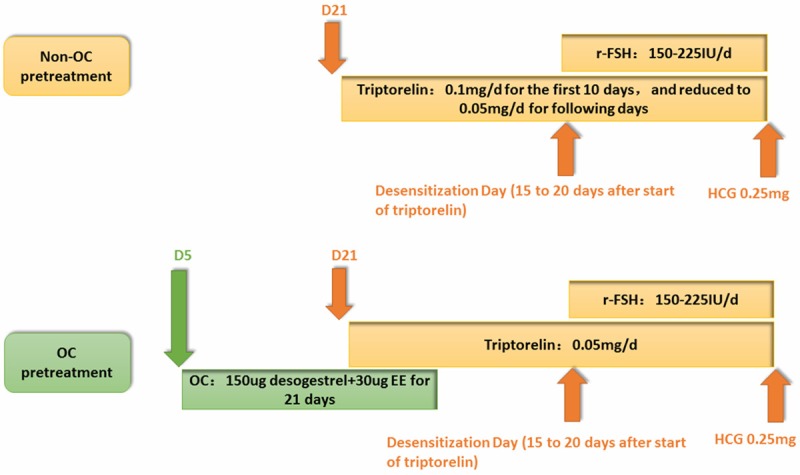
The long gonadotrophin releasing-hormone agonists (GnRH-a) protocol of pituitary down regulation was widely used in controlled ovarian hyperstimulation (COH). Some clinicians prefer to use one cycle of oral contraceptives (OC) pretreatment before the traditional long GnRH-a protocol. This study was aimed to investigate whether such pretreatment could reduce the incidence of ovarian hyperstimulation syndrome (OHSS) for patients with different ovarian responses in IVF/ICSI treatment. Participants undergoing IVF/ICSI treatment with long GnRH-a protocol of pituitary down regulation in luteal phase were recruited by their potential risk of OHSS into one group of suspected high responders (227 participants) and the other group of suspected normal responders (665 participants). As for the suspected high responders, pretreatment with OC could lower the serum LH level, LH/FSH ratio and E2 level right after 14 days of pituitary down regulation. It could also lower the serum E2 level before oocytes retrieval and the count of oocytes collected. The incidence of severe OHSS was also significantly decreased. Such effect of OC on hormone profile, follicular dynamics and incidence of OHSS was not discovered in the group of suspected normal responders.
Keywords: IVF; Oral contraceptives; ovarian hyperstimulation syndrome; pituitary down regulation.
Figures
References
-
- Navot D, Bergh PA, Laufer N. Ovarian hyperstimulation syndrome in novel reproductive technologies: prevention and treatment. Fertil Steril. 1992;58:249–261. - PubMed
-
- Golan A, Ron-el R, Herman A, Soffer Y, Weinraub Z, Caspi E. Ovarian hyperstimulation syndrome: an update review. Obstet Gynecol Surv. 1989;44:430–440. - PubMed
-
- Delvigne A, Rozenberg S. Epidemiology and prevention of ovarian hyperstimulation syndrome (OHSS): a review. Hum Reprod Update. 2002;8:559–577. - PubMed
-
- Lyons CA, Wheeler CA, Frishman GN, Hackett RJ, Seifer DB, Haning RV Jr. Early and late presentation of the ovarian hyperstimulation syndrome: two distinct entities with different risk factors. Hum Reprod. 1994;9:792–799. - PubMed
-
- Mathur RS, Akande AV, Keay SD, Hunt LP, Jenkins JM. Distinction between early and late ovarian hyperstimulation syndrome. Fertil Steril. 2000;73:901–907. - PubMed
LinkOut - more resources
Full Text Sources
Research Materials