


Obstetric and neonatal outcomes after antipsychotic medication exposure in pregnancy
- PMID: 25932852
- PMCID: PMC4418034
- DOI: 10.1097/AOG.0000000000000759
Obstetric and neonatal outcomes after antipsychotic medication exposure in pregnancy
Abstract
Objective: Antipsychotic medications are used by increasing numbers of women of reproductive age. The safety of these medications during pregnancy has not been well described. We undertook a systematic review and meta-analysis of the adverse obstetric and neonatal outcomes associated with exposure to antipsychotics during pregnancy.
Data sources: PubMed, Reprotox, and ClinicalTrials.gov were searched to identify potential studies for inclusion.
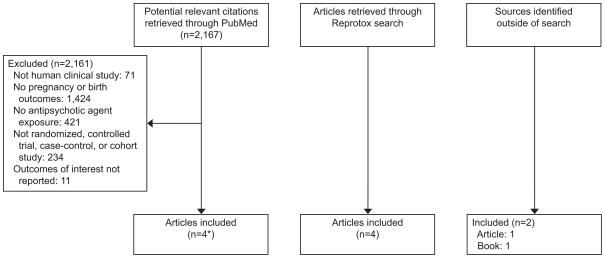
Methods of study selection: Case-control or cohort studies estimating adverse birth outcomes associated with antipsychotic exposure during pregnancy were included. Pooled odds ratios (ORs) were used for dichotomous outcomes and weighted mean differences were used for neonatal birth weight and gestational age. Thirteen cohort studies, including 6,289 antipsychotic-exposed and 1,618,039 unexposed pregnancies, were included.
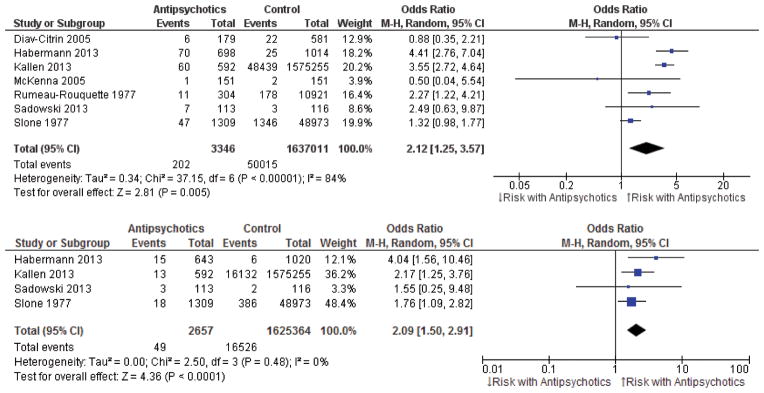
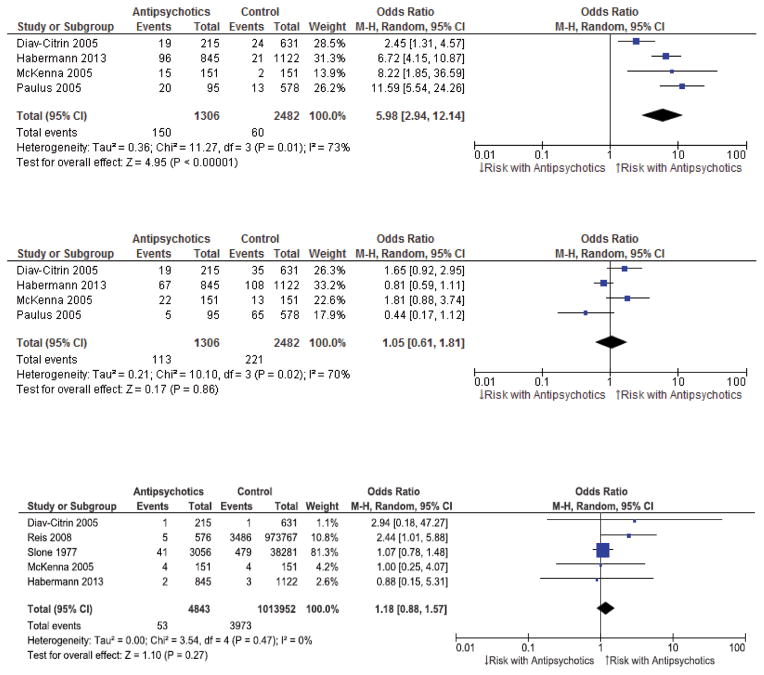
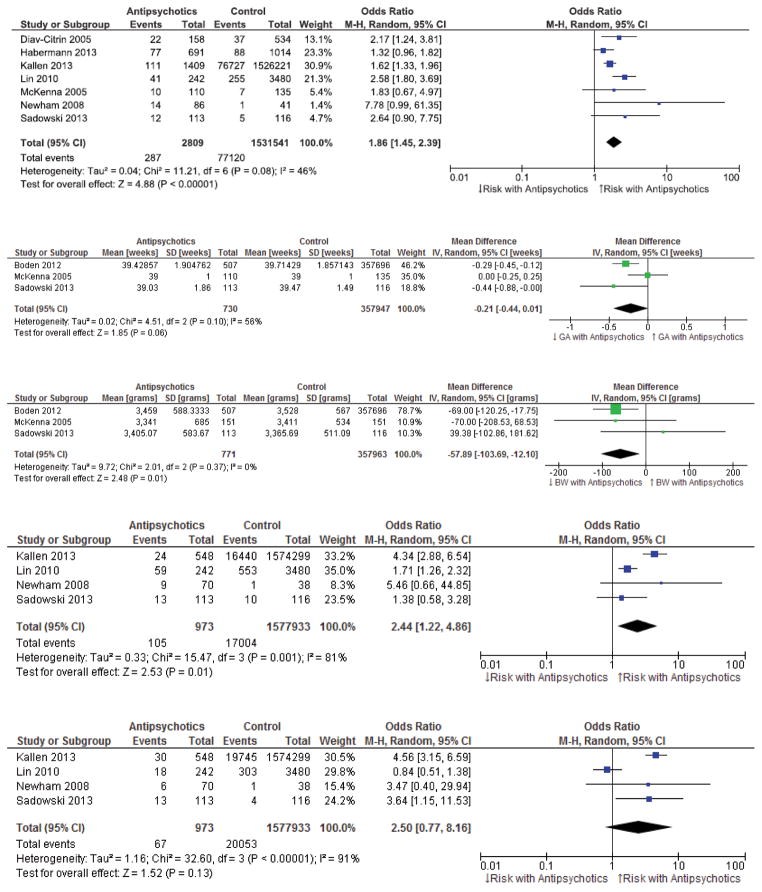
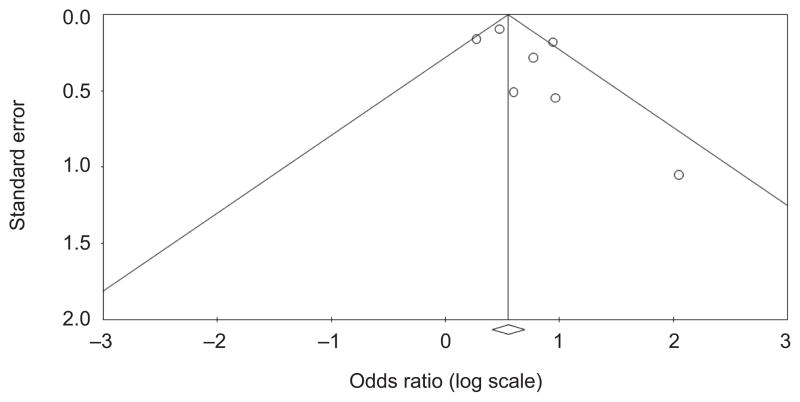
Tabulation, integration, and results: Antipsychotic exposure was associated with an increased risk of major malformations (absolute risk difference [ARD] 0.03, 95% confidence interval [CI] 0.00-0.05, P=.04, Z=2.06), heart defects (ARD 0.01, 95% CI 0.00-0.01, P<.001, Z=3.44), preterm delivery (ARD 0.05, 95% CI 0.03-0.08, P<.001, Z=4.10), small-for-gestational-age births (ARD 0.05, 95% CI 0.02-0.09, P=.006, Z=2.74), elective termination (ARD 0.09, 95% CI 0.05-0.13, P<.001, Z=4.69), and decreased birth weight (weighted mean difference -57.89 g, 95% CI -103.69 to -12.10 g, P=.01). There was no significant difference in the risk of major malformations (test for subgroup differences: χ²=0.07, degrees of freedom=1, P=.79) between typical (OR 1.55, 95% CI 1.21-1.99, P=.006) and atypical (OR 1.39, 95% CI 0.66-2.93, P=.38) antipsychotic medications. Antipsychotic exposure was not associated with risk of large-for-gestational-age births, stillbirth, and spontaneous abortion. Although antipsychotic exposure during pregnancy was associated with increased risk of adverse obstetric and neonatal outcomes, this association does not necessarily imply causation. This analysis was limited by the small number of included studies and limited adjustment in studies for possible confounders.
Conclusion: Women requiring antipsychotic treatment during pregnancy appear at higher risk of adverse birth outcomes, regardless of causation, and may benefit from close monitoring and minimization of other potential risk factors during pregnancy.
Figures
References
-
- Einarson A, Boskovic R. Use and safety of antipsychotic drugs during pregnancy. Journal of psychiatric practice. 2009 May;15(3):183–92. - PubMed
-
- Howard LM. Fertility and pregnancy in women with psychotic disorders. European journal of obstetrics, gynecology, and reproductive biology. 2005 Mar 1;119(1):3–10. - PubMed
-
- McCauley-Elsom K, Gurvich C, Elsom SJ, Kulkarni J. Antipsychotics in pregnancy. Journal of psychiatric and mental health nursing. 2010 Mar;17(2):97–104. - PubMed
Publication types
MeSH terms
Substances
Grants and funding
LinkOut - more resources
Full Text Sources
Research Materials
