


Which unmet needs contribute to behavior problems in persons with advanced dementia?
- PMID: 25933478
- PMCID: PMC4451402
- DOI: 10.1016/j.psychres.2015.03.043
Which unmet needs contribute to behavior problems in persons with advanced dementia?
Abstract
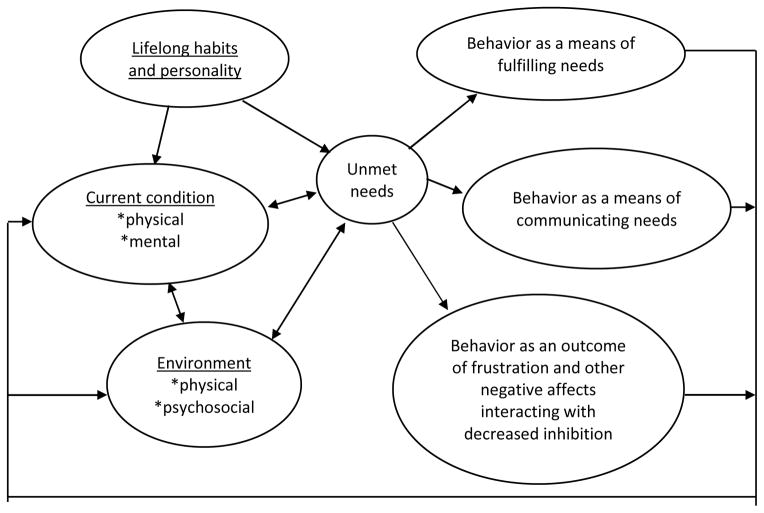
The Unmet Needs Model states that problem behaviors of people with dementia result from unmet needs stemming from a decreased ability to communicate those needs and to provide for oneself. The purpose of this study is to describe the unmet needs of persons with dementia exhibiting behavior problems. Eighty-nine residents with dementia from six Maryland nursing homes were assessed by research assistants and nursing assistants for their unmet needs using multiple assessment tools. Three unmet needs per resident were identified on average, with informants rating boredom/sensory deprivation, loneliness/need for social interaction, and need for meaningful activity as the most prevalent needs. Discomfort was associated with higher levels of verbally agitated behaviors (e.g., complaining). Based on results and independent ratings of pain, the authors estimate notable under-detection of discomfort and pain by both types of informants. The study demonstrates methodologies for uncovering unmet needs among persons with dementia and highlights the importance of developing programs that address those unmet needs, especially social and activity needs of nursing home residents. The detection of pain, and possibly that of discomfort, may require a different methodology.
Keywords: Nonpharmacological interventions; Older persons; Unmet needs model.
Copyright © 2015 Elsevier Ireland Ltd. All rights reserved.
Conflict of interest statement
Figures
References
-
- Bédard A, Landreville P, Voyer P, Verreault R, Vézina J. Reducing verbal agitation in people with dementia: evaluation of an intervention based on the satisfaction of basic needs. Aging & Mental Health. 2011;15:855–865. - PubMed
-
- Chung J. Care needs assessment of older Chinese individuals with dementia of Hong Kong. Aging & Mental Health. 2006;10:631–637. - PubMed
-
- Cohen-Mansfield J. Nonpharmacological management of behavioral problems in persons with dementia: the TREA model. Alzheimers Care Today. 2000a;1:22–34.
-
- Cohen-Mansfield J. Theoretical frameworks for behavioral problems in dementia. Alzheimers Care Today. 2000b;1:8–21.
-
- Cohen-Mansfield J. Nonpharmacologic interventions for inappropriate behaviors in dementia: a review, summary, and critique. American Journal of Geriatric Psychiatry. 2001;9:361–381. - PubMed
Publication types
MeSH terms
Grants and funding
LinkOut - more resources
Full Text Sources
Other Literature Sources
Medical
