Review
. 2015 Jul;17(4):828-36.
doi: 10.1208/s12248-015-9766-0. Epub 2015 May 2.

Antibody Drug Conjugates: Application of Quantitative Pharmacology in Modality Design and Target Selection

Affiliations
Review

Antibody Drug Conjugates: Application of Quantitative Pharmacology in Modality Design and Target Selection

S Sadekar et al. AAPS J. 2015 Jul.

Abstract

Antibody drug conjugates (ADCs) are a multi-component modality comprising of an antibody targeting a cell-specific antigen, a potent drug/payload, and a linker that can be processed within cellular compartments to release payload upon internalization. Numerous ADCs are being evaluated in both research and clinical settings within the academic and pharmaceutical industry due to their ability to selectively deliver potent payloads. Hence, there is a clear need to incorporate quantitative approaches during early stages of drug development for effective modality design and target selection. In this review, we describe a quantitative approach and framework for evaluation of the interplay between drug- and systems-dependent properties (i.e., target expression, density, localization, turnover, and affinity) in order to deliver a sufficient amount of a potent payload into the relevant target cells. As discussed, theoretical approaches with particular considerations given to various key properties for the target and modality suggest that delivery of the payload into particular effect cells to be more sensitive to antigen concentrations for targets with slow turnover rates as compared to those with faster internalization rates. Further assessments also suggest that increasing doses beyond the threshold of the target capacity (a function of target internalization and expression) may not impact the maximum amount of payload delivered to the intended effect cells. This article will explore the important application of quantitative sciences in selection of the target and design of ADC modalities.


Figures
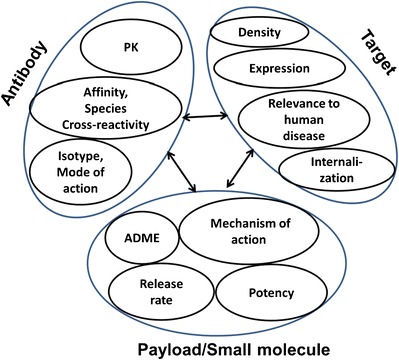
Fig. 1
Fig. 1
Antibody-drug conjugates: interplay between target and modality-related properties
Fig. 2
Fig. 2
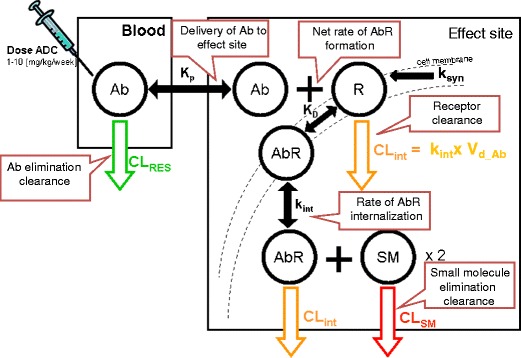
Compartmental model for ADC pharmacokinetics, target interaction, intracellular uptake, and drug release (Ab ADC, R receptor, AbR ADC-receptor complex, K D affinity for AbR formation, k syn zero-order synthesis rate of the receptor, k int complex/receptor internalization rate, CL int clearance of complex/receptor, SM small molecule/drug/payload, CL SM elimination clearance of small molecule). The balance of ksyn and kint determine the receptor-recycling rate (41). In this case, the ksyn was estimated from target capacity as described previously (39, 40). ksyn highlights the synthesis rate of the antigen and was estimated based on equation: kint x Css (concentration of the target at steady state). CLRES reflect the linear clearance reported for antibodies (38); CLSM reflects the clearance of the payload selected based on internal historical data; Vd_SM reflect volume of distribution for the payload; KD reflects the affinity of the antibody for the target antigen; Vd_Ab reflects volume of the central compartment selected based on historical data (38). Each mole of antibody is assumed to deliver two moles of the payload to the effect compartment. PK of the payload assumed to follow a 1-compartment model
Fig. 3
Fig. 3
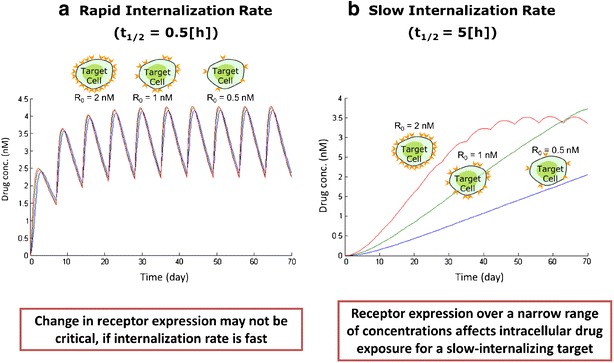
Impact of receptor concentration and rate of internalization on small molecule delivery to intracellular space; (left panel a). Intracellular drug concentration profile for a well-expressed (80,000 receptor copies per cell), fast internalizing target (t1/2 = 0.5 h) at target receptor concentrations 0.5, 1.0, and 2.0 nM; (right panel b). Intracellular drug concentration profile for a well-expressed (80,000 receptor copies per cell), slow internalizing target (t1/2 = 5 h) at target receptor concentrations 0.5, 1.0, and 2.0 nM. Note: All other parameters besides receptor internalization rate and receptor concentrations (as shown in the figures) are kept constant, i.e., CLRES = 5 mL/day/Kg; CLSM = 2.7 L/day/Kg; Vd_SM = 0.6 L/Kg; KD = 0.8 nM; ksyn = 64 μg/mL/day; Vd_Ab = 40 mL/Kg. In both a, b, kint was kept constant (in a: kint = 1.4 h−1 and in b: kint = 0.14 h−1) and ksyn was adjusted to achieve different scenarios with respect to receptor concentrations
Fig. 4
Fig. 4
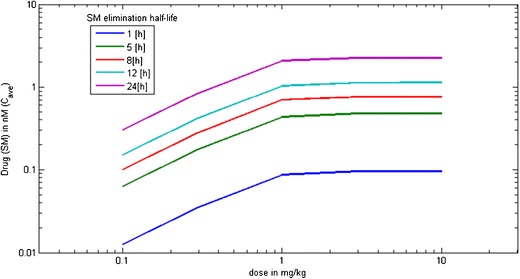
Effect of elimination rate of released small molecule on its delivery to intracellular space at varying doses. Note: All other parameters besides small molecule elimination rate are kept constant, i.e., CLRES = 5 mL/day/Kg; Vd_SM = 0.6 L/Kg; KD = 0.8 nM; ksyn = 64 μg/mL/day; Vd_Ab = 40 mL/Kg; kint = 2.77 h−1; number of receptor copies = 80,000 per cell; 1000 T cells per mm3 of blood
Fig. 5
Fig. 5
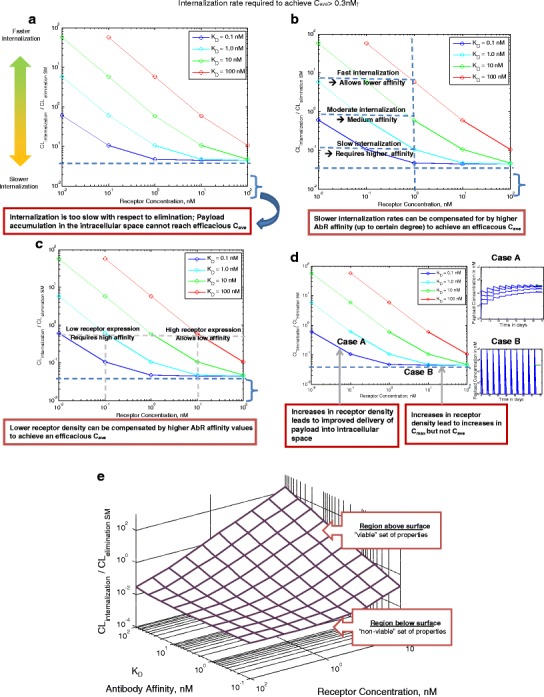
Interplay of target affinity, target expression, and rate of internalization on delivering efficacious drug concentration to effect site. Note: Antibody affinity for receptor, receptor internalization rate and receptor concentration are varied. All other parameters are kept constant: CLRES = 5 mL/day/Kg; CLSM = 2.7 L/day/Kg; Vd_SM = 0.6 L/Kg (t1/2_SM ∼ 4 h); Vd_Ab = 40 mL/Kg

References

    1. Zolot RS, Basu S, Million RP. Antibody-drug conjugates. Nat Rev Drug Discov. 2013;12(4):259–60. doi: 10.1038/nrd3980. - DOI - PubMed
    1. Adair JR, et al. Antibody-drug conjugates-a perfect synergy. Expert Opin Biol Ther. 2012;12(9):1191–206. doi: 10.1517/14712598.2012.693473. - DOI - PubMed
    1. Perez HL, et al. Antibody-drug conjugates: current status and future directions. Drug Discov Today. 2014;19(7):869–81. doi: 10.1016/j.drudis.2013.11.004. - DOI - PubMed
    1. Junutula JR, et al. Site-specific conjugation of a cytotoxic drug to an antibody improves the therapeutic index. Nat Biotechnol. 2008;26(8):925–32. doi: 10.1038/nbt.1480. - DOI - PubMed
    1. McDonagh CF, et al. Engineered anti-CD70 antibody-drug conjugate with increased therapeutic index. Mol Cancer Ther. 2008;7(9):2913–23. doi: 10.1158/1535-7163.MCT-08-0295. - DOI - PubMed