


A 35-Year Perspective (1975 to 2009) into the Long-Term Prognosis and Hospital Management of Patients Discharged from the Hospital After a First Acute Myocardial Infarction
- PMID: 25933734
- PMCID: PMC4466002
- DOI: 10.1016/j.amjcard.2015.03.035
A 35-Year Perspective (1975 to 2009) into the Long-Term Prognosis and Hospital Management of Patients Discharged from the Hospital After a First Acute Myocardial Infarction
Abstract
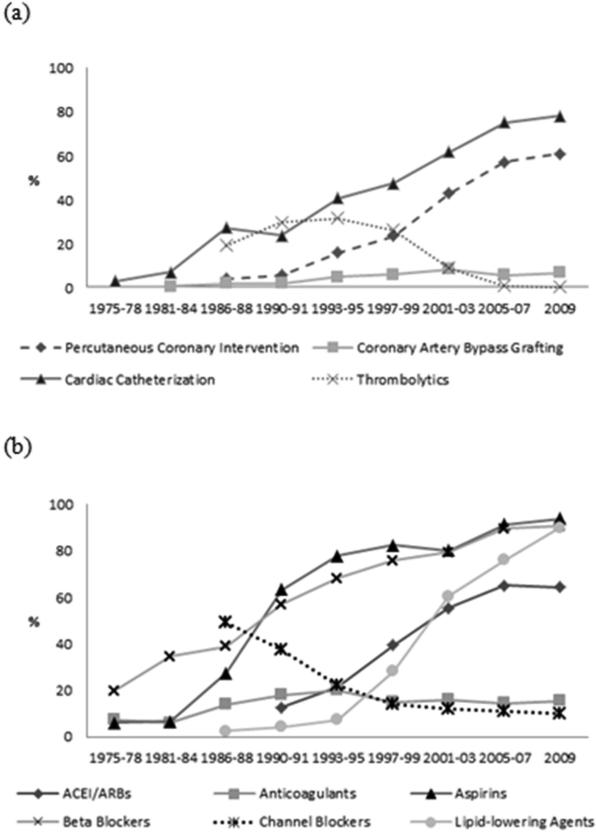
There are limited population-based data available describing trends in the long-term prognosis of patients discharged from the hospital after an initial acute myocardial infarction (AMI). Our objectives were to describe multidecade trends in post-discharge mortality and their association with hospital management practices in patients discharged from all medical centers in Central Massachusetts after a first AMI. Residents of the Worcester, Massachusetts, metropolitan area discharged from all hospitals in Central Massachusetts after a first AMI from 1975 to 2009 comprised the study population (n = 8,728). Multivariable-adjusted logistic regression analyses were used to examine the association between year of hospitalization and 1-year post-discharge mortality. The average age of this population was 66 years, and 40% were women. Patients hospitalized in 1999 to 2009, compared with those discharged in 1975 to 1984, were older, more likely to be women, and have multiple previously diagnosed co-morbidities. Hospital use of invasive cardiac interventions and medications increased markedly over time. Unadjusted 1-year mortality rates were 12.9%, 12.5%, and 15.8% for patients discharged during 1975 to 1984, 1986 to 1997, and 1999 to 2009, respectively. After adjusting for several demographic characteristics, clinical factors, and inhospital complications, there were no significant differences in the odds of dying at 1-year post-discharge during the years under study. After further adjustment for hospital treatment practices, the odds of dying at 1 year post-discharge was 2.43 (95% confidence interval = 1.83 to 3.23) times higher in patients hospitalized in 1999 to 2009 than in 1975 to 1984. In conclusion, the increased use of invasive cardiac interventions and pharmacotherapies was associated with enhanced long-term survival in patients hospitalized for a first AMI.
Copyright © 2015 Elsevier Inc. All rights reserved.
Figures
Comment in
-
The 35-Year Perspective as to Prognosis and Management of Myocardial Infarction.Am J Cardiol. 2015 Dec 15;116(12):1951. doi: 10.1016/j.amjcard.2015.09.015. Epub 2015 Oct 9. Am J Cardiol. 2015. PMID: 26602078 No abstract available.
References
-
- Goldberg RJ, Gore JM, Alpert JS, Dalen JE. Recent changes in attack and survival rates of acute myocardial infarction (1975 through 1981): the Worcester Heart Attack Study. JAMA. 1986;255:2774–2779. - PubMed
-
- Goldberg RJ, Gore JM, Alpert JS, Dalen JE. Incidence and case fatality rates of acute myocardial infarction (1975–1984): the Worcester Heart Attack Study. Am Heart J. 1988;115:761–767. - PubMed
-
- Goldberg RJ, Yarzebski J, Lessard D, Gore JM. A two-decades (1975 to 1995) long experience in the incidence, in-hospital and long-term case-fatality rates of acute myocardial infarction: a community-wide perspective. J Am Coll Cardiol. 1999;33:1533–1539. - PubMed
-
- Floyd KC, Yarzebski J, Spencer FA, Lessard D, Dalen JE, Alpert JS, Gore JM, Goldberg RJ. A 30-year perspective (1975-2005) into the changing landscape of patients hospitalized with initial acute myocardial infarction: Worcester Heart Attack Study. Circ Cardiovasc Qual Outcomes. 2009;2:88–95. - PMC - PubMed
-
- Jneid H, Anderson JL, Wright RS, Adams CD, Bridges CR, Casey DE, Jr, Ettinger SM, Fesmire FM, Ganiats TG, Lincoff AM, Peterson ED, Philippides GJ, Theroux P, Wenger NK, Zidar JP. 2012 ACCF/AHA focused update of the guideline for the management of patients with unstable angina/non-ST-elevation myocardial infarction (updating the 2007 guideline and replacing the 2011 focused update): a report of the American College of Cardiology Fo. J Am Coll Cardiol. 2012;60:645–681. - PubMed
Publication types
MeSH terms
Grants and funding
LinkOut - more resources
Full Text Sources
Other Literature Sources
Medical
