Review
. 2015 May 1;7(5):a021295.
doi: 10.1101/cshperspect.a021295.

Adult hippocampal neurogenesis in natural populations of mammals

Affiliations
Review

Adult hippocampal neurogenesis in natural populations of mammals

Irmgard Amrein. Cold Spring Harb Perspect Biol. .

Abstract

This review will discuss adult hippocampal neurogenesis in wild mammals of different taxa and outline similarities with and differences from laboratory animals. It begins with a review of evidence for hippocampal neurogenesis in various mammals, and shows the similar patterns of age-dependent decline in cell proliferation in wild and domesticated mammals. In contrast, the pool of immature neurons that originate from proliferative activity varies between species, implying a selective advantage for mammals that can make use of a large number of these functionally special neurons. Furthermore, rapid adaptation of hippocampal neurogenesis to experimental challenges appears to be a characteristic of laboratory rodents. Wild mammals show species-specific, rather stable hippocampal neurogenesis, which appears related to demands that characterize the niche exploited by a species rather than to acute events in the life of its members. Studies that investigate adult neurogenesis in wild mammals are not numerous, but the findings of neurogenesis under natural conditions can provide new insights, and thereby also address the question to which cognitive demands neurogenesis may respond during selection.


Figures

Figure 1.
Figure 1.
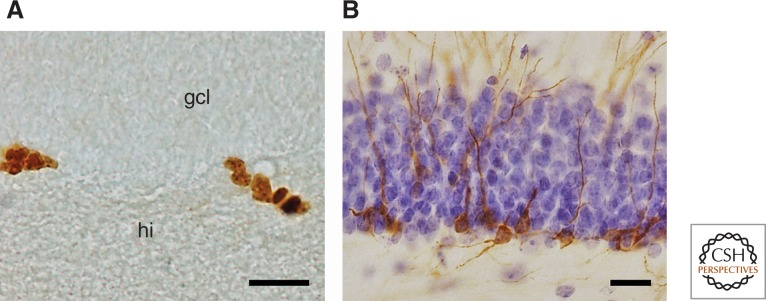
Endogenous markers used for visualizing adult hippocampal neurogenesis (AHN) in wild mammals. Immunopositive cells in the dentate gyrus of wood mice stained for the proliferation marker Ki67 (A) are found in the subgranular layer between granular cell layer (gcl) and hilus (hi) and are often seen in clusters. Young differentiating neurons, immunopositive for doublecortin (DCX) (B) show dendritic branching into the granule cell layer and beyond. The section in B was counterstained with haematoxylin to visualize the granule cell layer. Scale bars, 20 µm. (From Hauser et al. 2009; reprinted under the terms of the Creative Commons Attribution License, which permits unrestricted use, distribution, and reproduction in any medium, provided the original work is properly cited.)
Figure 2.
Figure 2.
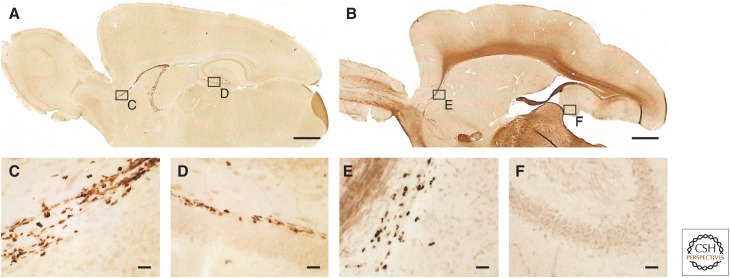
Neurogenic niches in mouse and bats. Mice (A) and echolocating bats (B) show comparable levels of proliferating cells in the subventricular zone (SVZ) and rostral migratory stream (C,E); however, proliferation activity in the hippocampus of bats (F) is completely missing, whereas mice show many proliferating cells in the subgranular layer of the dentate gyrus (D). Proliferating cells are visualized immunohistochemically using Ki67. Scale bars, 1 mm (A,B); 25 µm (CF). (From Amrein et al. 2007; reprinted, with permission, from the authors.)
Figure 3.
Figure 3.
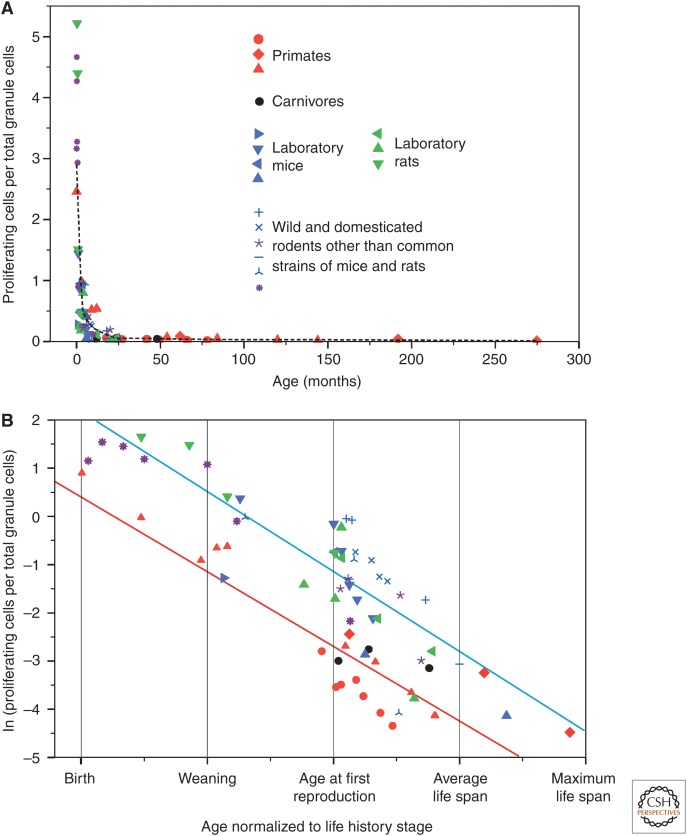
Similar decline of cell proliferation with chronological age. (A) Common exponential decline of standardized numbers of proliferating cells (as a percentage of total granule cell number) during aging of laboratory and wild rodents, foxes, and primates. (B) Log-transformed data with respect to major life history stages reveal that primates (red line) and foxes show lower cell proliferation at each stage than rodents (blue line). (From Amrein et al. 2011; adapted, with permission, from John Wiley and Sons © 2011.)
Figure 4.
Figure 4.
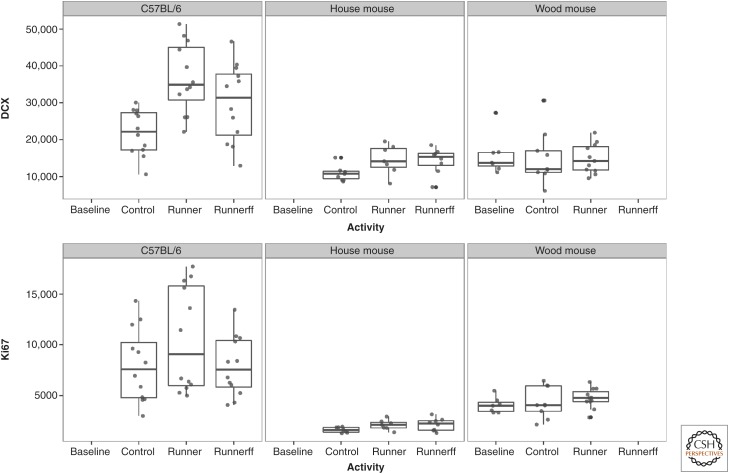
AHN stability in wild versus plasticity in laboratory rodents. High individual variability in the number of proliferating cells (Ki67) and young neurons (DCX) owing to experimental challenges in the running C57BL/6 stands in contrast to stable AHN with low interindividual variability in age-matched F1 of wild house mice and wild long-tailed wood mice. The experimental effect of voluntary running on AHN is significant in C57BL/6, but not in house mice or wood mice. If rodents have to run to get their food, running becomes a necessity, and running for food (runnerff) counteracts the positive effect of physical activity on AHN in C56BL/6, but not in wild house mice. Baseline: wild mice investigated right after trapping. (Data from Hauser et al. 2009 and Klaus et al. 2012.)
Figure 5.
Figure 5.
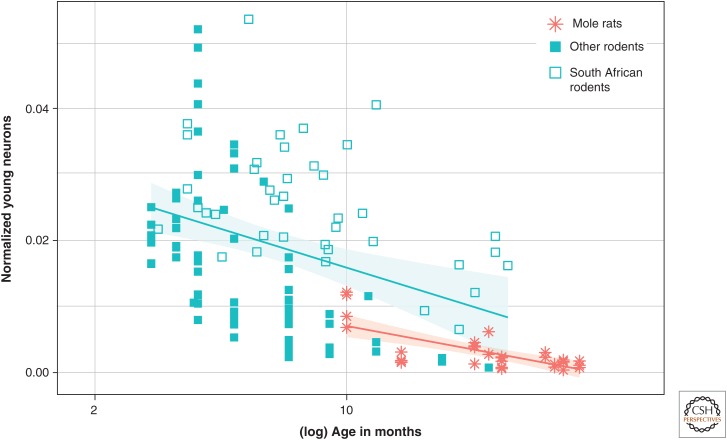
Habitat pattern of basal AHN in rodents. Estimated numbers of young neurons (DCX+ or PSA-NCAM+) as a percentage of total granule cells (normalized young neurons) relative to tentative age are markedly lower in subterranean mole rats compared with surface-dwelling rodents. Within the surface-dwelling rodents, the South African species from an environmental challenging habitat form their own cluster. (Data from Amrein et al. 2011, ; Cavegn et al. 2013.)

References

    1. Abusaad I, MacKay D, Zhao J, Stanford P, Collier DA, Everall IP. 1999. Stereological estimation of the total number of neurons in the murine hippocampus using the optical disector. J Comp Neurol 408: 560–566. - PubMed
    1. Alpár A, Künzle H, Gärtner U, Popkova Y, Bauer U, Grosche J, Reichenbach A, Härtig W. 2010. Slow age-dependent decline of doublecortin expression and BrdU labeling in the forebrain from lesser hedgehog tenrecs. Brain Res 1330: 9–19. - PubMed
    1. Altman J. 1963. Autoradiographic investigation of cell proliferation in the brains of rats and cats. Anat Rec 145: 573–591. - PubMed
    1. Altman J, Das GD. 1967. Postnatal neurogenesis in the guinea-pig. Nature 214: 1098–1101. - PubMed
    1. Amrein I, Lipp H-P. 2009. Adult hippocampal neurogenesis of mammals: Evolution and life history. Biol Lett 5: 141–144. - PMC - PubMed

Publication types

LinkOut - more resources