


Adult brainstem gliomas: Correlation of clinical and molecular features
- PMID: 25934342
- PMCID: PMC4782610
- DOI: 10.1016/j.jns.2015.04.014
Adult brainstem gliomas: Correlation of clinical and molecular features
Abstract
Background: Brainstem gliomas are rare in adults and overall have superior survival outcomes compared to pediatric brainstem gliomas.
Patients and methods: We conducted a retrospective data and tissue analysis of all adult patients (≥ 18 years old) with World Health Organization (WHO) Grade II, III, and IV brainstem gliomas in the University of Texas MD Anderson Cancer Center institutional database from 1990 to 2012.
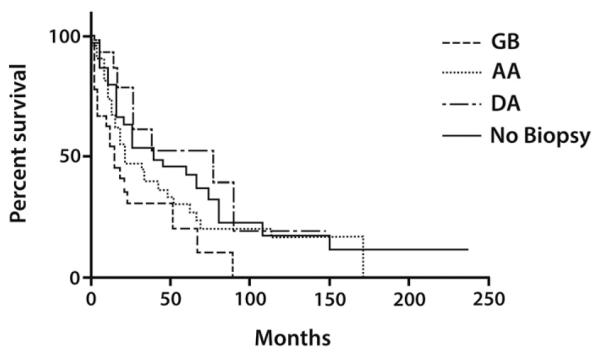
Results: We identified 143 cases in adults ages 18 and over. There were 28 glioblastomas, 43 anaplastic astrocytomas, 15 diffuse astrocytomas, and 11 gliomas not otherwise specified, and in 46 cases the diagnosis was made radiographically. 128 (89.5%) cases were classified radiographically as diffuse and of the focal tumors, 9 of the 15 were WHO Grade III or IV tumors. Increasing tumor grade and contrast enhancement were associated with significantly reduced overall survival. The median overall survival for the entire cohort was 32.1 months similar to previously published studies. Two of 25 grade II and III tumors, and 1 of 17 glioblastomas had IDH1 mutations on immunohistochemical testing. Nine cases had sufficient tissue for mutation profiling, 1 case had a BRAF V600E mutation and 2 had 2 PIK3CA mutations.
Conclusions: Survival outcomes for adult WHO Grade II to IV brainstem gliomas were similar to supratentorial IDH1 wild-type tumors of similar grade and histology. Potentially actionable mutations can be identified from small biopsy samples in a subset of adult brainstem gliomas.
Keywords: Astrocytoma; Brainstem glioma; Diffuse intrinsic pontine glioma; Glioblastoma; Isocitrate dehydrogenase mutation; Oligodendroglioma.
Published by Elsevier B.V.
Figures
References
-
- Grimm SA, Chamberlain MC. Brainstem glioma: a review. Curr Neurol Neurosci Rep. 2013;13:346. http://dx.doi.org/10.1007/s11910-013-0346-3. - DOI - PubMed
-
- Reyes-Botero G, Mokhtari K, Martin-Duverneuil N, et al. Adult brainstem gliomas. Oncologist. 2012;17:388–97. http://dx.doi.org/10.1634/theoncologist.2011-0335. - DOI - PMC - PubMed
-
- Donaldson SS, Laningham F, Fisher PG. Advances toward an understanding of brainstem gliomas. J Clin Oncol. 2006;24:1266–72. http://dx.doi.org/10.1200/JCO.2005.04.6599. - DOI - PubMed
-
- Guillamo JS, Monjour A, Taillandier L, et al. Brainstem gliomas in adults: prognostic factors and classification. Brain. 2001;124:2528–39. - PubMed
Publication types
MeSH terms
Substances
Grants and funding
LinkOut - more resources
Full Text Sources
Other Literature Sources
Research Materials
Miscellaneous
