Review
. 2015 Jun:776:136-43.
doi: 10.1016/j.mrfmmm.2015.03.014. Epub 2015 Apr 20.

High-throughput sequencing in mutation detection: A new generation of genotoxicity tests?

Affiliations
Review

High-throughput sequencing in mutation detection: A new generation of genotoxicity tests?

Alexander Y Maslov et al. Mutat Res. 2015 Jun.

Abstract

The advent of next generation sequencing (NGS) technology has provided the means to directly analyze the genetic material in primary cells or tissues of any species in a high throughput manner for mutagenic effects of potential genotoxic agents. In principle, direct, genome-wide sequencing of human primary cells and/or tissue biopsies would open up opportunities to identify individuals possibly exposed to mutagenic agents, thereby replacing current risk assessment procedures based on surrogate markers and extrapolations from animal studies. NGS-based tests can also precisely characterize the mutation spectra induced by genotoxic agents, improving our knowledge of their mechanism of action. Thus far, NGS has not been widely employed in genetic toxicology due to the difficulties in measuring low-abundant somatic mutations. Here, we review different strategies to employ NGS for the detection of somatic mutations in a cost-effective manner and discuss the potential applicability of these methods in testing the mutagenicity of genotoxic agents.

Keywords: Genetic toxicology; Genome rearrangement; Mutagenicity; Mutation; Next generation sequencing.


Conflict of interest statement

Conflict of Interest statement.

The authors declare that there are no conflicts of interest.

Figures
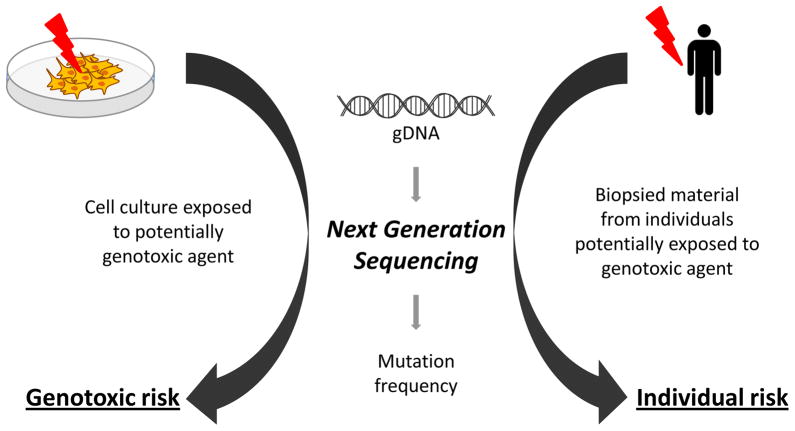
Fig. 1
Fig. 1
NGS-based assays allow for the direct assessment of potential genotoxic agents for mutagenicity (left) and individual risk of exposure to possible mutagenic agents, such as radiation.
Fig. 2
Fig. 2
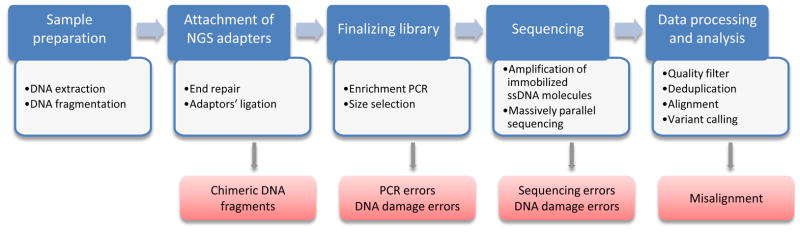
General workflow of NGS-based assays and putative errors associated with each step.
Fig. 3
Fig. 3
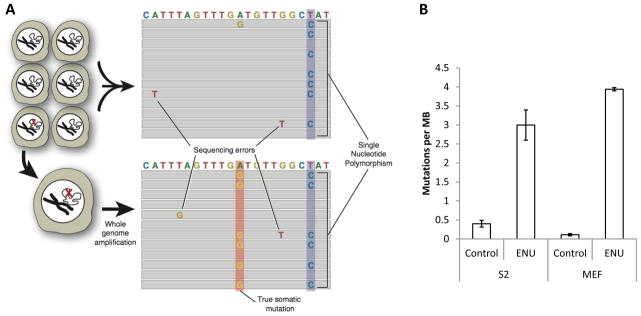
(A) Detecting point mutations and small indels in single cells. (B) ENU significantly elevates mutation frequency in both Drosophila S2 cells (n=3 for treated and untreated) cells and mouse embryonic fibroblasts (n=2 for treated and untreated). For details, see [22].
Fig. 4
Fig. 4
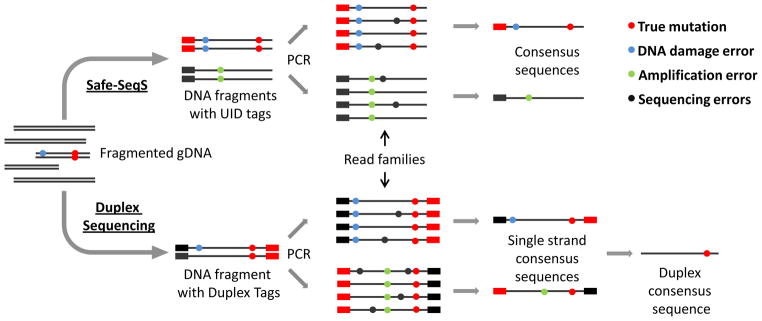
Schematic depiction of the Safe-Sequencing System and Duplex Sequencing assays.
Fig. 5
Fig. 5
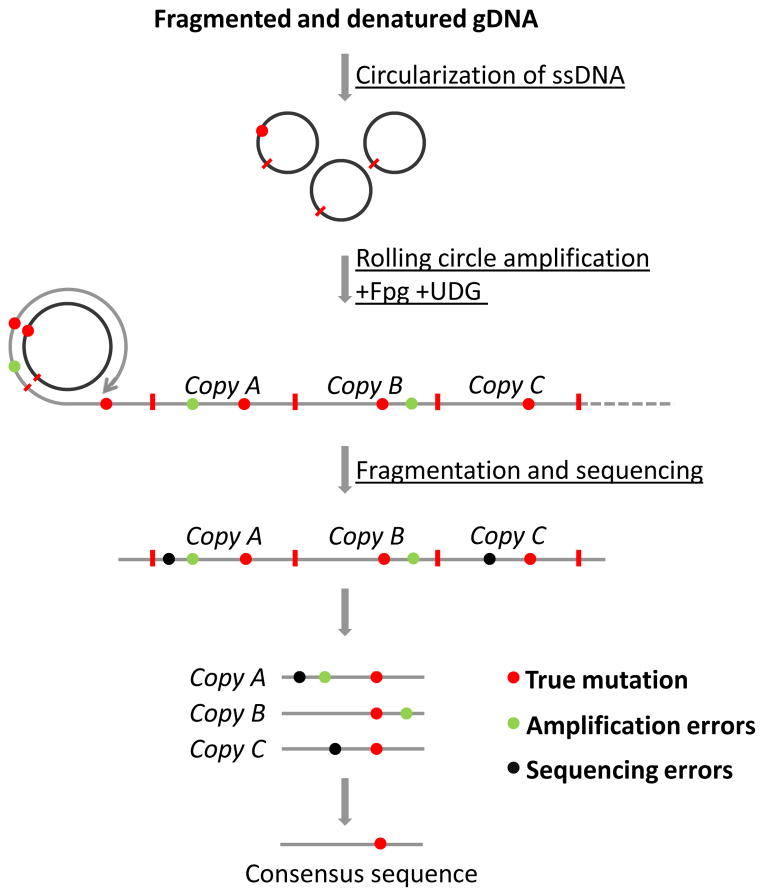
Schematic depiction of the circle sequencing assay for mutation detection. Genomic DNA is ligated into circles and amplified by RCA. Sequenced DNA copies are collapsed into a consensus sequence to determine true point mutations/indels.
Fig. 6
Fig. 6
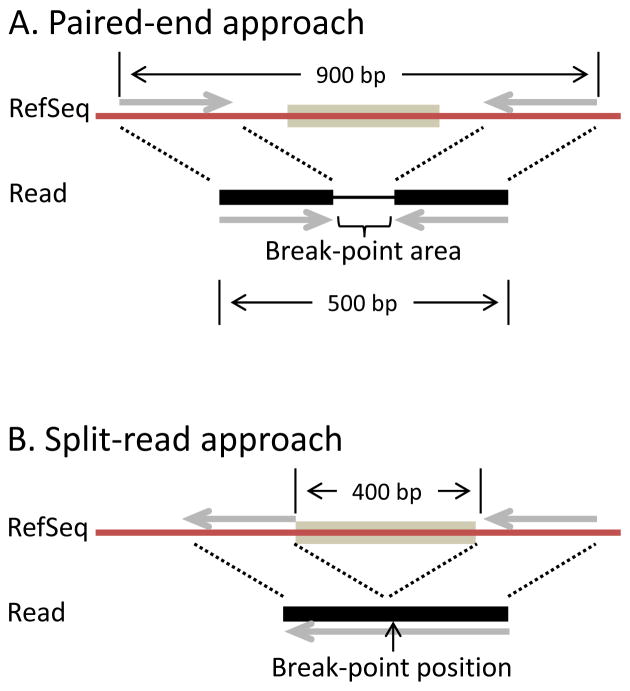
(A) Paired-end approach for detection of structural variants is based on discrepancies in mapping the ends of a sequenced fragment to the reference genome. When DNA fragments of a particular size are sequenced from both ends the paired reads should be positioned at a known distance from each other when aligned to a reference sequence. (B) Split-read approach is based on finding continuous sequencing reads with anomalous alignment of different parts. For both approaches if the distance and orientation between the read pairs (or parts of the read) differs from that on the reference genome, then a rearrangement event, such as a deletion or insertion is implied. It is also possible that one of the two read pairs (part of the read) maps to another chromosome, indicating a chromosomal translocation. An event of 400 bp deletion is shown for both approaches. Generally the split-read approach relays on longer read length, but has enhanced resolution and, unlike the paired-end method, allows for the precise identification of DNA breakpoints.

References

    1. Maslov AY, Vijg J. Genome instability, cancer and aging. Biochim Biophys Acta. 2009;1790(10):963–9. - PMC - PubMed
    1. Veltman JA, Brunner HG. De novo mutations in human genetic disease. Nat Rev Genet. 2012;13(8):565–75. - PubMed
    1. Poon SL, et al. Mutation signatures of carcinogen exposure: genome-wide detection and new opportunities for cancer prevention. Genome Med. 2014;6(3):24. - PMC - PubMed
    1. Hoeijmakers JH. DNA damage, aging, and cancer. N Engl J Med. 2009;361(15):1475–85. - PubMed
    1. Vijg J, Suh Y. Genome instability and aging. Annu Rev Physiol. 2013;75:645–68. - PubMed

Publication types