


The effect of hydroxyquinoline-based gel on pessary-associated bacterial vaginosis: a multicenter randomized controlled trial
- PMID: 25935783
- PMCID: PMC4627896
- DOI: 10.1016/j.ajog.2015.04.032
The effect of hydroxyquinoline-based gel on pessary-associated bacterial vaginosis: a multicenter randomized controlled trial
Abstract
Objective: Pessaries are important options for women with pelvic floor disorders, but many pessary users experience bacterial vaginosis (BV). The aim of this study was to evaluate the effect of TrimoSan gel (Milex Pessaries, Cooper Surgical, Trumbull, CT) on BV prevalence among pessary users.
Study design: Women presenting for a pessary fitting completed questionnaires on vaginal symptoms and hormone therapy use and underwent a BV BLUE test and slide collection for BV analysis by Nugent's criteria. Following pessary fitting, women were randomized to either standard pessary care with the use of TrimoSan placed vaginally twice weekly or to standard pessary care without TrimoSan gel. Women returned 2 weeks and 3 months later for a repeat slide collection for Gram stain, BV BLUE testing, and completion of questionnaires on vaginal symptoms and desire to continue the pessary.
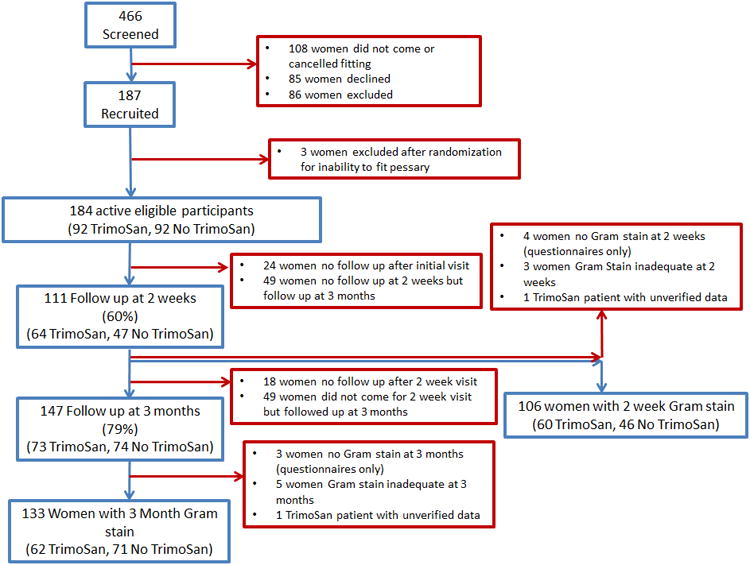
Results: There were 184 women randomized after successful fitting (92 to the TrimoSan group), and 147 (79%) presented for 3-month follow up. Mean age was 56 ± 16 years; patients were mostly white (57%) or Hispanic (23%), and 36% were using hormone therapy. The groups did not differ in the prevalence of BV by Nugent's criteria at 2 weeks (20% TrimoSan vs 26% no gel, P = .46) or 3 months (24% TrimoSan vs 23% no gel, P = .82), nor did they differ in BV by BV BLUE testing at 2 weeks (0% TrimoSan vs 4% no gel, P = .12) or 3 months (3% TrimoSan vs 0% no gel, P = .15). The prevalence of at least one vaginal symptom did not differ between groups at 2 weeks (44% TrimoSan vs 45% no gel, P = .98) or 3 months (42% TrimoSan vs 32% no gel, P = .30). The TrimoSan group was equally likely to want to continue their pessary use compared with the standard care group at 2 weeks (90% vs 86%, P = .64) and 3 months (63% vs 60%, P = .76).
Conclusion: TrimoSan gel in the first 3 months of pessary use does not decrease the prevalence of BV or vaginal symptoms and does not alter the likelihood of a woman desiring to continue pessary use.
Trial registration: ClinicalTrials.gov NCT01471457.
Keywords: TrimoSan; bacterial vaginosis; discharge; pessary; removal.
Copyright © 2015 Elsevier Inc. All rights reserved.
Conflict of interest statement
Figures
References
-
- Olsen AL, Smith VJ, Bergstrom JO, Colling JC, Clark AL. Epidemiology of surgically managed pelvic organ prolapse and urinary incontinence. Obstet Gynecol. 1997;89(4):501. - PubMed
-
- Robert M, Schulz JA, Harvey MA, Urogynaecology Committee. Lovatsis D, Walter JE, Chou Q, Easton WA, Epp A, Farrell SA, Geoffrion R, Girouard L, Gupta CK, Harvey MA, Larochelle A, Maslow KD, Neustaeder G, Pascali D, Pierce M, Robert M, Ross S, Schachter J, Schulz JA, Senikas V, Wilkie DH. Technical update on pessary use. J Obstet Gynaecol Can. 2013 Jul;35(7):664–74. - PubMed
Publication types
MeSH terms
Substances
Associated data
Grants and funding
LinkOut - more resources
Full Text Sources
Other Literature Sources
Medical
