Review
. 2015;2(2):89-100.
doi: 10.1007/s40471-015-0038-4.

Influenza Burden and Transmission in the Tropics

Affiliations
Review

Influenza Burden and Transmission in the Tropics

Sophia Ng et al. Curr Epidemiol Rep. 2015.

Abstract

Each year, influenza causes substantial mortality and morbidity worldwide. It is important to understand influenza in the tropics because of the significant burden in the region and its relevance to global influenza circulation. In this review, influenza burden, transmission dynamics, and their determinants in the tropics are discussed. Environmental, cultural, and social conditions in the tropics are very diverse and often differ from those of temperate regions. Theories that account for and predict influenza dynamics in temperate regions do not fully explain influenza epidemic patterns observed in the tropics. Routine surveillance and household studies have been useful in understanding influenza dynamics in the tropics, but these studies have been limited to only some regions; there is still a lack of information regarding influenza burden and transmission dynamics in many tropical countries. Further studies in the tropics will provide useful insight on many questions that remain.

Keywords: Burden; Environmental; Influenza; Phylogenetics; Transmission; Tropics.


Conflict of interest statement

S. Ng and A. Gordon both declare no conflict of interest.

Figures
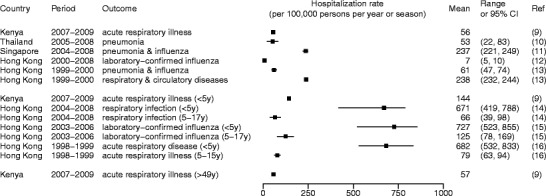
Fig. 1
Fig. 1
Influenza-associated hospitalization rates during non-pandemic years (Feikin et al. [9], Simmerman et al. [10], Ang et al. [11], Chan et al. [12], Li et al. [13], Chiu et al. [14, 15, 16])
Fig. 2
Fig. 2
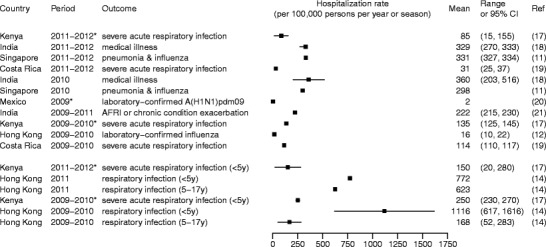
Influenza-associated hospitalization rates during the year of 2009 and after when A(H1N1)pdm09 virus circulated. The asterisk indicates a study period that did not cover an entire season or year. AFRI refers to acute febrile respiratory infection. Findings were stratified into two study periods: period 1, the year of 2009 (or 2009–2010 season) and the year of 2010 (or 2010–2011 season); and period 2, the year of 2011 (or 2011–2012 season) and 2012 (or 2012–2013 season) (Emukule et al. [•], Hirve et al. [18], Ang et al. [11], Saborio et al. [19], Echevarria-Zuno et al. [20], Chadha et al. [21], Chan et al. [12], Chiu et al. [14])
Fig. 3
Fig. 3
Influenza-associated mortality rates during non-pandemic years. COPD refers to chronic obstructive pneumonia disease. IHD refers to ischemic heart disease (Simmerman et al. [10], Wong et al. [23], Comas-Garcia et al. [24], Freitas et al. [25], Charu et al. [26], Wu et al. [27], Oliveira et al. [28], Chow et al. [29], Wong et al. [30], Lee et al. [31], Ho and Chow [32], Yang et al. [33], Li et al. [13], Freitas et al. [34])
Fig. 4
Fig. 4
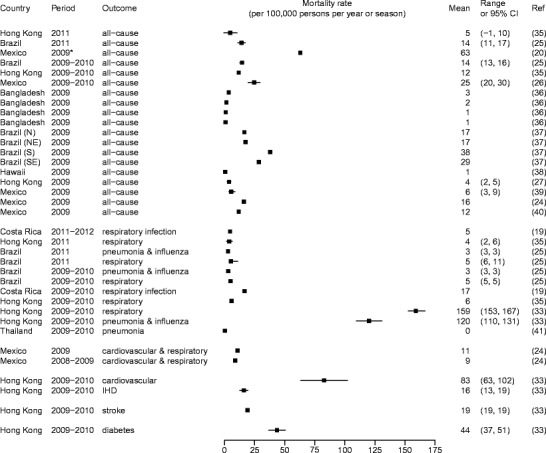
Influenza-associated mortality rates during the year of 2009 and after when A(H1N1)pdm09 virus circulated. Findings were stratified into two study periods: period 1, the year of 2009 (or 2009–2010 season) and the year of 2010 (or 2010–2011 season); and period 2, the year of 2011 (or 2011–2012 season) and 2012 (or 2012–2013 season). The asterisk indicates a study period that did not cover an entire season or year. IHD refers to ischemic heart disease (Wu et al. [35], Freitas et al. [25], Echevarria-Zuno et al. [20], Charu et al. [26], Homaria et al. [36], Cerbino Neto et al. [37], Fowlkes et al. [38], Wu et al. [27], Perez-Flores et al. [39], Comas-Garcia et al. [24], Fajardo-Dolci et al. [40], Saborio et al. [19], Yang et al. [33], Bunthi et al. [41])

References

    1. Mayor S. Acute respiratory infections are world’s third leading cause of death. BMJ. 2010 Nov 9;341(nov09 1):c6360–c6360.
    1. Dawood FS, Iuliano AD, Reed C, Meltzer MI, Shay DK, Cheng P-Y, et al. Estimated global mortality associated with the first 12 months of 2009 pandemic influenza a H1N1 virus circulation: a modelling study. Lancet Infect Dis. 2012;12(9):687. - PubMed
    1. Simonsen L, Spreeuwenberg P, Lustig R, Taylor RJ, Fleming DM, Kroneman M, et al. Global mortality estimates for the 2009 influenza pandemic from the GLaMOR project: a modeling study. PLoS Med. 2013 Nov;10(11). - PMC - PubMed
    1. Nair H, Brooks WA, Katz M, Roca A, Berkley JA, Madhi SA, et al. Global burden of respiratory infections due to seasonal influenza in young children: a systematic review and meta-analysis. Lancet. 2011;378(9807):1917–30. - PubMed
    1. United Nations Statistics Division. Compendium of human settlements statistics. 1995; Available from: http://unstats.un.org/unsd/demographic/sconcerns/housing/chss1995.htm

LinkOut - more resources