Clinical Trial
. 2015 Jun;125(6):2363-8.
doi: 10.1172/JCI81163. Epub 2015 May 4.

BCL11A deletions result in fetal hemoglobin persistence and neurodevelopmental alterations

Clinical Trial

BCL11A deletions result in fetal hemoglobin persistence and neurodevelopmental alterations

Anindita Basak et al. J Clin Invest. 2015 Jun.

Abstract

A transition from fetal hemoglobin (HbF) to adult hemoglobin (HbA) normally occurs within a few months after birth. Increased production of HbF after this period of infancy ameliorates clinical symptoms of the major disorders of adult β-hemoglobin: β-thalassemia and sickle cell disease. The transcription factor BCL11A silences HbF and has been an attractive therapeutic target for increasing HbF levels; however, it is not clear to what extent BCL11A inhibits HbF production or mediates other developmental functions in humans. Here, we identified and characterized 3 patients with rare microdeletions of 2p15-p16.1 who presented with an autism spectrum disorder and developmental delay. Moreover, these patients all exhibited substantial persistence of HbF but otherwise retained apparently normal hematologic and immunologic function. Of the genes within 2p15-p16.1, only BCL11A was commonly deleted in all of the patients. Evaluation of gene expression data sets from developing and adult human brains revealed that BCL11A expression patterns are similar to other genes associated with neurodevelopmental disorders. Additionally, common SNPs within the second intron of BCL11A are strongly associated with schizophrenia. Together, the study of these rare patients and orthogonal genetic data demonstrates that BCL11A plays a central role in silencing HbF in humans and implicates BCL11A as an important factor for neurodevelopment.


Figures
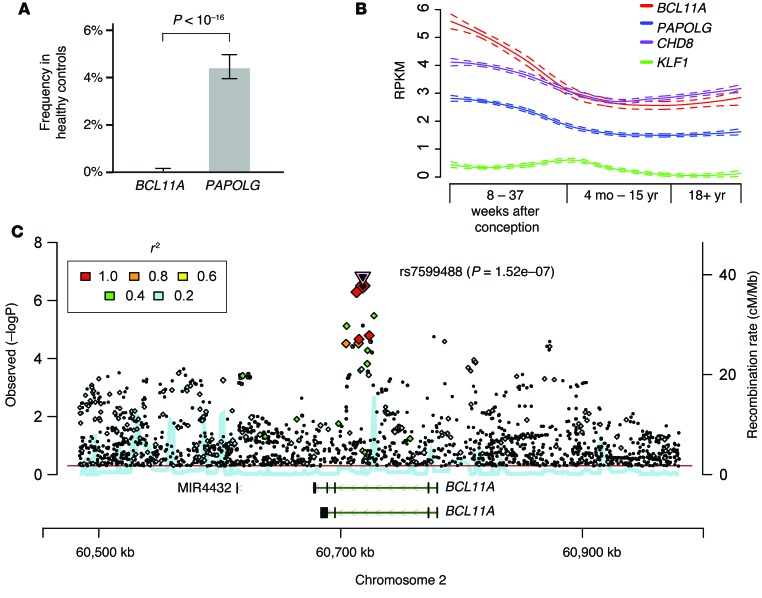
Figure 3
Figure 3. Role of BCL11A in human neurodevelopment.
(A) The percentage of LOF alleles in BCL11A and PAPOLG from the 6,503 individuals in the Exome Sequencing Project. Error bars represent 95% confidence intervals around the percentage of individuals with one or more LOF alleles. Comparison of these frequencies is performed by Fisher’s exact test. (B) The expression of select genes in brain tissue at different developmental stages (from various brain regions that are aggregated here for simplicity). Data are plotted as the number of reads per kb per million (RPKM) for the genes shown. A locally weighted scatterplot smoothing regression was applied to expression of each gene. Results from this regression are plotted with 95% confidence intervals. (C) Regional association plot depicting data analyzed from a recent schizophrenia GWAS (22).
Figure 2
Figure 2. Persistence of HbF with BCL11A haploinsufficiency.
(A) Relative gene expression from qPCR analysis done for BCL11A and PAPOLG. In addition, the percentage of HBG1 and HBG2 are shown. The color-coding of various samples in all the panels is shown on the right, and independent replicates (n = 3 per individual) are plotted individually. ***P < 0.001. (B) Hemoglobin electrophoresis (patients 1 and 2) and high-performance liquid chromatography (HPLC; Patient 3) chromatograms with the level of different hemoglobin subtypes quantified from peripheral blood samples. The level of hemoglobin A (HbA), HbF, and HbA2 are shown below the chromatograms. In the HPLC chromatogram, the peaks for HbF and HbA2 are filled in, while HbA remains without any filling. The ordering of the labels below the chromatograms is in the order of peak positions. All comparisons were performed using the 2-tailed nonparametric Mann-Whitney U test.
Figure 1
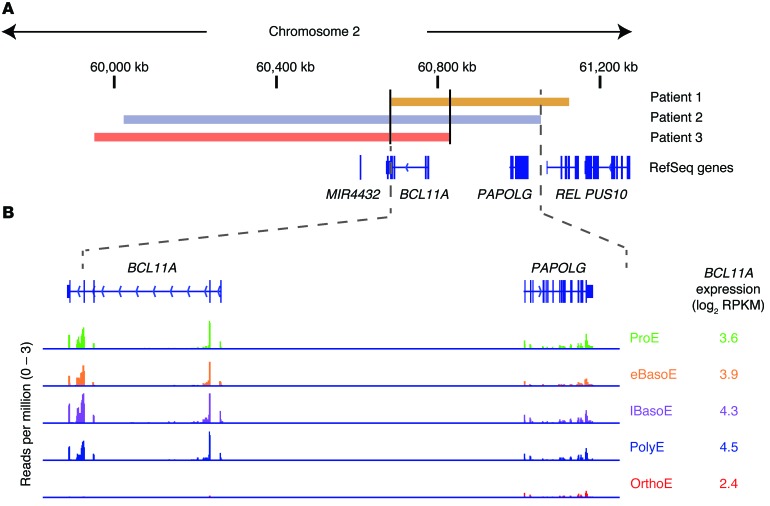
Figure 1. Involvement of BCL11A in the 2p microdeletion syndrome.
(A) A depiction of the 2p15-p16.1 region with coordinates shown (hg19). The position of the patient deletions are shown in orange (Patient 1), blue (Patient 2), and red (Patient 3), and RefSeq genes are shown below. The commonly deleted region of patients 1 and 2 is shown between dotted lines. (B) The common deleted region of patients 1 and 2 involving BCL11A and PAPOLG. RNA expression is shown below at various stages of human erythroid differentiation. This includes proerythroblasts (ProE), early basophilic erythroblasts (eBasoE), late basophilic erythroblasts (lBasoE), polychromatic erythroblasts (PolyE), and orthochromatic erythroblasts (OrthoE). The height of RNA peaks in each region demonstrates the number of reads per million at that site and the reads per kb per million (RPKM) mapped reads for BCL11A is shown in log2 scale.

References

    1. Sankaran VG, Orkin SH. The switch from fetal to adult hemoglobin. Cold Spring Harb Perspect Med. 2013;3(1):a011643. - PMC - PubMed
    1. Sankaran VG, Weiss MJ. Anemia: progress in molecular mechanisms and therapies. Nat Med. 2015;21(3):221–230. doi: 10.1038/nm.3814. - DOI - PMC - PubMed
    1. Sankaran VG, et al. Human fetal hemoglobin expression is regulated by the developmental stage-specific repressor BCL11A. Science. 2008;322(5909):1839–1842. doi: 10.1126/science.1165409. - DOI - PubMed
    1. Sankaran VG, et al. Developmental and species-divergent globin switching are driven by BCL11A. Nature. 2009;460(7259):1093–1097. doi: 10.1038/nature08243. - DOI - PMC - PubMed
    1. Yu Y, et al. Bcl11a is essential for lymphoid development and negatively regulates p53. J Exp Med. 2012;209(13):2467–2483. doi: 10.1084/jem.20121846. - DOI - PMC - PubMed

Publication types

MeSH terms