


Differences in the Epidemiology of Human Cases of Avian Influenza A(H7N9) and A(H5N1) Viruses Infection
- PMID: 25940354
- PMCID: PMC4542598
- DOI: 10.1093/cid/civ345
Differences in the Epidemiology of Human Cases of Avian Influenza A(H7N9) and A(H5N1) Viruses Infection
Abstract
Background: The pandemic potential of avian influenza viruses A(H5N1) and A(H7N9) remains an unresolved but critically important question.
Methods: We compared the characteristics of sporadic and clustered cases of human H5N1 and H7N9 infection, estimated the relative risk of infection in blood-related contacts, and the reproduction number (R).
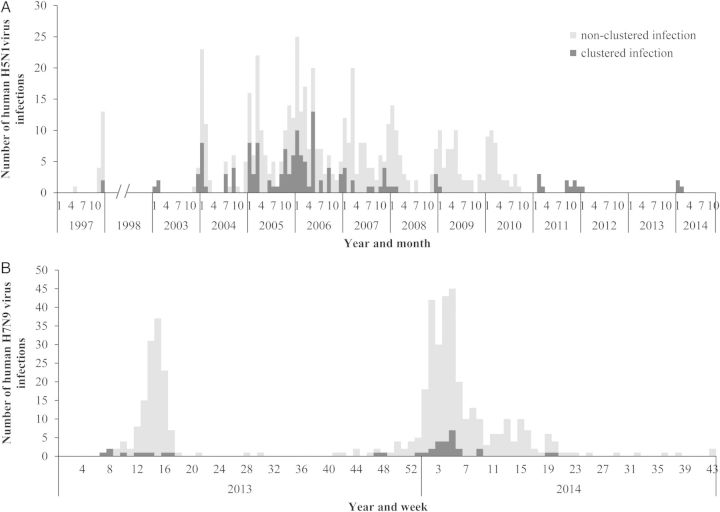
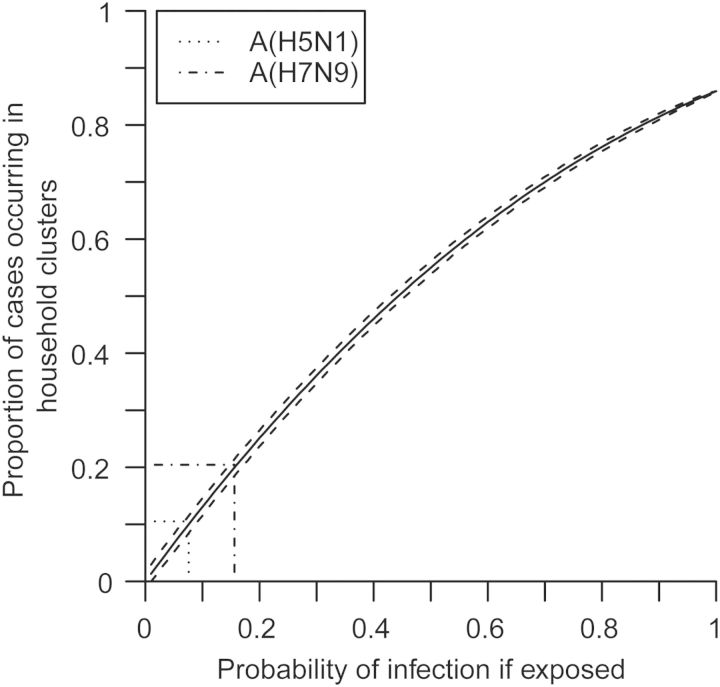
Results: We assembled and analyzed data on 720 H5N1 cases and 460 H7N9 cases up to 2 November 2014. The severity and average age of sporadic/index cases of H7N9 was greater than secondary cases (71% requiring intensive care unit admission vs 33%, P = .007; median age 59 years vs 31, P < .001). We observed no significant differences in the age and severity between sporadic/index and secondary H5N1 cases. The upper limit of the 95% confidence interval (CI) for R was 0.12 for H5N1 and 0.27 for H7N9. A higher proportion of H5N1 infections occurred in clusters (20%) compared to H7N9 (8%). The relative risk of infection in blood-related contacts of cases compared to unrelated contacts was 8.96 for H5N1 (95% CI, 1.30, 61.86) and 0.80 for H7N9 (95% CI, .32, 1.97).
Conclusions: The results are consistent with an ascertainment bias towards severe and older cases for sporadic H7N9 but not for H5N1. The lack of evidence for ascertainment bias in sporadic H5N1 cases, the more pronounced clustering of cases, and the higher risk of infection in blood-related contacts, support the hypothesis that susceptibility to H5N1 may be limited and familial. This analysis suggests the potential pandemic risk may be greater for H7N9 than H5N1.
Keywords: clinical epidemiology; cluster; influenza A(H5N1); influenza A(H7N9).
© The Author 2015. Published by Oxford University Press on behalf of the Infectious Diseases Society of America. All rights reserved. For Permissions, please e-mail: journals.permissions@oup.com.
Figures
Comment in
-
Much Higher Case-fatality Rates of Index Cases. Commentary: Differences in the Epidemiology of Human Cases of Avian Influenza A(H7N9) and A(H5N1) Viruses Infection.Front Public Health. 2016 Jun 20;4:116. doi: 10.3389/fpubh.2016.00116. eCollection 2016. Front Public Health. 2016. PMID: 27378438 Free PMC article. No abstract available.
References
-
- World Health Organization. Influenza at the Human-Animal Interface. Monthly Risk Assessment Summary. Available at: http://www.who.int/influenza/human_animal_interface/Influenza_Summary_IR... Accessed 8 January 2015.
-
- World Health Organization. WHO risk assessment of human infection with avian influenza A(H7N9) virus. Available at: http://www.who.int/influenza/human_animal_interface/influenza_h7n9/riska... Accessed 8 January 2015.
-
- Centers for Disease Control and Prevention. Influenza Risk Assessment Tool (IRAT). Available at: http://www.cdc.gov/flu/pandemic-resources/tools/risk-assessment.htm Accessed 8 January 2015.
Publication types
MeSH terms
Grants and funding
LinkOut - more resources
Full Text Sources
Other Literature Sources
Medical
Molecular Biology Databases
