


Consistent differences in medical unit fall rates: implications for research and practice
- PMID: 25940548
- PMCID: PMC4439336
- DOI: 10.1111/jgs.13387
Consistent differences in medical unit fall rates: implications for research and practice
Abstract
Objectives: To determine the proportion of variation in long-term fall rates attributable to variability between rather than within hospital units and to identify unit- and hospital-level characteristics associated with persistently low- and high-fall units.
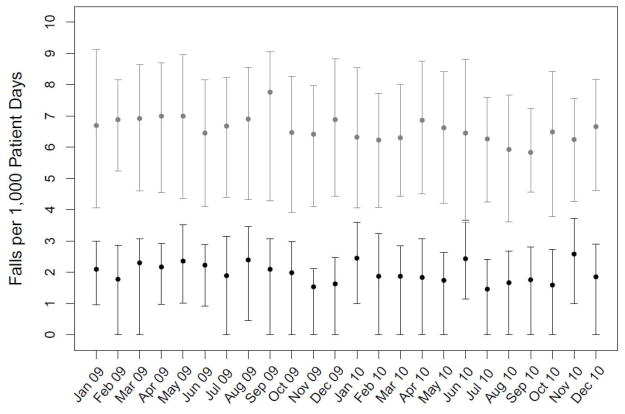
Design: Retrospective study of administrative data on inpatient falls. Eighty low-fall and 74 high-fall units were identified based on monthly rankings of fall rates. Unit- and hospital-level characteristics of these units were compared.
Setting: U.S. general hospitals participating in the National Database of Nursing Quality Indicators.
Participants: Nonsubspecialty medical units (n=800) with 24 consecutive months of falls data.
Measurements: Monthly self-reported unit fall rates (falls per 1,000 patient-days).
Results: An estimated 87% of variation in 24-month fall rates was due to between-unit differences. With the exception of patient-days, a proxy for unit bed size, low- and high-fall units did not differ on nurse staffing or any other unit or hospital characteristic variable.
Conclusion: There are medical units with persistently low and persistently high fall rates. High-fall units had higher patient volume, suggesting patient turnover as a variable for further study. Understanding additional factors underlying variability in long-term fall rates could lead to sustainable interventions for reducing inpatient falls.
Keywords: accidental falls; nursing; patient safety.
© 2015, Copyright the Authors Journal compilation © 2015, The American Geriatrics Society.
Conflict of interest statement
Figures
References
-
- Currie L. Fall and injury prevention. In: Hughes RG, editor. Patient Safety and Quality: An Evidence-based Handbook for Nurses. Rockville, MD: Agency for Healthcare Research and Quality; 2008. pp. 195–250. AHRQ Publication NO08-0043. - PubMed
-
- Healey F, Scobie S, Oliver D, et al. Falls in English and Welsh hospitals: A national observational study based on retrospective analysis of 12 months of patient safety incident reports. Qual Saf Health Care. 2008;17:424–430. - PubMed
-
- Schwendimann R, Buhler H, De Geest S, et al. Characteristics of hospital inpatient falls across clinical departments. Gerontology. 2008;54:342–348. - PubMed
-
- Brand CA, Sundararajan V. A 10-year cohort study of the burden and risk of in-hospital falls and fractures using routinely collected hospital data. Qual Saf Health Care. 2010;19:e51. - PubMed
Publication types
MeSH terms
Grants and funding
LinkOut - more resources
Full Text Sources
Other Literature Sources
Medical
