


Efficient gene disruption in cultured primary human endothelial cells by CRISPR/Cas9
- PMID: 25940550
- PMCID: PMC4490936
- DOI: 10.1161/CIRCRESAHA.117.306290
Efficient gene disruption in cultured primary human endothelial cells by CRISPR/Cas9
Abstract
Rationale: The participation of endothelial cells (EC) in many physiological and pathological processes is widely modeled using human EC cultures, but genetic manipulation of these untransformed cells has been technically challenging. Clustered regularly interspaced short palindromic repeats (CRISPR)/CRISPR-associated protein 9 nuclease (Cas9) technology offers a promising new approach. However, mutagenized cultured cells require cloning to yield homogeneous populations, and the limited replicative lifespan of well-differentiated human EC presents a barrier for doing so.
Objective: To create a simple but highly efficient method using CRISPR/Cas9 to generate biallelic gene disruption in untransformed human EC.
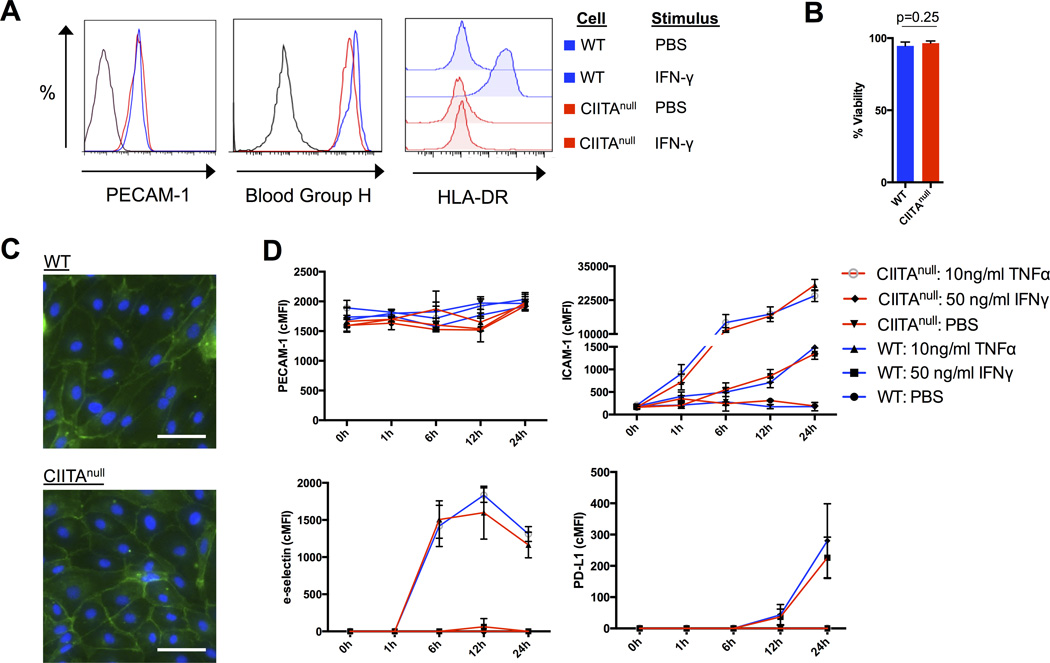
Methods and results: To demonstrate proof-of-principle, we used CRISPR/Cas9 to disrupt the gene for the class II transactivator. We used endothelial colony forming cell-derived EC and lentiviral vectors to deliver CRISPR/Cas9 elements to ablate EC expression of class II major histocompatibility complex molecules and with it, the capacity to activate allogeneic CD4(+) T cells. We show the observed loss-of-function arises from biallelic gene disruption in class II transactivator that leaves other essential properties of the cells intact, including self-assembly into blood vessels in vivo, and that the altered phenotype can be rescued by reintroduction of class II transactivator expression.
Conclusions: CRISPR/Cas9-modified human EC provides a powerful platform for vascular research and for regenerative medicine/tissue engineering.
Keywords: clustered regularly interspaced short palindromic repeats; endothelial cells; genetic engineering; genetic techniques; immunologic techniques.
© 2015 American Heart Association, Inc.
Figures



Comment in
-
A platform for reverse genetics in endothelial cells.Circ Res. 2015 Jul 3;117(2):107-8. doi: 10.1161/CIRCRESAHA.117.306816. Circ Res. 2015. PMID: 26139853 Free PMC article. No abstract available.
References
-
- Thornton SC, Mueller SN, Levine EM. Human endothelial cells: use of heparin in cloning and long-term serial cultivation. Science. 1983;222:623–625. - PubMed
-
- Shiao SL, Kirkiles-Smith NC, Shepherd BR, McNiff JM, Carr EJ, Pober JS. Human effector memory CD4+ T cells directly recognize allogeneic endothelial cells in vitro and in vivo. The Journal of Immunology. 2007;179:4397–4404. - PubMed
Publication types
MeSH terms
Substances
Grants and funding
- 1R01HL116705-01/HL/NHLBI NIH HHS/United States
- R01-HL109455/HL/NHLBI NIH HHS/United States
- R01-HL085416/HL/NHLBI NIH HHS/United States
- T32-GM007205/GM/NIGMS NIH HHS/United States
- R01 HL051014/HL/NHLBI NIH HHS/United States
- R01 HL036003/HL/NHLBI NIH HHS/United States
- R01-HL051014/HL/NHLBI NIH HHS/United States
- T32 GM007205/GM/NIGMS NIH HHS/United States
- F30AI112218/AI/NIAID NIH HHS/United States
- F30 AI112218/AI/NIAID NIH HHS/United States
- R01 HL116705/HL/NHLBI NIH HHS/United States
- R01 HL109455/HL/NHLBI NIH HHS/United States
- R01-HL036003/HL/NHLBI NIH HHS/United States
- R01 HL085416/HL/NHLBI NIH HHS/United States
LinkOut - more resources
Full Text Sources
Other Literature Sources
Research Materials
