


Randomized Multicenter Placebo-Controlled Trial of Omega-3 Fatty Acids for the Control of Aromatase Inhibitor-Induced Musculoskeletal Pain: SWOG S0927
- PMID: 25940724
- PMCID: PMC4451174
- DOI: 10.1200/JCO.2014.59.5595
Randomized Multicenter Placebo-Controlled Trial of Omega-3 Fatty Acids for the Control of Aromatase Inhibitor-Induced Musculoskeletal Pain: SWOG S0927
Abstract
Purpose: Musculoskeletal symptoms are the most common adverse effects of aromatase inhibitors (AIs) and can result in decreased quality of life and discontinuation of therapy. Omega-3 fatty acids (O3-FAs) can be effective in decreasing arthralgia resulting from rheumatologic conditions and reducing serum triglycerides.
Patients and methods: Women with early-stage breast cancer receiving an AI who had a worst joint pain/stiffness score ≥ 5 of 10 using the Brief Pain Inventory-Short Form (BPI-SF) were randomly assigned to receive either O3-FAs 3.3 g or placebo (soybean/corn oil) daily for 24 weeks. Clinically significant change was defined as ≥ 2-point drop from baseline. Patients also completed quality-of-life (Functional Assessment of Cancer Therapy-Endocrine Symptoms) and additional pain/stiffness assessments at baseline and weeks 6, 12, and 24. Serial fasting blood was collected for lipid analysis.
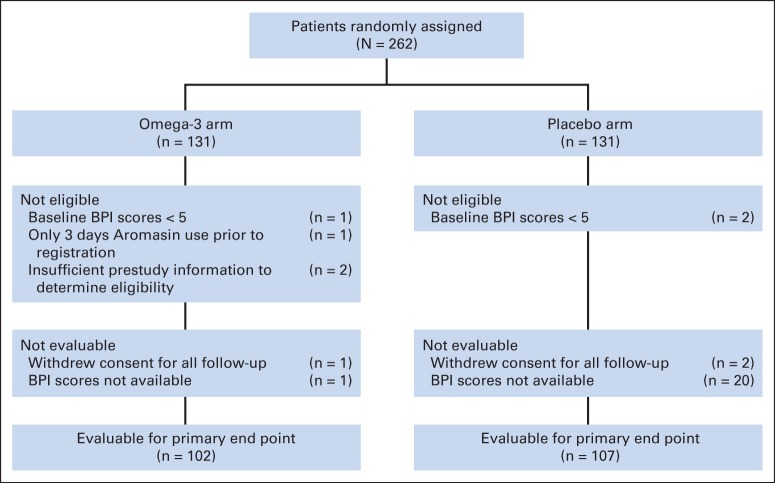
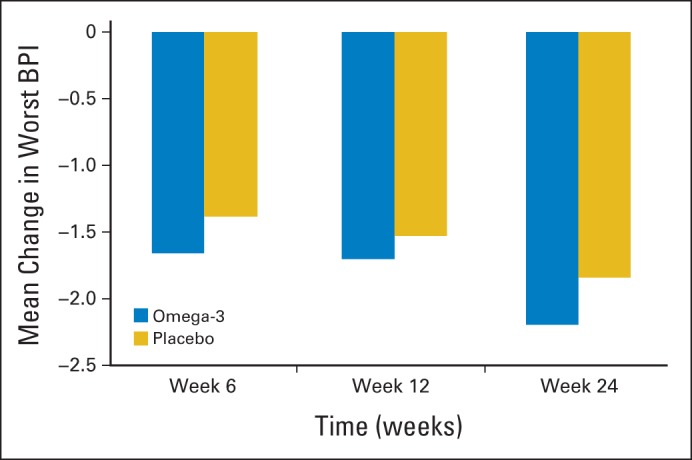
Results: Among 262 patients registered, 249 were evaluable, with 122 women in the O3-FA arm and 127 in the placebo arm. Compared with baseline, the mean observed BPI-SF score decreased by 1.74 points at 12 weeks and 2.22 points at 24 weeks with O3-FAs and by 1.49 and 1.81 points, respectively, with placebo. In a linear regression adjusting for the baseline score, osteoarthritis, and taxane use, adjusted 12-week BPI-SF scores did not differ by arm (P = .58). Triglyceride levels decreased in patients receiving O3-FA treatment and remained the same for those receiving placebo (P = .01). No between-group differences were seen for HDL, LDL, or C-reactive protein.
Conclusion: We found a substantial (> 50%) and sustained improvement in AI arthralgia for both O3-FAs and placebo but found no meaningful difference between the groups.
Trial registration: ClinicalTrials.gov NCT01385137.
© 2015 by American Society of Clinical Oncology.
Conflict of interest statement
Authors' disclosures of potential conflicts of interest are found in the article online at
Figures
Comment in
-
The Power of the Placebo in Symptom Management.J Clin Oncol. 2015 Jun 10;33(17):1870-2. doi: 10.1200/JCO.2015.61.1004. Epub 2015 May 4. J Clin Oncol. 2015. PMID: 25940722 No abstract available.
-
Omega-3 Fatty Acids for Aromatase Inhibitor-Induced Musculoskeletal Pain: Anything Other Than a Placebo Effect?J Clin Oncol. 2015 Dec 20;33(36):4311-2. doi: 10.1200/JCO.2015.63.8726. Epub 2015 Sep 21. J Clin Oncol. 2015. PMID: 26392100 No abstract available.
-
Reply to L. Gianni et al.J Clin Oncol. 2015 Dec 20;33(36):4312. doi: 10.1200/JCO.2015.63.9690. Epub 2015 Sep 21. J Clin Oncol. 2015. PMID: 26392106 No abstract available.
References
-
- Cuzick J, Sestak I, Baum M, et al. Effect of anastrozole and tamoxifen as adjuvant treatment for early-stage breast cancer: 10-year analysis of the ATAC trial. Lancet Oncol. 2010;11:1135–1141. - PubMed
-
- Crew KD, Awad D, Brafman L, et al. Prospective evaluation of joint symptoms in postmenopausal women initiating aromatase inhibitors for early stage breast cancer. Presented at the 32nd San Antonio Breast Cancer Symposium; December 10-13, 2009; San Antonio, TX.
Publication types
MeSH terms
Substances
Associated data
Grants and funding
LinkOut - more resources
Full Text Sources
Medical
Research Materials
Miscellaneous
