


Dose-response relationship between methadone dose and adherence to antiretroviral therapy among HIV-positive people who use illicit opioids
- PMID: 25940906
- PMCID: PMC4503496
- DOI: 10.1111/add.12970
Dose-response relationship between methadone dose and adherence to antiretroviral therapy among HIV-positive people who use illicit opioids
Abstract
Background and aims: For HIV-positive individuals who use illicit opioids, engagement in methadone maintenance therapy (MMT) can contribute to improved HIV treatment outcomes. However, to our knowledge, the role of methadone dosing in adherence to antiretroviral therapy (ART) has not yet been investigated. We sought to examine the relationship between methadone dose and ART adherence among a cohort of people who use illicit opioids.
Design and setting: We used data from the AIDS Care Cohort to Evaluate Access to Survival Services (ACCESS) study, an ongoing prospective observational cohort of HIV-positive people who use illicit drugs in Vancouver, Canada, linked confidentially to comprehensive HIV treatment data in a setting of universal no-cost medical care, including medications. We evaluated the longitudinal relationship between methadone dose and the likelihood of ≥ 95% adherence to ART among ART-exposed participants during periods of engagement in MMT.
Participants: Two hundred and ninety-seven ART-exposed individuals on MMT were recruited between December 2005 and May 2013 and followed for a median of 42.1 months.
Measurements: We measured methadone dose at ≥ 100 versus < 100 mg/day and the likelihood of ≥ 95% adherence to ART.
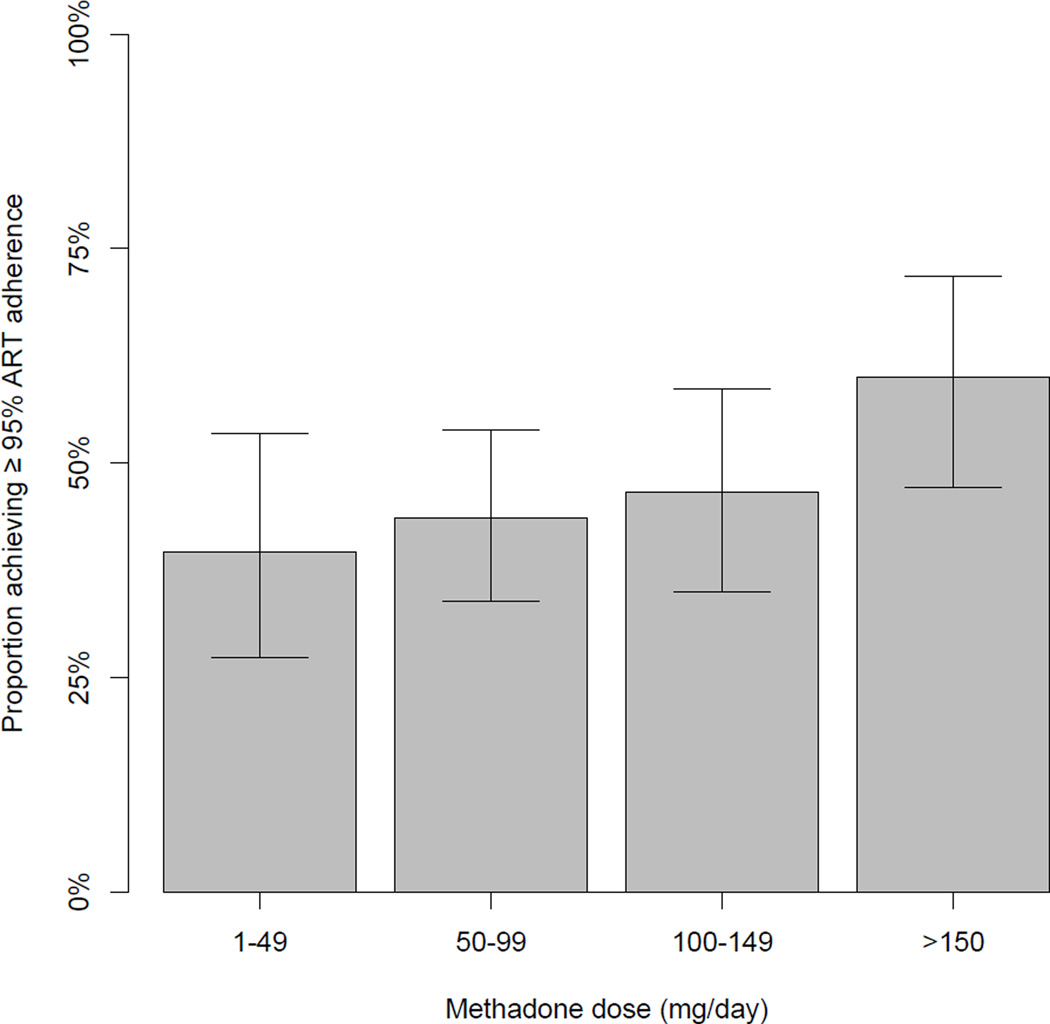
Findings: In adjusted generalized estimating equation (GEE) analyses, MMT dose ≥ 100 mg/day was associated independently with optimal adherence to ART [adjusted odds ratio (AOR) = 1.38; 95% confidence interval (CI) = 1.08-1.77). In a subanalysis, we observed a dose-response relationship between increasing MMT dose and ART adherence (AOR = 1.06 per 20 mg/day increase, 95% CI = 1.00-1.12).
Conclusion: Among HIV-positive individuals in methadone maintenance therapy, those receiving higher doses of methadone (≥ 100 mg/day) are more likely to achieve ≥ 95% adherence to antiretroviral therapy than those receiving lower doses.
Keywords: Adherence; HIV; antiretroviral therapy; illicit drug use; methadone; opioid.
© 2015 Society for the Study of Addiction.
Figures
References
-
- Palella FJ, Baker RK, Moorman AC, Chmiel JS, Wood KC, Brooks JT, et al. Mortality in the highly active antiretroviral therapy era: changing causes of death and disease in the HIV outpatient study. Journal of acquired immune deficiency syndromes. 2006;43(1):27–34. - PubMed
-
- Palella FJ, Delaney KM, Moorman AC, Loveless MO, Fuhrer J, Satten GA, et al. Declining morbidity and mortality among patients with advanced human immunodeficiency virus infection. HIV Outpatient Study Investigators. The New England journal of medicine. 1998;338(13):853–860. - PubMed
-
- Low-Beer S, Yip B, O'Shaughnessy MV, Hogg RS, Montaner JS. Adherence to triple therapy and viral load response. Journal of acquired immune deficiency syndromes. 2000;23(4):360–361. - PubMed
Publication types
MeSH terms
Substances
Grants and funding
LinkOut - more resources
Full Text Sources
Other Literature Sources
Medical
