


An end-to-end hybrid algorithm for automated medication discrepancy detection
- PMID: 25943550
- PMCID: PMC4427951
- DOI: 10.1186/s12911-015-0160-8
An end-to-end hybrid algorithm for automated medication discrepancy detection
Abstract
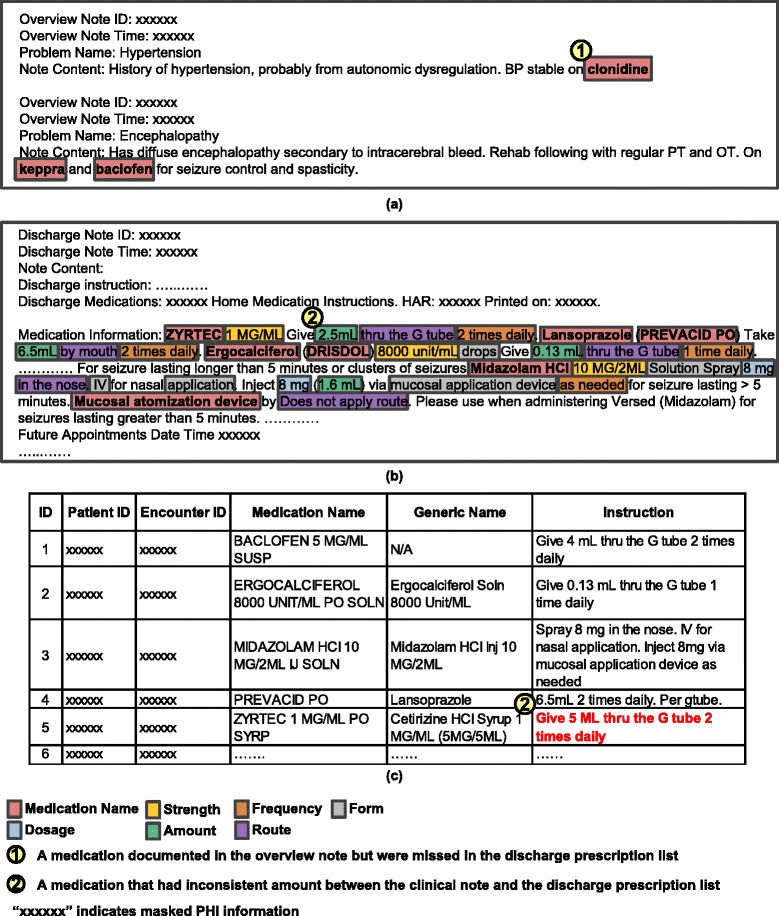
Background: In this study we implemented and developed state-of-the-art machine learning (ML) and natural language processing (NLP) technologies and built a computerized algorithm for medication reconciliation. Our specific aims are: (1) to develop a computerized algorithm for medication discrepancy detection between patients' discharge prescriptions (structured data) and medications documented in free-text clinical notes (unstructured data); and (2) to assess the performance of the algorithm on real-world medication reconciliation data.
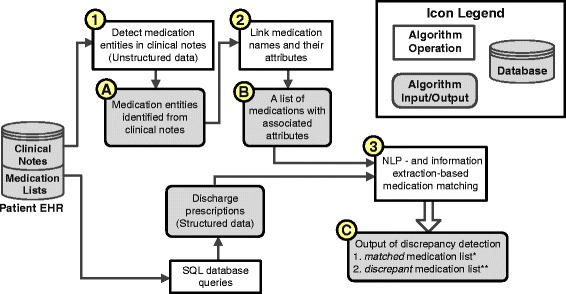
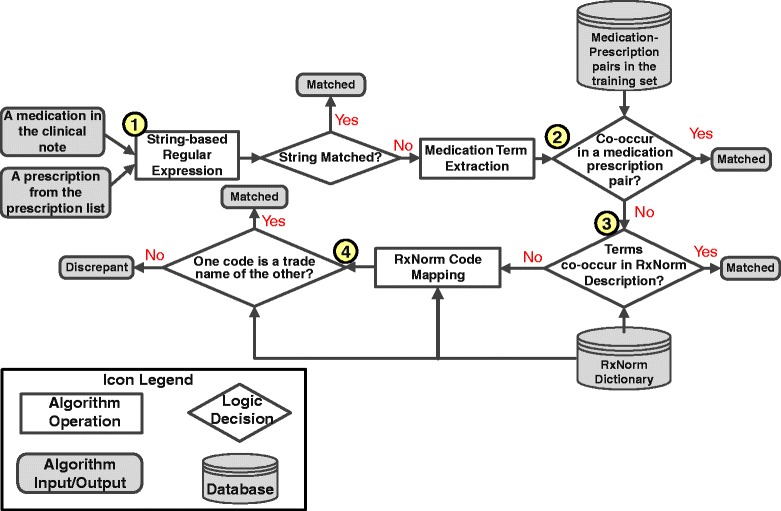
Methods: We collected clinical notes and discharge prescription lists for all 271 patients enrolled in the Complex Care Medical Home Program at Cincinnati Children's Hospital Medical Center between 1/1/2010 and 12/31/2013. A double-annotated, gold-standard set of medication reconciliation data was created for this collection. We then developed a hybrid algorithm consisting of three processes: (1) a ML algorithm to identify medication entities from clinical notes, (2) a rule-based method to link medication names with their attributes, and (3) a NLP-based, hybrid approach to match medications with structured prescriptions in order to detect medication discrepancies. The performance was validated on the gold-standard medication reconciliation data, where precision (P), recall (R), F-value (F) and workload were assessed.
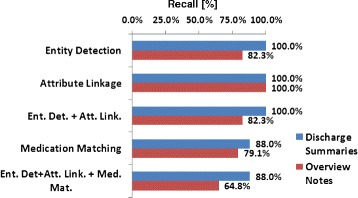
Results: The hybrid algorithm achieved 95.0%/91.6%/93.3% of P/R/F on medication entity detection and 98.7%/99.4%/99.1% of P/R/F on attribute linkage. The medication matching achieved 92.4%/90.7%/91.5% (P/R/F) on identifying matched medications in the gold-standard and 88.6%/82.5%/85.5% (P/R/F) on discrepant medications. By combining all processes, the algorithm achieved 92.4%/90.7%/91.5% (P/R/F) and 71.5%/65.2%/68.2% (P/R/F) on identifying the matched and the discrepant medications, respectively. The error analysis on algorithm outputs identified challenges to be addressed in order to improve medication discrepancy detection.
Conclusion: By leveraging ML and NLP technologies, an end-to-end, computerized algorithm achieves promising outcome in reconciling medications between clinical notes and discharge prescriptions.
Figures
References
-
- Wong JD, Bajcar JM, Wong GG, Alibhai SM, Huh JH, Cesta A, et al. Medication reconciliation at hospital discharge: evaluating discrepancies. Ann Pharmacother. 2008;42(10):1373–9. - PubMed
-
- The joint commission. Using medication reconciliation to prevent errors. Available at: http://www.jointcommission.org/sentinel_event_alert_issue_35_using_medic... (Accessed 5 September 2014).
-
- World health organisation. Assuring medication accuracy at transitions in care. Patient Safety Solution 2007;1(6). Available at: http://www.who.int/patientsafety/solutions/patientsafety/PS-Solution6.pdf (Accessed 5 September 2014).
Publication types
MeSH terms
Grants and funding
LinkOut - more resources
Full Text Sources
Other Literature Sources
