The European and Japanese outbreaks of H5N8 derive from a single source population providing evidence for the dispersal along the long distance bird migratory flyways
- PMID: 25945320
- PMCID: PMC4419530
- DOI: 10.7717/peerj.934
The European and Japanese outbreaks of H5N8 derive from a single source population providing evidence for the dispersal along the long distance bird migratory flyways
Abstract
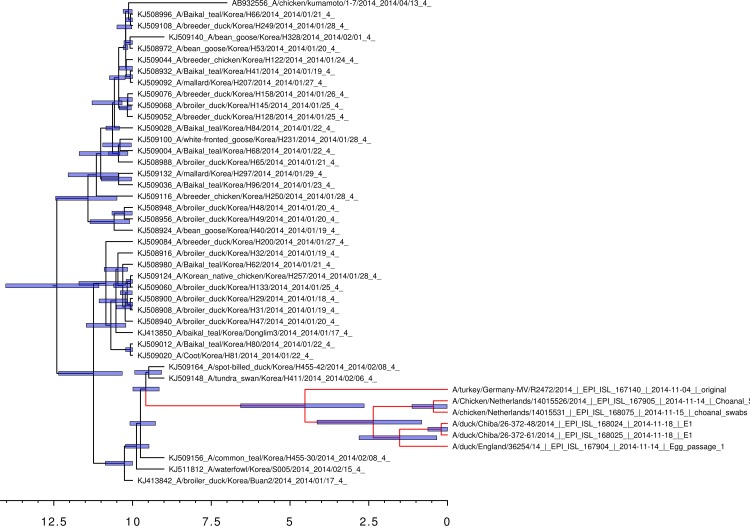
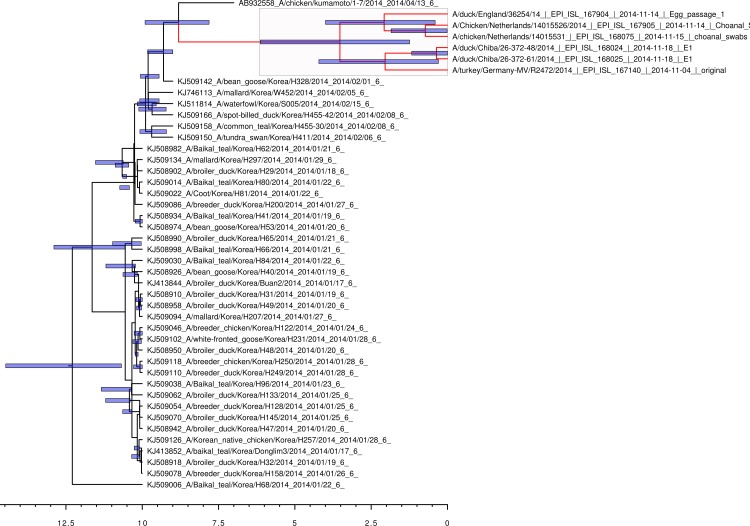
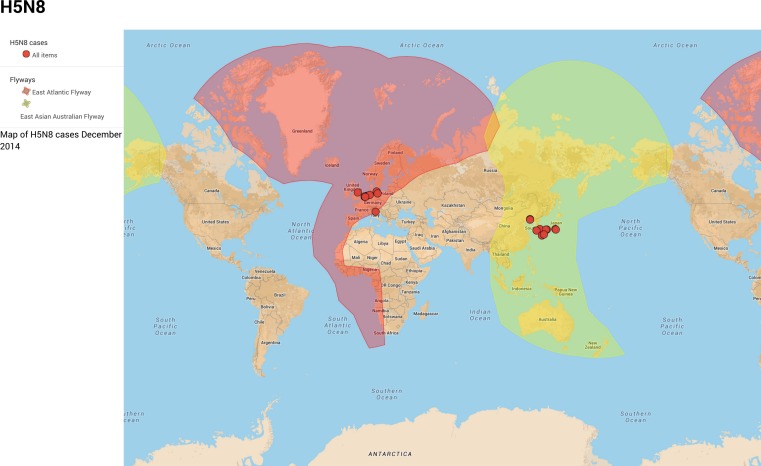
The origin of recent parallel outbreaks of the high pathogenicity H5N8 avian flu virus in Europe and in Japan can be traced to a single source population, which has most likely been spread by migratory birds. By using Bayesian coalescent methods to analyze the DNA sequences of the virus to find the times for divergence and combining this sequence data with bird migration data we can show the most likely locations and migratory pathways involved in the origin of the current outbreak. This population was most likely located in the Siberian summer breeding grounds of long-range migratory birds. These breeding grounds provide a connection between different migratory flyways and explain the current outbreaks in remote locations. By combining genetic methods and epidemiological data we can rapidly identify the sources and the dispersion pathways for novel avian influenza outbreaks.
Keywords: Bayesian; Coalescence; H5N8; HPAI; High pathogenicity avian influenza; Korea; Migratory birds; Siberia.
Conflict of interest statement
The authors declare there are no competing interests.
Figures
References
-
- Allport G, Poole C, Park E, Jo S, Eldridge M. The feeding ecology, requirements and distribution of Baikal Teal Anas formosa in the Republic of Korea. Wildfowl. 1991;42:98–107.
-
- Bae Y, Lee S-B, Min KC, Mo J-S, Jeon EO, Koo B-S, Kwon H-I, Choi YK, Kim JJ, Kim J-N. Pathological evaluation of natural cases of a highly pathogenic avian influenza virus, subtype H5N8, in broiler breeders and commercial layers in South Korea. Avian Diseases. 2014;59(1):175–182. doi: 10.1637/10921-081914-Case. - DOI - PubMed
-
- Beekman JH, Nolet BA, Klaassen M. Skipping swans: fuelling rates and wind conditions determine differential use of migratory stopover sites of Bewick’s Swans Cygnus bewickii. Ardea. 2002;90:437–460.
Grants and funding
LinkOut - more resources
Full Text Sources
Other Literature Sources